Economic Pulse Net | Sources: World Bank World Development Indicators, Government Sources | 2026
Key Takeaways
* Moderate Growth Amidst Inflation: Romania’s economy is navigating a period of cautious expansion with a projected GDP growth of 0.68%, even as consumer prices remain elevated at 7.19%.
Strong Human Capital: The country boasts a relatively low unemployment rate of 5.99% and a high GDP per capita (PPP) of $50,895, indicating robust purchasing power for its 19 million citizens.
Tech and Finance Powerhouses: Global leaders like Bitdefender and major financial institutions such as Banca Transilvania anchor a diverse industrial landscape that extends beyond traditional manufacturing.
Stable Democratic Framework: As a unitary semi-presidential republic, Romania maintains a structured governance system with an active civil society, providing a predictable political environment for long-term planning.
Economic Momentum in a Complex Landscape
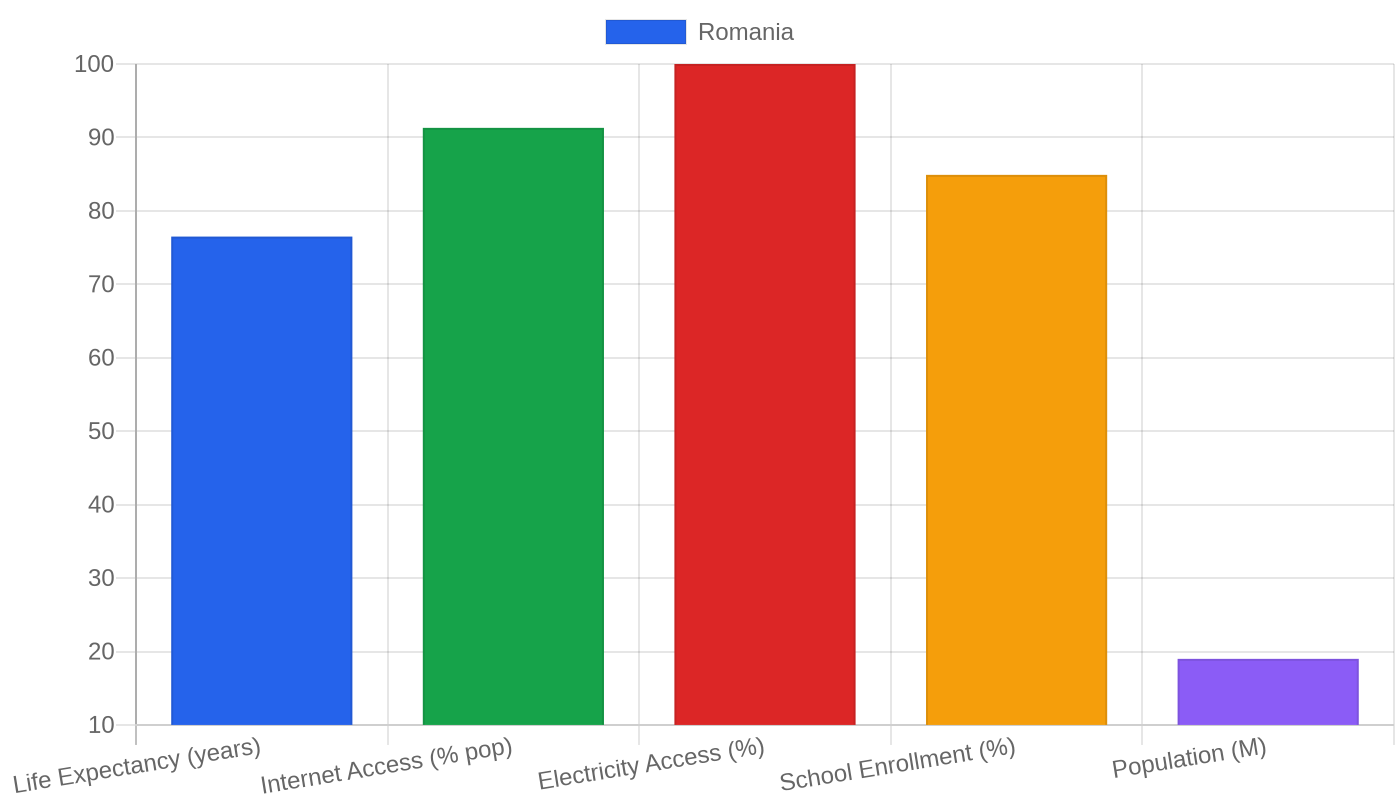
Romania’s economic trajectory in 2025 presents a nuanced picture of stability amidst global headwinds. According to World Bank data, the nation’s Gross Domestic Product (GDP) stands at approximately $428.7 billion USD, reflecting a substantial economic base for a population of roughly 19 million people.
While the year-over-year GDP growth rate is recorded at a modest 0.68%, this figure signals a consolidation phase rather than rapid acceleration, suggesting that the economy is absorbing external shocks without significant contraction. This moderate growth occurs against a backdrop of persistent inflation, with the Consumer Price Index (CPI) hovering around 7.19%.
For policymakers, this divergence between steady output growth and higher-than-desirable inflation highlights the challenge of maintaining price stability while fostering development. However, the labor market remains a bright spot; with an unemployment rate of just under 6%, the country is effectively absorbing its workforce, which supports domestic consumption.
Furthermore, the GDP per capita based on Purchasing Power Parity (PPP) reaches nearly $50,895, a metric that underscores the real living standards and economic capacity of the average Romanian citizen far better than nominal figures alone. This combination of solid human capital metrics and controlled, albeit slow, growth suggests an economy that is resilient, if not currently explosive, in its performance.
Living Costs and Housing Dynamics
For residents and expatriates alike, understanding the cost of living in Romania requires looking beyond headline inflation numbers to daily realities. With inflation at 7.19%, households are facing increased pressure on discretionary spending, yet the high GDP per capita (PPP) indicates that wages have largely kept pace with these rising costs, preserving overall welfare.
While specific housing rent indices are not detailed in the current dataset, the strong GNI per capita of $20,190 provides a baseline for affordability relative to Western European neighbors. The interplay between employment rates and income levels suggests that housing markets are likely stable, driven by a workforce that is largely employed and earning incomes that support homeownership or rental commitments.
Daily expenses, influenced by the CPI, may see fluctuations in food and energy sectors, but the broader economic health implied by the $428 billion GDP ensures that essential services remain accessible. Ultimately, the high PPP-adjusted income level acts as a buffer, allowing consumers to navigate the 7.19% inflation environment without a drastic decline in quality of life, making Romania a relatively affordable hub within the Central and Eastern European region.
Investment Climate and Corporate Leaders
The business environment in Romania is characterized by a mix of established industrial giants and emerging technology leaders, creating a diversified investment landscape. At the forefront of the digital sector is Bitdefender, a global cybersecurity firm that exemplifies the country’s shift toward high-value tech exports.
In the financial sector, heavyweights like Banca Transilvania and Banca Comercială Română dominate the lending and banking markets, providing critical infrastructure for both local enterprises and foreign investors. Traditional industries also play a vital role; Automobile Dacia continues to be a cornerstone of the manufacturing sector, linking Romania closely with international automotive supply chains.
Meanwhile, consumer goods companies such as Apulum and Arctic S.A., alongside healthcare provider Antibiotice Iași, demonstrate the depth of the domestic production capabilities. These entities, along with media holdings like Adevărul Holding and transportation services from Blue Air, illustrate a vibrant private sector that spans multiple value chains.
For investors, the presence of these top-tier companies signals a mature market where regulatory frameworks and corporate governance are increasingly aligned with international standards, offering opportunities in both legacy industries and innovative tech-driven sectors.
Safety, Politics, and Social Stability
Romania operates as a unitary semi-presidential representative democratic republic, a structure that provides a clear separation of powers and checks on executive authority. The President, elected by popular vote, serves as the head of state and supreme commander of the Armed Forces, ensuring continuity in international relations and constitutional safeguarding.
Meanwhile, the Prime Minister, appointed by the President and confirmed by Parliament, manages the day-to-day operations of the executive branch, fostering a dynamic political dialogue. This structured system supports an active civil society, which contributes to social cohesion and political accountability. Regarding safety, current data does not provide specific crime or safety indices, leaving precise statistical comparisons unavailable.
However, the stability of the political framework and the absence of reported systemic unrest suggest a generally secure environment for residents and businesses. The combination of democratic norms and institutional strength creates a predictable atmosphere, which is crucial for long-term social and economic planning. While granular safety metrics are missing, the overarching political narrative is one of institutional resilience and civic engagement.
Current Affairs and Policy Shifts
As we look at the immediate horizon, Romania is focused on balancing its modest 0.68% GDP growth with the urgent need to curb 7.19% inflation. Policymakers are likely grappling with monetary and fiscal adjustments to stabilize prices without stifling the already constrained economic expansion. The labor market’s healthy 5.99% unemployment rate provides a cushion, allowing the government to prioritize inflation control measures over emergency job creation programs.
In the corporate sphere, companies like Bitdefender and Banca Transilvania are adapting their strategies to navigate this inflationary environment, potentially focusing on efficiency and digital transformation to maintain margins. The political landscape remains active, with the semi-presidential system facilitating ongoing debates on how best to distribute resources and manage public expectations.
Recent developments suggest a focus on maintaining the integrity of key industries, from automotive to finance, as they serve as anchors for the $428 billion economy. As the year progresses, the interplay between political decisions and economic outcomes will be critical in determining whether Romania can achieve a more sustainable growth trajectory in the coming quarters.
The Bottom Line
Romania offers a compelling case for observers interested in a stable, middle-income economy with strong technological and industrial foundations. The high GDP per capita (PPP) and low unemployment indicate a population with significant economic agency, while the presence of global brands like Bitdefender highlights innovation potential. Investors should watch how the government manages the tension between 7.19% inflation and modest growth, as this will define the near-term business climate.
For those seeking a resilient market within the EU, Romania’s structured democracy and diversified corporate sector make it a noteworthy destination for strategic attention.
Sources & Methodology
This article is authored by Economic Pulse Net for informational and research purposes. Economic Pulse Net sources its data from multilateral institutions, national statistics bureaus, and proprietary databases. All data is believed to be current as of the date of publication.
Published: October 08, 2026 | Category: Research — Romania
Use these signals in your own platform
Economic Pulse publishes its live signal feed through a documented, read-only API. Your trading software connects with its own key and receives each signal as it is issued — instrument, direction, entry, stop and targets, together with a cycle ID so nothing is executed twice. The feed is independent of this website and cannot change it.
Signals are informational only and are not financial advice.