Economic Pulse Net | Sources: World Bank World Development Indicators, Government Sources | 2026
Key Takeaways
* Moderate Growth Trajectory: The Portuguese economy is projected to expand by approximately 1.86% in 2025, reflecting a steady but cautious recovery phase amidst global uncertainties.
Inflationary Pressures Persist: Consumer price inflation is hovering around 2.34%, indicating that while prices are rising, they remain within a manageable range for central bank targets.
Labor Market Resilience: With an unemployment rate of 6.16%, the country maintains a relatively tight labor market, supporting domestic consumption and social stability.
Robust Corporate Sector: A diverse array of leading companies, from financial giants like Banco Comercial Português to industrial leaders such as Cimpor, underpins the national economic output.
Political Continuity: As a semi-presidential republic established by the 1976 Constitution, Portugal offers a stable democratic framework with universal suffrage, providing a predictable environment for long-term investment.
Economic Engine: Navigating Steady Growth
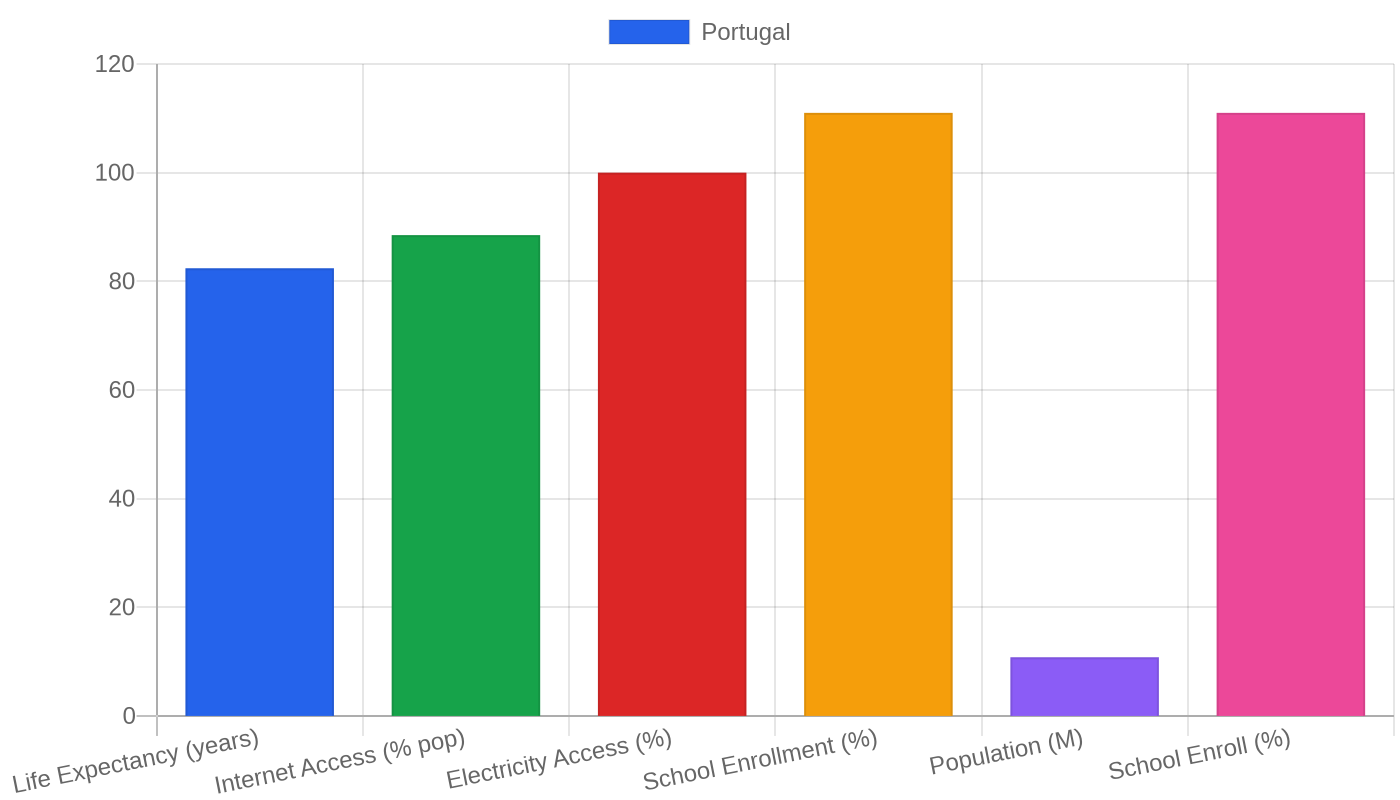
Portugal’s economic landscape in 2025 is characterized by measured expansion rather than explosive growth. According to World Bank data, the Gross Domestic Product (GDP) is expected to grow by 1.86448007464475% this year. This figure suggests a healthy, sustainable pace that allows for structural adjustments without overheating the economy. The total GDP stands at approximately $346.6 billion USD, a substantial aggregate that supports a population of over 10.8 million people.
On a per-capita basis, the picture is even more encouraging; the GDP per capita based on Purchasing Power Parity (PPP) reaches $53,145.73, signaling a high standard of living relative to many other nations. Furthermore, the GNI per capita is recorded at $29,930, highlighting the income levels available to residents after accounting for international transfers. However, this prosperity is tempered by an inflation rate of 2.33601620316701%.
While not negligible, this level of CPI growth indicates that cost-of-living pressures are present but not spiraling out of control. Crucially, the unemployment rate sits at 6.164%, which implies that a significant portion of the workforce is engaged in productive activity, reducing social strain and boosting consumer confidence. These numbers collectively paint a picture of a mature economy that is balancing growth with price stability.
Cost of Living: The Price of Residence
The affordability of life in Portugal varies significantly depending on location and lifestyle choices, though the underlying economic indicators suggest a certain level of purchasing power. With a GDP per capita (PPP) exceeding $53,000, residents generally possess the means to cover essential expenses comfortably compared to lower-income regions. However, the inflation rate of roughly 2.34% means that daily expenditures are creeping upward, affecting everything from groceries to utilities.
For housing, the interplay between rent and buy decisions is influenced by these macroeconomic trends; as interest rates and inflation fluctuate, the decision to invest in property becomes a strategic calculation rather than a simple necessity. Daily expenses are also subject to the broader European context, where energy and food costs can impact household budgets.
While specific rental indices are not provided in the current dataset, the general economic health suggests that housing remains a viable asset class, albeit one that requires careful financial planning given the modest but persistent inflation. The cost of living, therefore, is not just about absolute prices but about the ratio of income to expenditure, which appears favorable for those earning above the national average.
Investment & Business Climate: Pillars of Industry
Portugal boasts a dynamic corporate sector anchored by several key players across various industries. In the financial sector, institutions like Banco Comercial Português and Caixa Geral de Depósitos serve as critical pillars of the economy, facilitating credit and investment flows. The industrial landscape is equally robust, with companies such as Cimpor in building materials and Ambar – Ideas on Paper S.A. driving production and innovation.
Basic materials are represented by Altri, ensuring that raw resource processing contributes to export revenues. Meanwhile, the consumer goods sector features strong brands like Central de Cervejas and Churchill’s Port, leveraging Portugal’s cultural heritage for global appeal. In healthcare, Bial stands out as a leader in pharmaceutical development, adding value through high-tech manufacturing.
Technology is also emerging as a key area, with firms like Chipidea contributing to the digital transformation of the economy. This diversity reduces reliance on any single industry, creating a resilient business environment. Investors should note that the presence of these established corporations provides a stable foundation for supply chains and partnerships, making Portugal an attractive destination for both domestic and foreign capital seeking exposure to Southern European markets.
Safety, Politics & Quality of Life: A Stable Foundation
Political stability is a cornerstone of Portugal’s attractiveness as a place to live and do business. Since the ratification of the Constitution of 1976, the country has operated as a semi-presidential representative democratic republic. This system divides sovereignty among four main organs: the president, the government, the Assembly of the Republic, and the courts.
Universal suffrage for adults over 18 ensures that citizens have a voice in governance through secret ballots, fostering a competitive multi-party system at both national and regional levels. This political structure provides continuity and predictability, which are essential for long-term planning. Regarding safety, specific crime and safety indices are currently listed as N/A in the provided data, leaving a gap in quantitative assessment.
However, the absence of reported instability or frequent political upheaval in the historical record suggests a generally secure environment. The quality of life is further supported by the economic metrics discussed earlier, including reasonable unemployment and solid per-capita income. Together, these factors create a backdrop of societal cohesion that enhances the overall appeal of the country for expatriates and investors alike.
What’s Happening Now: Current Affairs and Trends
The current economic narrative in Portugal is defined by a delicate balance between maintaining growth momentum and managing inflationary pressures. With GDP growth projected at nearly 1.9%, policymakers are likely focusing on sustaining this trajectory while keeping the CPI below critical thresholds. The inflation rate of 2.34% suggests that monetary policy may remain cautious, avoiding abrupt changes that could disrupt the labor market, which currently enjoys a low unemployment rate of 6.164%.
Businesses are adapting to this environment by leveraging their core competencies; for instance, financial institutions are likely optimizing lending strategies to support the industrial sectors led by companies like Cimpor and Altri. Meanwhile, consumer-facing businesses such as Churchill’s Port and Central de Cervejas are navigating shifting consumer preferences amidst rising costs.
The political landscape remains active, with the multi-party system ensuring that economic policies are debated and refined through the Assembly of the Republic. This ongoing dialogue helps to address emerging challenges before they become crises. As we move through 2025, the focus will remain on how effectively these institutions can translate macroeconomic stability into tangible improvements in daily life for the 10.8 million residents.
The Bottom Line
Portugal presents a compelling case for observers looking for a stable, mid-sized European economy with strong institutional foundations. The combination of solid GDP per capita figures, manageable inflation, and a diversified industrial base makes it a resilient market. Investors and policymakers should watch closely how the country navigates the next phase of post-pandemic adjustment, particularly in its financial and industrial sectors.
For those seeking a blend of political stability and economic opportunity, Portugal remains a noteworthy contender in the global arena.
Sources & Methodology
This article is authored by Economic Pulse Net for informational and research purposes. Economic Pulse Net sources its data from multilateral institutions, national statistics bureaus, and proprietary databases. All data is believed to be current as of the date of publication.
Published: October 20, 2026 | Category: Research — Portugal
Use these signals in your own platform
Economic Pulse publishes its live signal feed through a documented, read-only API. Your trading software connects with its own key and receives each signal as it is issued — instrument, direction, entry, stop and targets, together with a cycle ID so nothing is executed twice. The feed is independent of this website and cannot change it.
Signals are informational only and are not financial advice.