Economic Pulse Net | Sources: World Bank World Development Indicators, Government Sources | 2026
Key Takeaways
* Robust Growth Trajectory: Poland’s economy is projected to expand by approximately 3.57% in 2025, signaling steady momentum despite global headwinds.
Tight Labor Market: With unemployment hovering near 2.98%, the country faces a competitive labor landscape that supports consumer spending but may pressure wage growth.
Moderate Inflation Pressures: Consumer price inflation is recorded at roughly 3.81%, indicating a stabilization effort that remains slightly above typical central bank targets.
Rising Living Standards: GDP per capita adjusted for purchasing power parity (PPP) stands at over $54,000, reflecting significant improvements in national wealth and consumption capacity.
Stable Democratic Framework: As a unitary parliamentary republic, Poland maintains a structured political environment with clear executive and legislative branches under President Karol Nawrocki.
Economic Momentum and Structural Strength
Poland’s economic performance in the current cycle demonstrates a notable capacity for resilience, driven by a combination of domestic consumption and industrial output. According to World Bank data, the nation’s GDP growth is forecasted at 3.57% for 2025, a figure that underscores a healthy expansion rate relative to many advanced economies.
This growth is supported by a remarkably tight labor market; the unemployment rate sits at just 2.976%, suggesting that nearly all available workers are engaged in productive activity. Such low unemployment typically correlates with strong wage dynamics and robust consumer demand, which serves as a primary engine for internal economic stability. However, this vigor comes with moderate inflationary pressures, as the CPI indicates an inflation rate of 3.81%.
While not alarming, this level requires careful monetary management to ensure that price stability does not erode the gains made in real income. The financial health of the population is further evidenced by a GNI per capita of $25,520, highlighting a steady rise in national income levels. When adjusted for local cost structures, the GDP per capita (PPP) reaches $54,262, illustrating that the average Polish citizen enjoys a standard of living comparable to more developed Western European nations.
These metrics collectively paint a picture of an economy that is not only growing but also maturing, with increasing productivity and household wealth driving sustainable development rather than speculative bubbles.
Cost of Living and Housing Dynamics
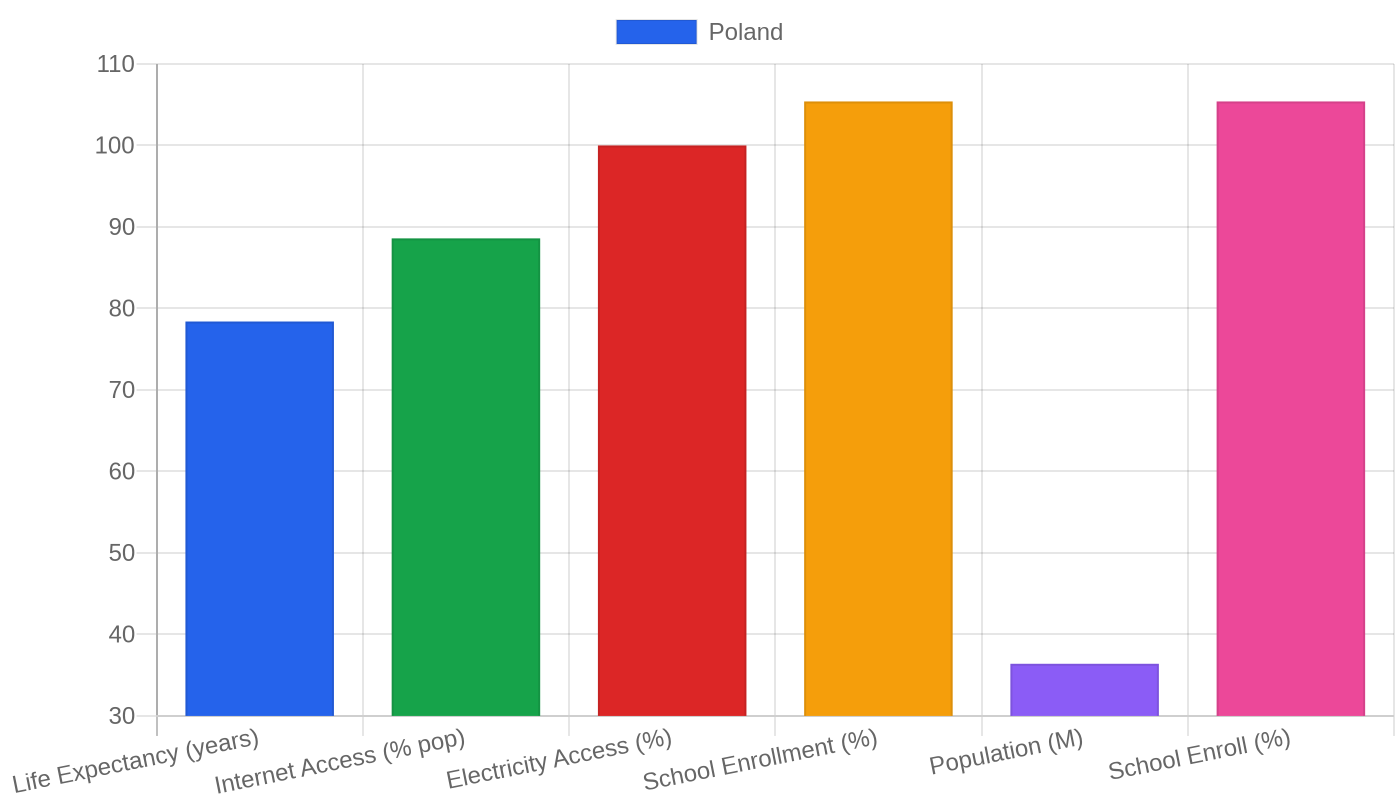
The intersection of rising incomes and moderate inflation creates a complex but generally favorable environment for residents regarding daily expenses and housing affordability. With a population of approximately 36.4 million people, the demand for housing and services remains high, particularly in urban centers where major corporations are headquartered.
While specific rental indices are not detailed in the provided datasets, the overall CPI of 3.81% suggests that everyday costs are rising at a manageable pace, allowing households to maintain their purchasing power. The high GDP per capita (PPP) of $54,262 implies that consumers have substantial disposable income compared to regional peers, which can support higher spending on housing, education, and leisure.
For investors and expatriates, this indicates that while entry-level costs may be lower than in Western Europe, the quality of life and service offerings justify the expenditure. The balance between rent and buy decisions likely favors homeownership given the cultural emphasis on property stability in the region, though the tight labor market may keep wages competitive, thereby supporting mortgage servicing capabilities.
Daily expenses, therefore, appear to be well-aligned with income levels, preventing severe cost-of-living crises that often plague emerging markets during periods of rapid growth.
Investment & Business Climate
Poland’s business landscape is characterized by a diverse array of leading enterprises across technology, finance, and consumer goods sectors, offering fertile ground for both domestic and foreign investment. The presence of prominent tech firms like 11 bit studios and Asseco highlights the country’s growing reputation as a hub for software development and digital innovation.
In the financial sector, institutions such as Alior Bank, Bank Millennium, and Bank Ochrony Środowiska provide a robust banking infrastructure that supports corporate lending and retail financial services. Consumer-facing companies like Allegro, Agora, and 4F demonstrate a vibrant domestic market with strong brand loyalty and digital integration. Traditional industries remain vital as well, with entities like Adamów Coal Mine contributing to the basic materials sector, ensuring energy and resource security.
Amica further rounds out the consumer goods landscape, indicating a strong manufacturing base for household appliances and durable goods. This mix of traditional industry and modern tech services creates a balanced investment climate, appealing to a wide range of capital providers looking for exposure to Central Europe. The concentration of these top companies suggests that supply chains are well-developed and that there are ample opportunities for partnerships in logistics, IT, and retail distribution.
Safety, Politics & Quality of Life
Political stability and public safety form the bedrock upon which Poland’s economic achievements are built, providing a predictable environment for long-term planning. The country operates as a unitary parliamentary republic and representative democracy, with executive power vested in the Council of Ministers and the Prime Minister, who acts as the head of government.
The President, currently Karol Nawrocki, serves a five-year term elected by popular vote, ensuring democratic legitimacy and continuity in state affairs. Individual council members are selected by the Prime Minister, approved by parliament, and sworn in by the President, creating a system of checks and balances within the executive branch.
While specific crime and safety indices are not quantified in the current dataset, the general political framework suggests a stable society where rule of law is upheld through established constitutional processes. This political maturity contributes significantly to the quality of life, allowing citizens to focus on professional and personal development without undue concern for civil unrest.
The combination of a clear governmental structure and active civic participation fosters an atmosphere of order and predictability, which is essential for maintaining high social cohesion and economic confidence.
What’s Happening Now / Current Affairs
In the immediate term, Poland is navigating a period of sustained economic expansion coupled with careful inflation management. The projected 3.57% GDP growth for 2025 indicates that policymakers are successfully balancing stimulus with restraint, avoiding overheating while maximizing employment benefits.
With unemployment at a historic low of 2.976%, the focus is shifting toward addressing labor shortages and enhancing productivity through technology adoption, as seen in the rise of firms like 11 bit studios and Asseco. Meanwhile, the 3.81% inflation rate suggests that the central bank and government are monitoring price trends closely to prevent erosion of the gains seen in GDP per capita (PPP).
The political landscape under President Karol Nawrocki continues to provide a stable backdrop for these economic maneuvers, with the Council of Ministers implementing policies that support key industries like finance and technology. Recent developments in the consumer sector, led by platforms like Allegro and Agora, reflect a digital transformation that is accelerating domestic commerce and integrating Poland more deeply into the European digital economy.
These concurrent trends point to a country that is actively shaping its future through structural reforms and technological integration rather than passively reacting to external shocks.
The Bottom Line
Poland represents a compelling case study in resilient economic growth, characterized by strong fundamentals, a skilled workforce, and a diversified industrial base. Investors and businesses should watch this country closely due to its high GDP per capita (PPP), low unemployment, and expanding tech sector, which offer attractive opportunities for returns and market penetration. The stable political environment under the current administration provides the necessary predictability for long-term strategic planning.
For those seeking exposure to Central Europe’s most dynamic economy, Poland offers a balanced mix of emerging market potential and developed market stability.
Sources & Methodology
This article is authored by Economic Pulse Net for informational and research purposes. Economic Pulse Net sources its data from multilateral institutions, national statistics bureaus, and proprietary databases. All data is believed to be current as of the date of publication.
Published: October 20, 2026 | Category: Research — Poland
Use these signals in your own platform
Economic Pulse publishes its live signal feed through a documented, read-only API. Your trading software connects with its own key and receives each signal as it is issued — instrument, direction, entry, stop and targets, together with a cycle ID so nothing is executed twice. The feed is independent of this website and cannot change it.
Signals are informational only and are not financial advice.