Economic Pulse Net | Sources: World Bank World Development Indicators, Government Sources | 2026
Key Takeaways
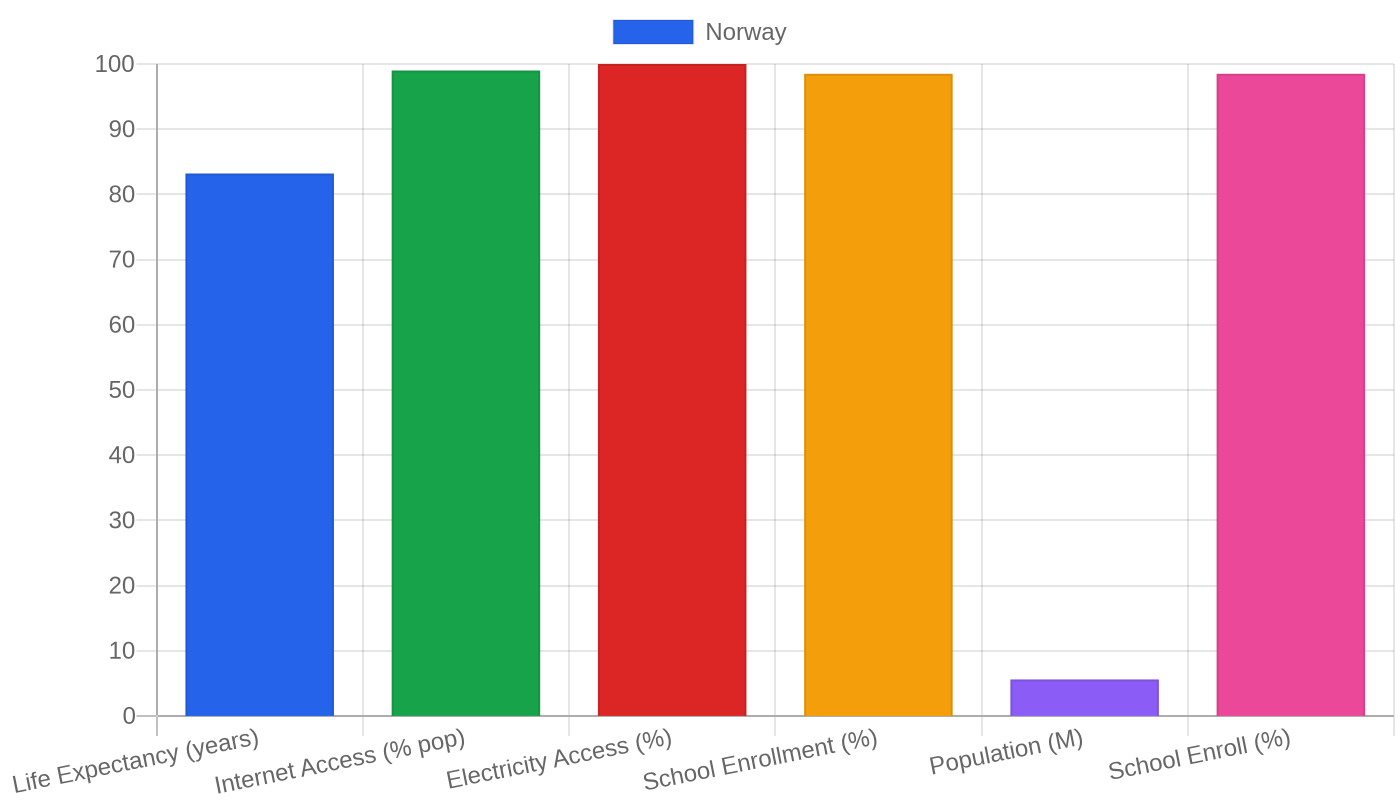
– Norway’s economy continues to expand at a modest 1.09% pace, according to the World Bank, reflecting a mature, high-income nation managing steady rather than spectacular growth.
– Inflation is running at 3.06%, a figure that is uncomfortably above the comfort zone for consumers, even in a country with one of the world’s highest GDP per capita figures.
– With GDP per capita exceeding $104,000 on a purchasing power parity basis, Norway remains a global outlier in wealth generation and distribution.
– The political system is widely regarded as the world’s most democratic, with international indices ranking the country at the top for elected government and gender equality.
– Unemployment sits at 4.6%, a relatively low figure that suggests a labour market under pressure but not in crisis.
The Wealth Machine: Growth, Prices and the Norwegian Paradox
Norway’s economic story is one of extraordinary wealth creation tempered by the complexities of managing that prosperity. The World Bank’s latest data paints a picture of a nation that has largely solved the problem of poverty, but now wrestles with the consequences of affluence. GDP growth of 1.09% in 2025 is modest by global standards, but it must be understood in context.
This is a mature economy, already operating at or near full capacity, where the challenge is not creating growth from scratch but sustaining it without overheating.
The headline figure of $530.7 billion in GDP is remarkable for a population of just 5.6 million people. That translates to a GDP per capita of over $104,000 on a PPP basis, a figure that places Norway in the very top tier of global living standards. The GNI per capita of $97,310 confirms that this wealth is not merely a statistical artefact but is genuinely accruing to ordinary citizens. When a country reaches this level of development, the economic questions change.
The debate is no longer about how to grow the pie, but about how to distribute it, how to protect it from external shocks, and how to maintain competitiveness in a world where labour costs are high.
Inflation at 3.06% is the key pressure point. While this is not hyperinflation by any stretch, it is above the levels that central banks and households find comfortable. For a nation where the cost of services is already among the highest in Europe, persistent inflation erodes the purchasing power of even the most generous salaries. It also complicates the investment landscape, as businesses must factor in rising input costs when planning expansions.
The unemployment rate of 4.6% is something of a paradox — it is low enough to suggest a healthy economy, but high enough to indicate that the labour market is not as tight as it once was. This could be a sign of structural shifts, perhaps as the energy sector automates and the service economy absorbs workers at different wage levels.
The Price of Paradise: What Living Costs in Norway’s Economy
For the uninitiated, Norway’s cost of living comes as a shock. The data on specific housing prices is not detailed in the World Bank figures, but the broader economic indicators tell a compelling story. When a country has a GNI per capita of nearly $100,000, the cost of everyday goods and services adjusts accordingly. Housing in Oslo and other major cities is among the most expensive in Europe, driven by strong demand, limited supply, and one of the highest standards of living in the world.
The relationship between rent and buying is a delicate one. With interest rates responding to the 3.06% inflation figure, mortgage costs are significant, yet the cultural preference for homeownership remains strong. For those who rent, the market is tight, particularly in urban centres where the influx of skilled workers and students keeps demand high. The broader point is that Norway’s wealth is visible in its infrastructure, public services, and social safety nets, but it comes with a price tag.
Daily expenses — from groceries to dining out — are consistently above the European average. This is the Norwegian paradox: a country so wealthy that its citizens can afford almost anything, yet so expensive that even they feel the pinch of inflation.
The Engines of Enterprise: Investment and Industry in the Norwegian Model
Norway’s corporate landscape is dominated by a mix of industrial heavyweights and consumer-facing giants. The list of top companies provided by the World Bank data reveals a sophisticated economy. AF Group and Aker Solutions represent the industrial and oil & gas sectors respectively, underscoring the continued importance of energy to the national economy. Aker ASA operates as a conglomerate, a structure that allows for diversification across shipping, finance, and technology.
Meanwhile, companies like Bama Gruppen and Cermaq show the strength of the consumer goods and seafood sectors, with Cermaq playing a significant role in global aquaculture.
The investment climate is defined by stability. Norway’s political system, ranked as the world’s most democratic by the Democracy Index since 2010, provides a predictable legal and regulatory framework. For investors, this reduces risk. The presence of companies like Aker BioMarine, which focuses on marine biotechnology, signals a forward-looking economy that is investing in the industries of the future, not just managing the resources of the past. Bergen Engines and Bertel O.
Steen demonstrate the strength of the industrial and automotive distribution sectors.
The sectors to watch are those that leverage Norway’s natural advantages: renewable energy, seafood, and advanced engineering. The transition away from pure oil dependence is underway, but it is a managed transition, not a sudden shift. The business environment is one where transparency is high, corruption is minimal, and the rule of law is absolute. For any company considering a Nordic expansion, Norway offers a market that is wealthy, stable, and increasingly focused on sustainability.
The Safest Bet in Europe: Democracy, Security and the Quality of Life
Norway’s reputation as one of the most developed democracies and states of justice in the world is not mere rhetoric. According to International IDEA’s Global State of Democracy Indices and the Democracy Tracker, Norway performs in the high range on overall democratic measures, with particular strengths in elected government and gender equality. Since 2010, the Democracy Index has classified Norway as the world’s most democratic country.
This political stability is the bedrock upon which the country’s economic success is built.
The crime and safety indices for Norway are not provided in the current data, but the broader picture is one of a society with high social trust and low levels of violent crime. The quality of life is exceptional, supported by a comprehensive welfare state that is funded by the country’s immense sovereign wealth. This is a society where the gap between the rich and the poor is relatively narrow, where social mobility is high, and where the state is seen as a partner in prosperity rather than an obstacle to it.
For citizens, this translates into free healthcare, subsidised education, and a generous pension system. For businesses, it means a workforce that is educated, healthy, and motivated.
The Current Crossroads: Inflation, Transition, and the Shape of Tomorrow
Right now, Norway is navigating a delicate phase. The immediate issue is inflation, which at 3.06% is proving sticky. This is not a crisis, but it is a persistent headache for policymakers who must balance the need to cool prices against the risk of stalling growth. The World Bank’s growth figure of 1.09% suggests that the economy is not in danger of a boom-and-bust cycle, but rather a period of steady, managed expansion.
The unemployment rate of 4.6% provides a buffer, but it also signals that the labour market is not as red-hot as it was a few years ago.
The ongoing transition in the energy sector is the defining narrative. As the world moves towards decarbonisation, Norway is leveraging its expertise in offshore engineering to pivot towards wind and other renewable sources. Companies like Aker Solutions are at the forefront of this shift, adapting their capabilities from oil and gas to new energy technologies.
The consumer goods sector, with companies like Bama Gruppen, is also evolving, responding to changing consumer preferences for sustainability and local sourcing. The political landscape remains stable, but the debates are shifting towards how to manage the country’s wealth fund, how to invest in infrastructure, and how to ensure that the green transition does not leave any region behind. Norway is not a country in crisis; it is a country in careful, deliberate motion.
The Bottom Line
Norway is a must-watch for anyone interested in how a wealthy, democratic society navigates the challenges of the 21st century. The country is a bellwether for the energy transition, a case study in the management of sovereign wealth, and a test of whether high taxes and a generous welfare state can coexist with economic dynamism. For investors, it offers a haven of stability. For policymakers, it provides a model of governance.
And for anyone watching the global economy, Norway’s ability to balance inflation, growth, and social cohesion will be a story worth following.
Sources & Methodology
This article is authored by Economic Pulse Net for informational and research purposes. Economic Pulse Net sources its data from multilateral institutions, national statistics bureaus, and proprietary databases. All data is believed to be current as of the date of publication.
Published: August 27, 2026 | Category: Research — Norway
Use these signals in your own platform
Economic Pulse publishes its live signal feed through a documented, read-only API. Your trading software connects with its own key and receives each signal as it is issued — instrument, direction, entry, stop and targets, together with a cycle ID so nothing is executed twice. The feed is independent of this website and cannot change it.
Signals are informational only and are not financial advice.