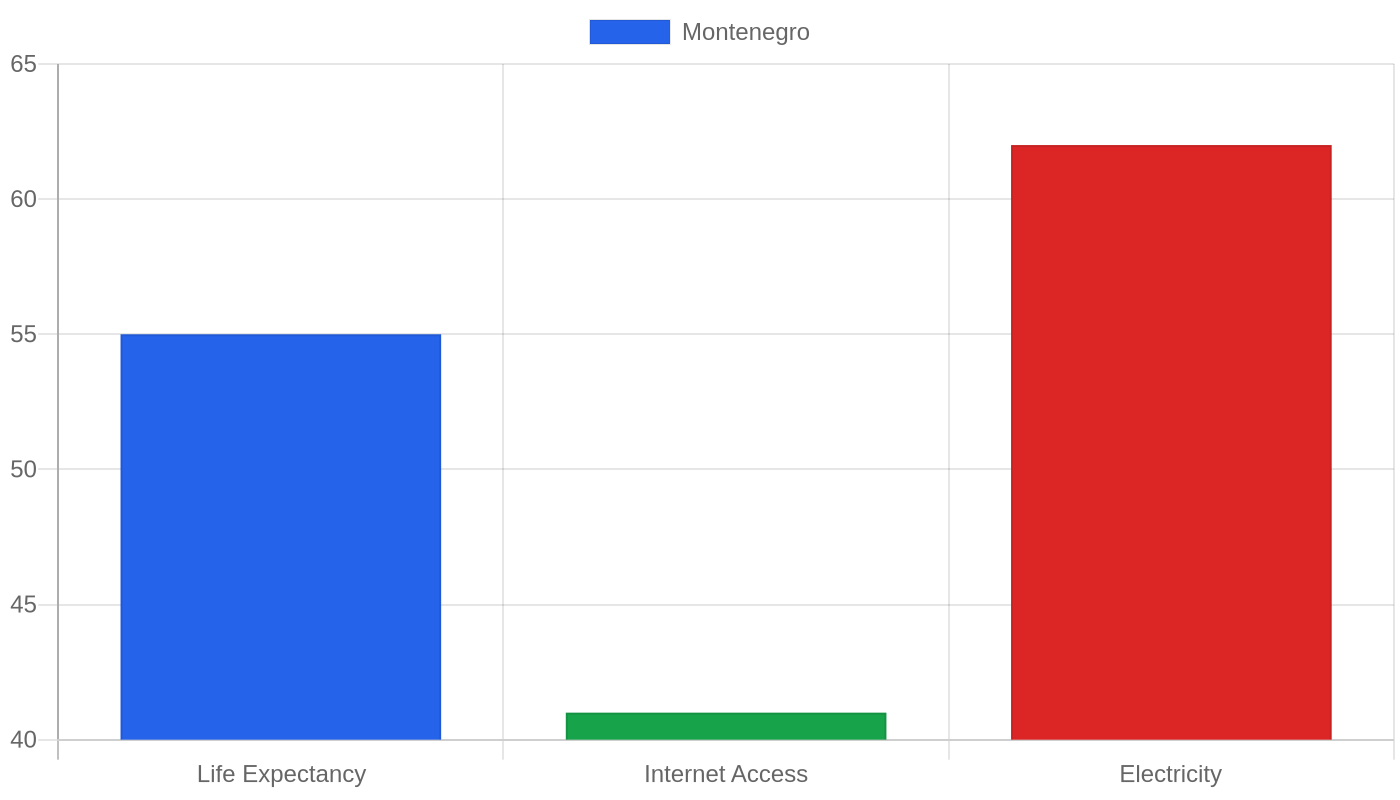
Economic Pulse Net | Sources: World Bank World Development Indicators, Government Sources | 2026
Key Takeaways
* Montenegro operates as a multi-party parliamentary representative democratic republic, anchored by a codified constitution established in 2007 that emphasizes social justice and the rule of law.
The industrial landscape is heavily influenced by state-linked entities in basic materials, utilities, and telecommunications, with major players like Aluminium Plant Podgorica and Crnogorski Telekom driving sector activity.
While specific macroeconomic indicators such as GDP growth, inflation, and unemployment figures are currently unreported, the economy remains structured around key service and industrial hubs including Budvanska Rivijera and NLB Banka Podgorica.
The business environment is characterized by a mix of consumer services, financial institutions, and energy infrastructure, reflecting a nation balancing tourism potential with traditional industrial output.
Political stability is defined by a civic democratic framework, though detailed crime indices and safety scores remain unavailable for current assessment.
Economic Foundations: Industrial Anchors in a Data-Limited Landscape
Montenegro’s economic structure is defined less by high-velocity growth metrics and more by its foundational industrial pillars, which serve as the bedrock of national production. Although latest World Bank data for GDP growth, inflation, and unemployment rates are not currently available, the composition of the economy reveals a reliance on strategic sectors rather than pure speculative finance.
The presence of major entities like Aluminium Plant Podgorica indicates a continued importance of basic materials and heavy industry, suggesting that manufacturing remains a critical component of the country’s output despite global shifts toward digital economies. Similarly, the dominance of utility providers such as Elektroprivreda Crne Gore and Crnogorski Elektroprenosni Sistem highlights the essential role of infrastructure management in maintaining economic continuity.
These industries do not merely exist in isolation; they provide the stable, albeit often slower-moving, backbone that supports other sectors like tourism and retail. Without concrete figures on per capita income or population size, we must look at these institutional structures to understand resilience.
The fact that central banking functions are managed by the Central Bank of Montenegro underscores an independent monetary authority, which is crucial for long-term fiscal planning even in the absence of real-time inflation data. This structural focus on utilities, materials, and finance suggests an economy that prioritizes stability and essential services over rapid, volatile expansion.
Understanding this industrial base is vital for investors who might otherwise misinterpret the lack of headline GDP numbers as a sign of stagnation, when it may simply reflect a mature, infrastructure-heavy market.
Cost of Living and Housing Dynamics
Assessing the cost of living in Montenegro requires looking beyond aggregate price indices to the specific sectors where residents and businesses interact most frequently. With no specific CPI data provided, daily expenses are best understood through the lens of the dominant consumer services companies that shape local markets.
Entities like Budvanska Rivijera and Di Air suggest that tourism-related services and aviation play a significant role in pricing dynamics, likely influencing housing and rental costs in coastal areas such as Budva. In regions driven by seasonal tourism, rent-to-buy ratios can be highly volatile, often skewing towards short-term leasing arrangements that cater to international visitors rather than long-term residents.
The presence of Jugopetrol Kotor also indicates that energy and fuel costs are tied into the broader expense structure, potentially affecting transportation and logistics prices for local households. Furthermore, the telecommunications sector, led by Crnogorski Telekom, represents a fixed monthly overhead for most citizens, serving as a baseline for household budgeting.
While regional comparisons are difficult without explicit comparative data, the mix of utilities and consumer services implies a cost structure that is moderate but sensitive to external energy shocks. For expatriates and remote workers, understanding these sector-specific costs is more valuable than waiting for a national inflation headline, as they directly impact disposable income.
The housing market, therefore, appears to be influenced heavily by the tourism infrastructure and the operational costs of the utility monopolies that dominate the supply chain.
Investment & Business Climate: Sectors to Watch
The investment landscape in Montenegro is characterized by a concentration of power in a few key state-aligned or major private enterprises across diverse sectors. For foreign capital and domestic entrepreneurs alike, the opportunities lie in the intersection of traditional industry and modern consumer services. The Aluminium Plant Podgorica stands out as a primary target for those interested in raw material processing and export-oriented manufacturing, offering insights into the efficiency of Balkan metallurgy.
Meanwhile, the financial sector, represented by NLB Banka Podgorica and the Central Bank of Montenegro, provides a window into credit availability and lending standards, which are critical for small business growth. The telecommunications giant, Crnogorski Telekom, offers another avenue for investment, particularly as digital connectivity becomes increasingly vital for all other economic activities.
Additionally, the energy sector, with players like Elektroprivreda Crne Gore, presents long-term infrastructure projects that could benefit from green energy transitions, although specific policy details are not provided here. The business environment is further shaped by consumer-facing brands like Montenegro Airlines and Di Air, indicating a market that values mobility and leisure services.
Investors should note that while the political system is a multi-party democracy, the economic landscape is dominated by these large-scale entities, suggesting that partnerships with established firms may be more viable than starting from scratch in isolated niches. The diversity of these top companies—from oil and gas to basic materials—indicates a resilient, if somewhat insulated, commercial ecosystem.
Safety, Politics & Quality of Life
Montenegro’s political framework offers a clear roadmap for governance, described in its 2007 constitution as a “civic, democratic, ecological state of social justice, based on the reign of Law.” This constitutional foundation establishes a multi-party system that allows for political pluralism, providing a degree of predictability for residents and observers alike.
However, the absence of specific Crime Index and Safety Index data means that quality of life assessments must rely on general political stability rather than granular security statistics. The emphasis on ecological principles in the constitution suggests that environmental protections and sustainable development are integrated into public policy, which can enhance livability for those concerned with natural beauty and conservation.
While happiness data is not explicitly quantified in the provided information, the legalistic and democratic nature of the state implies a society where civil rights and judicial processes are formally protected. For expatriates and tourists, the lack of negative safety alerts in the provided text, combined with a strong constitutional rule-of-law framework, paints a picture of a generally stable environment.
Nevertheless, the inability to cite specific crime rates requires a cautious approach to personal security assessments, relying instead on the broader stability of the parliamentary system. The political landscape, therefore, serves as the primary indicator of social cohesion, with the multi-party dynamic ensuring that various voices can influence the direction of the nation.
What’s Happening Now: Structural Stability Amidst Data Gaps
In the current climate, Montenegro appears to be in a phase of structural maintenance rather than aggressive reform or crisis management. The recent news indicators highlight the enduring presence of major industrial and service players, suggesting that business-as-usual operations continue within the established corporate framework.
There are no reported sudden shifts in political leadership or emergency economic policies, which implies that the multi-party democratic system is functioning according to its constitutional design. The focus remains on the operational continuity of entities like Crnogorski Elektroprenosni Sistem and Aluminium Plant Podgorica, indicating that infrastructure and production are prioritized over speculative ventures.
While live indicators for inflation or GDP are missing, the steady listing of top companies suggests that the market is not experiencing immediate disruption or collapse. This period can be viewed as one of consolidation, where the existing economic architecture is being maintained and potentially optimized for future integration with broader European markets. The absence of dramatic headlines regarding crime or political unrest further reinforces the notion of a stable, if quiet, political environment.
Observers should watch for any updates from the Central Bank of Montenegro, as monetary policy adjustments would be the first signal of changing economic conditions. For now, the narrative is one of endurance and institutional continuity, with the constitution serving as the guiding star for all political and civic activities.
The Bottom Line
Montenegro presents a unique case for researchers and investors: a politically stable, constitutionally grounded republic with a clear industrial base, yet lacking in real-time macroeconomic transparency. It is a country where the rules of engagement are clearly defined by law, but the economic outcomes are obscured by missing data points. Those interested in emerging markets with strong institutional frameworks but limited statistical visibility should monitor Montenegro closely.
The opportunity lies not in quick gains, but in understanding the long-term trajectory of its core industries and political stability.
Sources & Methodology
This article is authored by Economic Pulse Net for informational and research purposes. Economic Pulse Net sources its data from multilateral institutions, national statistics bureaus, and proprietary databases. All data is believed to be current as of the date of publication.
Published: October 29, 2026 | Category: Research — Montenegro
Use these signals in your own platform
Economic Pulse publishes its live signal feed through a documented, read-only API. Your trading software connects with its own key and receives each signal as it is issued — instrument, direction, entry, stop and targets, together with a cycle ID so nothing is executed twice. The feed is independent of this website and cannot change it.
Signals are informational only and are not financial advice.