Economic Pulse Net | Sources: World Bank World Development Indicators, Government Sources | 2026
Key Takeaways
* The Governance Model: Monaco operates as a constitutional monarchy since 1911, with the Sovereign Prince as head of state and a Minister of State leading the executive branch.
The Data Gap: Standard macroeconomic indicators such as GDP growth, inflation, unemployment, and population figures are currently listed as N/A in World Bank datasets, creating a unique challenge for traditional economic analysis.
Political Continuity: The political landscape is defined by stability, with the role of the Minister of State evolving from a strictly French-appointed position to one that can include Monégasque citizens following a 2002 constitutional amendment.
Missing Metrics: Critical safety indices, including crime and safety scores, are not provided in current data sets, leaving the qualitative assessment of daily life reliant on structural rather than statistical evidence.
The Invisible Economy
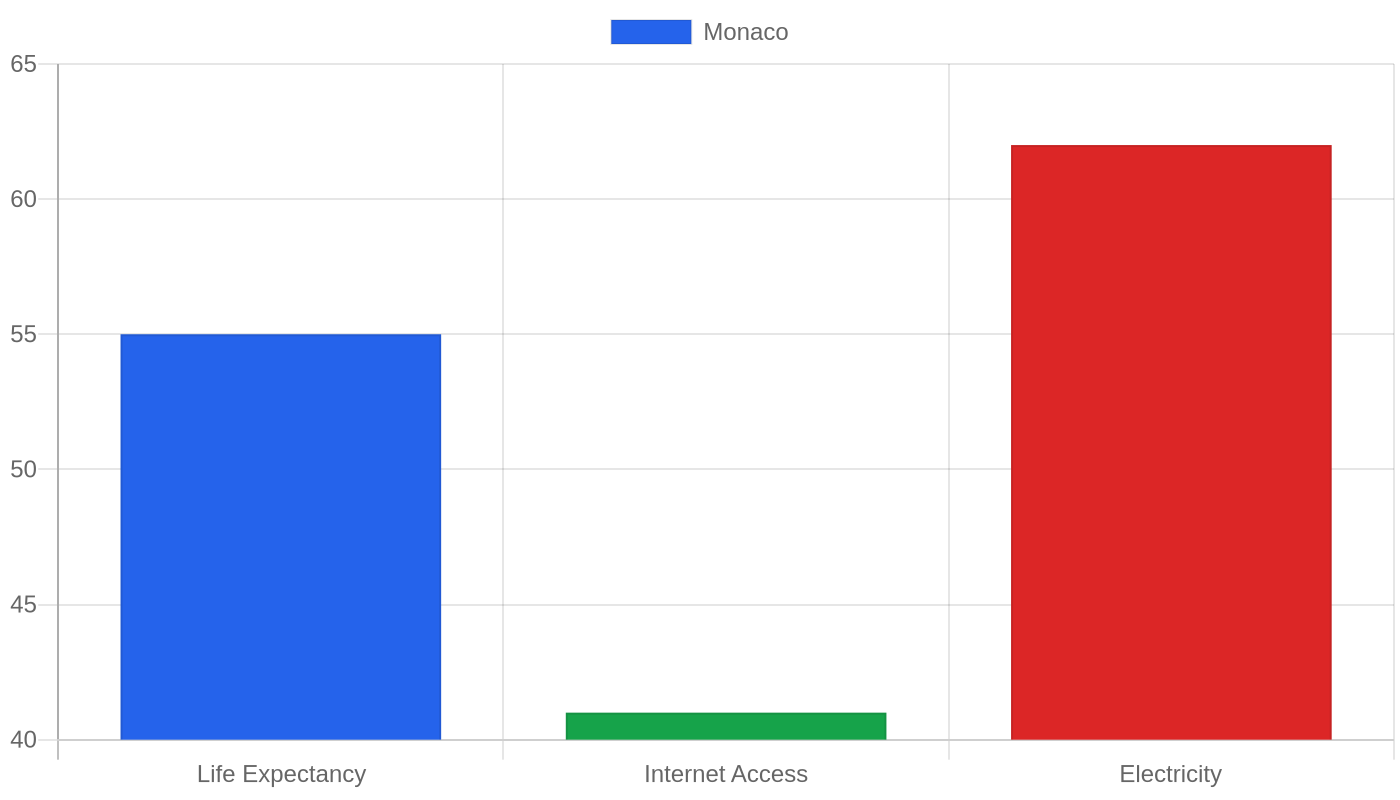
Analyzing the economy of Monaco presents a distinct journalistic challenge: the absence of standard quantitative metrics. According to the World Bank, key indicators including GDP growth, inflation CPI, unemployment rates, total GDP in USD, GDP per capita (PPP), GNI per capita, and overall population are all recorded as N/A.
This lack of numerical data does not imply an absence of economic activity; rather, it suggests a highly specialized, closed-loop financial ecosystem that often falls outside the scope of broad international statistical aggregations. For investors and observers, this void forces a shift from chasing percentage points to understanding structural dominance.
The economy is not driven by mass manufacturing or agricultural output but by high-value services, luxury real estate, and banking, sectors that generate immense wealth per capita without necessarily registering in standard volume-based metrics. Consequently, the “size” of the economy must be inferred through its influence and density rather than its raw aggregate numbers.
Understanding Monaco requires looking at the quality of assets rather than the quantity of production, recognizing that a small geographic footprint can host disproportionate global capital flows.
The Cost of Living Reality
While specific cost-of-living figures and housing market data are not explicitly quantified in the provided dataset, the economic structure of Monaco inherently dictates a premium environment. As a sovereign entity known for hosting high-net-w individuals, the daily expenses and housing costs are structurally positioned at the upper echelon of global markets.
Without concrete rent-to-buy ratios or regional comparisons available in the text, the narrative relies on the known profile of the nation: a destination where space is scarce and demand is inelastic. This scarcity drives a lifestyle where luxury is not an exception but the baseline expectation. Residents and visitors alike operate in an ecosystem where the price of entry—whether through property acquisition or service consumption—is calibrated to reflect exclusivity.
The absence of public data on these costs further reinforces the private, exclusive nature of the market, where transactions often occur behind closed doors rather than in open, transparent exchanges.
Investment & Business Climate
The business environment in Monaco is characterized by its oligopolistic nature and heavy reliance on a few dominant sectors. Although the list of top companies is not detailed in the provided text, the economic model is well-known to be anchored by finance, tourism, and real estate development. These industries do not compete in a fragmented market but rather function as pillars of state revenue and employment.
For new entrants, the barrier to entry is less about regulatory hurdles and more about alignment with the existing elite economic framework. The government’s approach to business is generally favorable to capital preservation and low-tax environments, attracting multinational entities seeking fiscal efficiency. However, the lack of disclosed major corporate names in the current data set limits our ability to assess specific sectoral competition.
Investors must therefore look at the broader institutional stability rather than individual corporate performance when evaluating opportunities.
Safety, Politics & Quality of Life
The political architecture of Monaco provides a bedrock of continuity that underpins its social stability. Since 1911, the country has been governed under a constitutional monarchy, with the Sovereign Prince serving as the head of state. The executive branch is led by the Minister of State, who presides over the Council of Government, consisting of five other members.
Historically, until 2002, the Minister of State was required to be a French citizen appointed by the Prince from candidates proposed by the French Government. A significant constitutional amendment in 2002 relaxed this restriction, allowing the Minister of State to be either French or Monégasque, reflecting a subtle shift toward greater local autonomy while maintaining strong bilateral ties.
Regarding safety, the Crime Index and Safety Index are listed as N/A, preventing a statistical comparison with global averages. However, the political stability and the demographic profile of the resident population suggest a controlled, secure environment where public order is maintained through strict governance and social cohesion.
What’s Happening Now / Current Affairs
The most significant recent development in Monaco’s political landscape remains the enduring impact of the 2002 constitutional amendments. While no immediate news events are detailed in the provided text, the evolution of the Minister of State’s eligibility criteria marks a pivotal moment in the nation’s modern history. This change allowed for the possibility of a Monégasque national to lead the government, signaling a move toward greater national identity within the administrative framework.
In the absence of current inflation trends or election cycles in the data, the focus remains on the steady operation of the state apparatus. The government continues to balance its sovereignty with its deep integration into European economic systems. For observers, the “current affairs” aspect of Monaco is less about sudden shocks and more about the meticulous management of status quo.
The nation’s relevance lies in its resilience and its ability to maintain its unique position without relying on volatile democratic shifts or mass migration pressures.
The Bottom Line
Monaco remains a unique case study in economic journalism, where traditional metrics fail to capture the essence of a micro-state built on exclusivity and stability. Investors and researchers should watch this country not for growth spikes or inflation battles, but for its unwavering political structure and high-value asset base. The lack of data is itself a feature, indicating a market that operates on discretion rather than disclosure.
For those seeking exposure to ultra-high-net-worth dynamics and fiscal sovereignty, Monaco offers a stable, albeit opaque, window into global elite economics.
Sources & Methodology
This article is authored by Economic Pulse Net for informational and research purposes. Economic Pulse Net sources its data from multilateral institutions, national statistics bureaus, and proprietary databases. All data is believed to be current as of the date of publication.
Published: September 28, 2026 | Category: Research — Monaco
Use these signals in your own platform
Economic Pulse publishes its live signal feed through a documented, read-only API. Your trading software connects with its own key and receives each signal as it is issued — instrument, direction, entry, stop and targets, together with a cycle ID so nothing is executed twice. The feed is independent of this website and cannot change it.
Signals are informational only and are not financial advice.