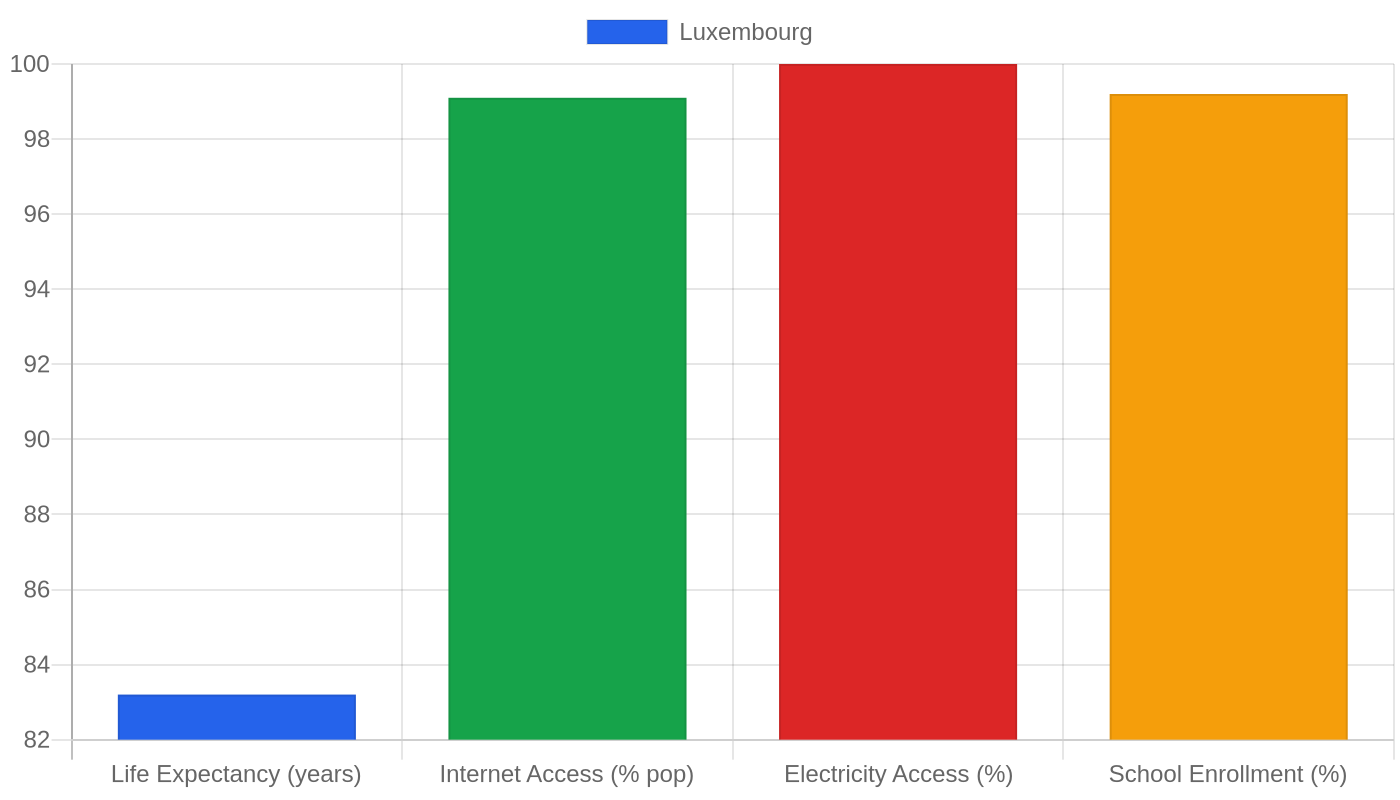
Economic Pulse Net | Sources: World Bank World Development Indicators, Government Sources | 2026
Key Takeaways
- Political Stability as an Asset: Luxembourg operates as a full democracy with a parliamentary system headed by a constitutional monarch, providing a layer of institutional continuity that is rare in the modern European landscape.
- Financial Hub Dominance: The country’s corporate landscape is heavily dominated by the financial sector, with major players like BGL BNP Paribas, Advanzia Bank, and Banque Raiffeisen anchoring the local economy.
- Industrial Diversification: While finance leads, the presence of global giants in basic materials, such as ArcelorMittal, highlights a significant industrial base that complements the service sector.
- Constitutional Resilience: The nation’s supreme law, the Constitution, was originally adopted in 1868 and last updated in July 2023, demonstrating a legal framework that balances historical tradition with modern governance needs.
The Engine Room: A Financial Colossus
While specific aggregate economic indicators such as GDP growth rates, inflation figures, and unemployment statistics are currently not detailed in the available World Bank data for this period, the structural composition of Luxembourg’s economy tells a powerful story of specialization.
The country has long positioned itself not just as a microstate, but as a central node in the global financial network.
This status is underpinned by a dense cluster of major financial institutions that define the local business environment.
The presence of entities like BGL BNP Paribas, Advanzia Bank, and the state-owned Banque et Caisse d’Épargne de l’État indicates a mature banking sector capable of handling complex international transactions.
Beyond banking, the investment sector is robust, with firms like BIP Investment Partners signaling a strong appetite for capital allocation and private equity.
This concentration of financial power suggests that the country’s economic resilience relies heavily on its ability to maintain trust, regulatory stability, and connectivity with global markets.
The lack of volatile inflation or employment data in the current snapshot may reflect a period of steady state, where the focus remains on preserving the integrity of these financial pillars rather than chasing rapid expansion.
Living in the Capital: The Price of Proximity
Determining the precise cost of living in Luxembourg requires looking beyond simple price tags to the broader context of a high-value economic hub.
While specific housing costs, rent-versus-buy ratios, and daily expense figures are not provided in the current dataset, the nature of the local economy implies a premium on quality of life and infrastructure.
Residents and expatriates in such a specialized financial center typically face a cost structure that reflects the high demand for skilled labor and the high standard of public services.
The dominance of major financial and industrial corporations suggests a labor market that commands high wages, which in turn supports a cost of living that is competitive with other Western European capitals.
For the average worker, the trade-off is clear: high earning potential balanced against the necessity of maintaining a lifestyle that aligns with the expectations of a globalized, high-income society.
The absence of specific crime or safety indices in this particular data set does not diminish the general perception of the country as a stable environment, but it does mean that daily economic decisions are driven more by market forces and professional opportunities than by external safety concerns.
Corporate Powerhouses: Where the Money Moves
The business landscape of Luxembourg is defined by a few massive players that have achieved global recognition, particularly in the financial and industrial sectors.
The financial sector is the undisputed leader, with a roster of top companies including Advanzia Bank, Banque de Luxembourg, and Banque Raiffeisen, all of which play critical roles in the national economy.
However, the country is not solely a banking haven; it also boasts significant industrial strength, most notably through ArcelorMittal, a giant in the basic materials sector.
This diversification is crucial, as it provides a buffer against the volatility of pure financial markets.
In the technology space, Artec 3D represents a newer wave of innovation, suggesting that the country is actively investing in future-facing industries beyond traditional finance and steel.
Consumer goods are also represented by entities like Brasserie Nationale, indicating a local market that supports both industrial output and domestic consumption.
The coexistence of these diverse sectors—finance, heavy industry, technology, and consumer goods—creates a multifaceted business climate that attracts a wide range of international investors and talent.
Stability Under the Crown: Politics and Governance
Luxembourg’s political framework is a unique blend of modern democratic principles and monarchical tradition.
The country is officially described as a “full democracy,” characterized by a parliamentary system that is headed by a constitutional monarch.
This structure ensures that while the Grand Duke holds a symbolic and ceremonial role, the actual executive power is exercised by the Grand Duke alongside the cabinet, which is led by the Prime Minister.
The cabinet itself is composed of members with various titles, including minister, minister delegate, or secretary of state, creating a nuanced hierarchy of governance.
The legal backbone of this system is the Constitution of Luxembourg, which serves as the supreme law of the land.
Originally adopted on 17 October 1868, this document has stood the test of time, with the most recent update occurring on 1 July 2023.
This recent update suggests that the political system is not static but is actively evolving to meet contemporary challenges, ensuring that the governance model remains relevant for the 21st century.
The Current Moment: Navigating a Quiet Transition
In the absence of breaking news headlines or live market indicators detailing immediate crises or reforms, the current period for Luxembourg appears to be one of consolidation and steady progression.
The most recent significant political development noted is the update to the Constitution in July 2023, which likely sets the stage for the current legislative and executive agendas.
This legal refresh is a subtle but important signal that the government is focused on long-term structural integrity rather than short-term political theater.
With key industries like finance and basic materials continuing to operate under the stewardship of established giants like BGL BNP Paribas and ArcelorMittal, the immediate business climate is likely characterized by routine operations and strategic adjustments rather than disruptive shifts.
The focus for the current period is on maintaining the high standards of governance and economic performance that have defined the country.
For observers, the “now” in Luxembourg is about watching how the recently updated constitutional framework influences policy decisions and how the major corporate players adapt to global trends within this stable domestic environment.
The Bottom Line
Luxembourg remains a critical watchpoint for investors and policymakers interested in the stability of small-state economies.
Its ability to maintain a “full democracy” with a constitutional monarch while housing some of the world’s largest financial and industrial firms makes it a unique economic case study.
The recent update to the Constitution in 2023 signals a commitment to modernizing its governance structures, which is vital for retaining its status as a trusted international hub.
For those seeking stability, high-income potential, and a deep-rooted connection to global finance, Luxembourg offers a compelling, if complex, proposition.
The key to understanding this market lies not in chasing volatile daily data, but in appreciating the enduring strength of its institutions and the global reach of its corporate titans.
Sources & Methodology
This article is authored by Economic Pulse Net for informational and research purposes.
Economic Pulse Net sources its data from multilateral institutions, national statistics bureaus, and proprietary databases.
All data is believed to be current as of the date of publication. Published: September 05, 2026 |
Category: Research — Luxembourg
Use these signals in your own platform
Economic Pulse publishes its live signal feed through a documented, read-only API. Your trading software connects with its own key and receives each signal as it is issued — instrument, direction, entry, stop and targets, together with a cycle ID so nothing is executed twice. The feed is independent of this website and cannot change it.
Signals are informational only and are not financial advice.