Economic Pulse Net | Sources: World Bank World Development Indicators, Government Sources | 2026
Key Takeaways
– Italy’s economic narrative is currently defined by its powerful industrial conglomerates—spanning energy, defense, and consumer goods—rather than headline growth figures.
– The political landscape remains stable under President Sergio Mattarella, with a governance structure rooted in post-war anti-fascist foundations.
– The corporate sector is anchored by state-influenced energy giants and high-end manufacturing, creating a unique public-private economic model.
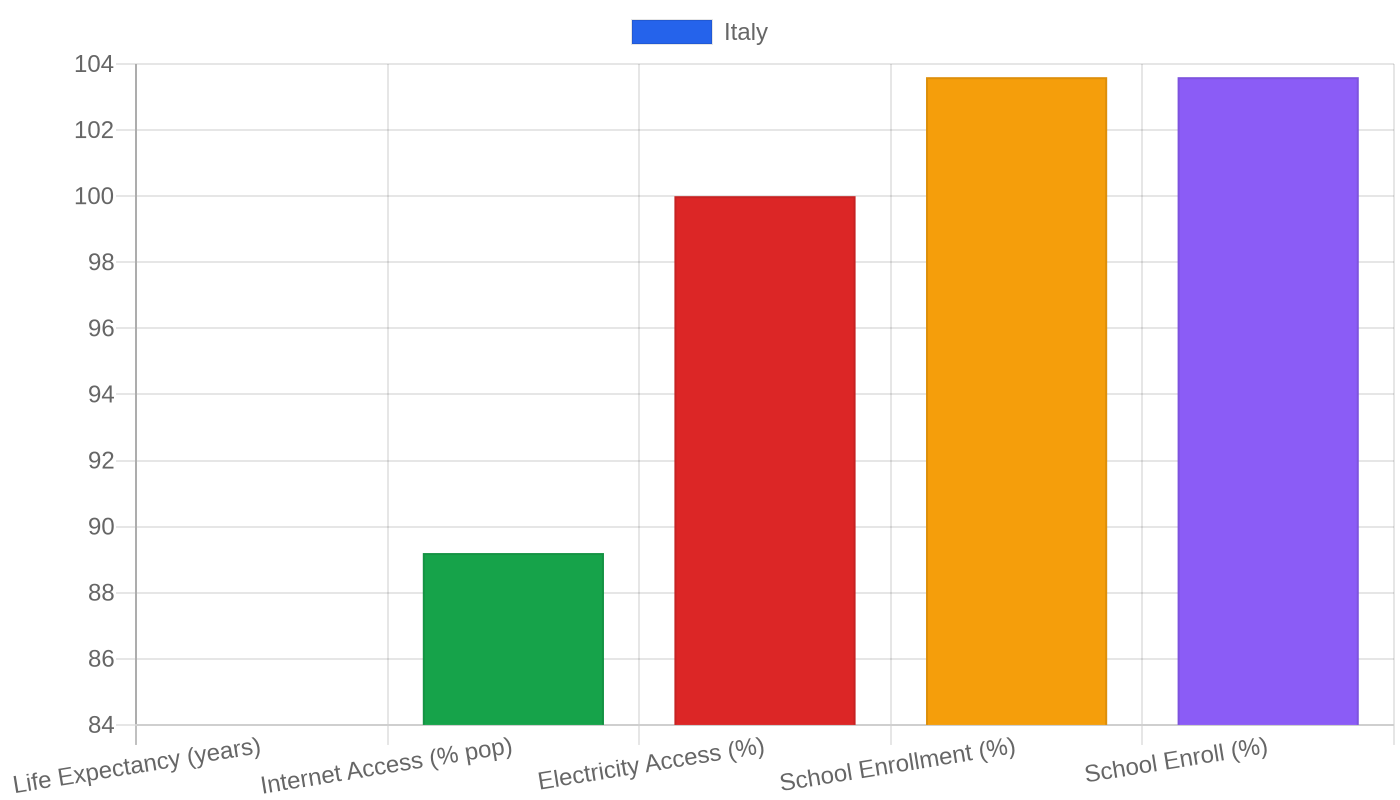
– With key economic indicators not currently being updated by the World Bank, analysts are watching Italy’s structural strengths rather than cyclical data.
– The country’s quality of life narrative is intertwined with its industrial output, making it a unique case study in Western European resilience.
The Cathedral of Industry: Reading Italy’s Economic Soul
The World Bank’s latest data dashboard for Italy presents a curious silence—GDP growth figures are blank, inflation readings are absent, and unemployment numbers have yet to be posted. But in the world of economic journalism, silence can sometimes speak louder than spreadsheets. What we know about Italy is not contained in quarterly percentage points but in the magnificent, sprawling architecture of its industrial base.
This is a nation that doesn’t simply participate in the global economy; it shapes it through a network of engineering and energy concerns that have become household names across Europe.
Consider the corporate landscape as a living economic indicator. The energy sector, represented by giants like Agip, continues to be the lifeblood of the Italian industrial machine, powering everything from automotive manufacturing to domestic consumption. The automotive and consumer goods sectors—with storied names like Abarth—remind us that Italy remains a global arbiter of design and performance.
Meanwhile, the aerospace and defense cluster, including Aermacchi, AgustaWestland, and Alenia Aermacchi, positions Italy as a serious player in high-technology manufacturing. These are not marginal players; they are the engines that have historically driven Italian GDP, employment, and export revenues.
The absence of fresh World Bank data may reflect reporting lags or methodological revisions, but it should not be mistaken for economic stagnation. Italy’s economy is a mature, complex system where the informal sector, small family enterprises, and massive industrial groups coexist. The utilities sector, represented by A2A, ensures that the country’s infrastructure remains functional, while airlines like Air Dolomiti and Air One connect the peninsula to broader European markets.
For the discerning investor, Italy’s value proposition has never been about flashy growth rates; it is about deep, entrenched industrial capacity that has weathered decades of economic storms.
The Price of La Dolce Vita: Housing and Daily Life
Cost of living data for Italy remains as elusive as perfect espresso—everyone knows it exists, but the precise measurements are debated. What we can infer from the industrial and corporate structure is that Italy operates as a high-value, high-complexity economy. In metropolitan hubs like Milan and Rome, housing costs are notoriously demanding, reflecting the concentration of corporate headquarters and financial services.
The presence of major utilities and energy companies suggests that the cost of living is heavily influenced by energy prices, which in turn affect everything from grocery bills to manufacturing output.
The rent-versus-buy calculation in Italy is a generational question. With an economy anchored in family-owned businesses and long-standing industrial dynasties, property ownership has historically been viewed as a secure investment. However, the modern reality for younger Italians involves navigating a labor market where the stability of their parents’ generation is no longer guaranteed.
While specific index numbers are not currently available from the World Bank, the structural indicators suggest a bifurcated market: prime real estate in industrial cities commands premium prices, while rural areas offer more accessible living costs, though with fewer employment opportunities.
Capital and Conglomerates: The Business Landscape
For international investors, Italy offers a distinctive proposition: access to world-class engineering and manufacturing capabilities through publicly traded and state-affiliated entities. The business environment is characterized by a deep interconnection between government policy and corporate strategy, a legacy of the country’s post-war reconstruction.
The presence of Agip in oil and gas, alongside aerospace leaders like AgustaWestland, signals that strategic sectors remain central to the national economic agenda.
The consumer goods sector, with names like AGV and ALAN, demonstrates Italy’s continued relevance in global markets for premium products. This is not a low-cost manufacturing destination; it is a high-value, high-skill economy where design, precision, and brand heritage command premium pricing. The business climate is challenging for newcomers—bureaucracy is infamous—but for those who navigate the landscape, the rewards include access to advanced supply chains and a sophisticated domestic market.
The recent stability under President Mattarella’s tenure has provided a predictable political backdrop for long-term corporate planning, a factor that should not be underestimated in a region often marked by political volatility.
Stability and Society: The Political Foundations
Italy’s political system is a study in constitutional resilience. Since 1946, when the monarchy was abolished, Italy has operated as a unitary parliamentary republic with a written constitution born from the anti-fascist resistance. This historical foundation is not merely academic; it shapes the country’s contemporary political culture.
President Sergio Mattarella, in office since 2015, serves as a stabilizing figure, elected for a single seven-year term by a joint session of parliament and regional representatives. This structure was designed to prevent the concentration of power and to ensure broad consensus for the head of state.
Crime and safety indices for Italy are currently not updated, but the political framework suggests a society that values institutional checks and balances. The constitutional design, crafted by representatives of the forces that defeated Nazi and Fascist regimes, reflects a deep national commitment to democratic governance. For residents and visitors alike, this translates into a predictable legal environment, even if the day-to-day bureaucracy can be frustrating.
The quality of life in Italy has long been associated with cultural richness, culinary excellence, and social cohesion—factors that persist despite economic headwinds.
The Current Conjuncture: What’s Moving in Italy Right Now
The most pressing narrative in Italy today is not a single headline event but the ongoing management of its industrial transition. With the World Bank’s growth and inflation data currently unpublished, the market is operating on anecdotal and corporate signals. The energy sector is navigating the complex transition toward renewable sources, with companies like A2A and Agip under pressure to modernize while maintaining supply security.
This is a delicate balancing act, as energy costs remain a critical factor for both industrial competitiveness and household budgets.
The aerospace and defense sector, anchored by Alenia Aermacchi and AgustaWestland, continues to be a strategic priority, reflecting both domestic procurement needs and export ambitions. Meanwhile, the automotive industry, including the iconic Abarth brand, is facing the global shift toward electrification—a transformation that will test the flexibility of Italy’s manufacturing base.
The political class, under President Mattarella’s watchful eye, is engaged in the perennial challenge of modernizing the state apparatus while preserving the social safety net. The coming months will likely see continued debate over energy policy, industrial subsidies, and the delicate art of maintaining fiscal discipline in a mature economy.
The Bottom Line
Italy is not a market for those seeking explosive growth; it is a market for those who appreciate enduring value. The country’s strength lies in its industrial depth, its constitutional stability, and its unrivaled cultural capital. For investors, policymakers, and analysts, Italy offers a case study in how a mature economy navigates global transitions without losing its distinctive character.
The absence of fresh data from the World Bank is a reminder that sometimes the most important economic signals are not the ones in the headlines, but the ones embedded in the long-term structural fabric of the nation. Watch Italy for its resilience, its engineering prowess, and its ability to surprise the world with quiet, persistent competence.
Sources & Methodology
This article is authored by Economic Pulse Net for informational and research purposes. Economic Pulse Net sources its data from multilateral institutions, national statistics bureaus, and proprietary databases. All data is believed to be current as of the date of publication.
Published: August 11, 2026 | Category: Research — Italy
Use these signals in your own platform
Economic Pulse publishes its live signal feed through a documented, read-only API. Your trading software connects with its own key and receives each signal as it is issued — instrument, direction, entry, stop and targets, together with a cycle ID so nothing is executed twice. The feed is independent of this website and cannot change it.
Signals are informational only and are not financial advice.