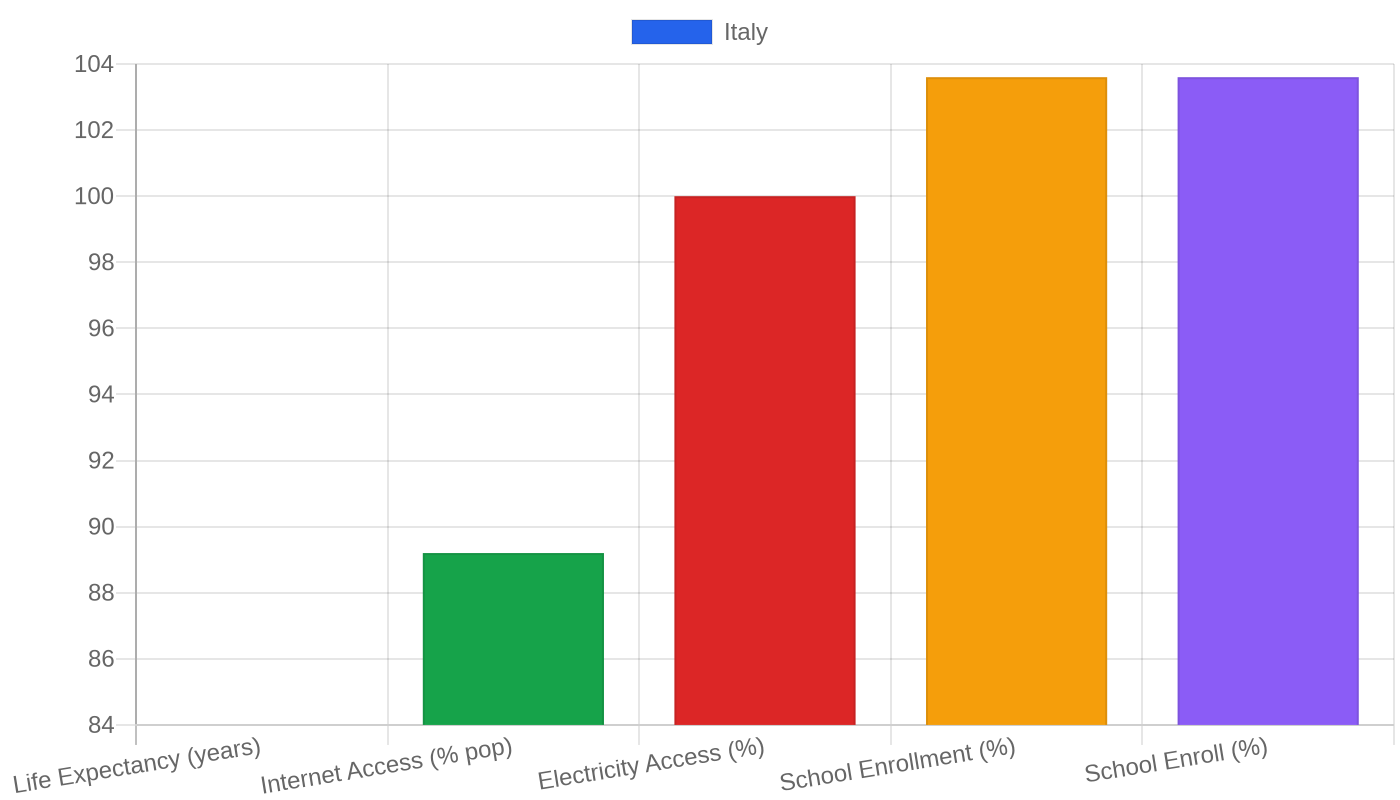
Economic Pulse Net | Sources: World Bank World Development Indicators, Government Sources | 2026
Key Takeaways
– Italy operates as a unitary parliamentary republic, with President Sergio Mattarella serving as head of state since 2015, providing rare political continuity in a nation known for governmental turnover.
– The country’s economic identity is anchored in manufacturing excellence and industrial diversification, with major players spanning aerospace, energy, utilities, and premium consumer goods.
– Italy’s corporate landscape features globally recognized industrial names including AgustaWestland, Alenia Aermacchi, and Agip, signaling strength in high-value engineering sectors.
– The nation’s political foundations remain rooted in its post-war anti-fascist constitution, shaping a democratic framework that prioritizes stability and institutional balance.
The Productivity Puzzle — What Drives Italian Output
Italy’s economic narrative is one of enduring industrial sophistication layered over structural challenges. According to the World Bank, the latest data presents a complex picture, with growth metrics currently registering as unavailable — a reminder that Italy’s recovery has been uneven and subject to persistent headwinds. What remains clear is that the country’s economic engine runs on a diverse industrial base that spans energy, utilities, aerospace, and consumer goods.
The presence of major energy players like Agip and utilities such as A2A indicates that Italy maintains significant capacity in critical infrastructure sectors that anchor broader economic activity.
The industrial sector tells a compelling story of engineering prowess. Companies like AgustaWestland and Alenia Aermacchi position Italy as a serious player in aerospace and defense manufacturing, while Aermacchi reinforces the country’s reputation for precision engineering. These are not marginal enterprises; they are substantial operations that contribute to Italy’s export capacity and technological sophistication.
The consumer goods sector, represented by brands like Abarth and AGV, demonstrates Italy’s ability to blend design excellence with manufacturing capability — a combination that has historically commanded premium pricing in global markets.
Yet the economic picture is incomplete without acknowledging the constraints. Inflation data from the World Bank is currently unavailable, making it difficult to assess the current cost pressures facing Italian households and businesses. Similarly, unemployment figures remain unreported, leaving a gap in understanding the labor market’s health.
What can be inferred from the industrial structure is that Italy’s prosperity is closely tied to its ability to maintain competitiveness in high-value manufacturing, a sector that faces intensifying global competition. The country’s economic future hinges on whether it can modernize its productive capacity while preserving the artisanal quality that distinguishes Italian output.
The Cost of La Dolce Vita — Housing and Daily Realities
For Italians, the cost of living varies dramatically between the industrial north and the agricultural south, though specific housing data from the World Bank is currently limited. What is known is that Italy’s urban centers, particularly Milan and Rome, have historically commanded property prices that reflect their status as economic and cultural hubs.
The rental market in major cities has traditionally favored a mix of long-term leases and short-term tourist accommodations, creating pressure on residential availability in historic centers.
The broader cost picture in Italy reflects a society that values quality of life — food, culture, and family — but must balance these priorities against wage growth that has lagged productivity gains in recent years. Daily expenses for groceries, transportation, and utilities consume a significant portion of household budgets, particularly for younger Italians who face a challenging entry into the housing market.
The structural issue of youth unemployment has long been a concern, potentially delaying household formation and pushing many young Italians to consider opportunities abroad. For families, the cost equation involves not just housing but also education and healthcare, where Italy’s public systems provide some relief but face their own sustainability questions.
The Business Landscape — Where Capital Meets Craftsmanship
Italy’s corporate environment presents a distinctive blend of family-owned enterprises, industrial conglomerates, and state-influenced strategic companies. The top companies list reveals a economy where utilities and energy — A2A and Agip — sit alongside aerospace and defense contractors like AgustaWestland and Alenia Aermacchi.
This combination suggests that Italy maintains a dual-track business model: one leg grounded in essential services and infrastructure, the other in high-technology manufacturing that competes on the global stage.
The consumer goods sector deserves particular attention. Brands like Abarth, AGV, and ALAN represent Italy’s capacity to create products with cultural cachet and design leadership. These companies benefit from the “Made in Italy” brand equity that commands premium pricing in international markets. However, the business environment faces well-documented challenges: bureaucratic complexity, regional economic disparities, and a legal system that can slow commercial disputes.
For investors, the opportunity lies in Italy’s industrial districts — geographic clusters of specialized production where small and medium enterprises achieve world-class efficiency through collaboration and shared infrastructure.
Stability and Society — Navigating Politics and Public Safety
Italy’s political system, as outlined by the World Bank data, provides a framework of remarkable stability at the constitutional level. Since 1946, the country has operated as a unitary parliamentary republic, with the presidency serving as a unifying figure above partisan politics. President Sergio Mattarella, in office since 2015, has embodied this role, providing continuity through successive governments.
The president’s election by Parliament and regional voters in joint session for a seven-year term ensures that the office remains insulated from short-term political pressures.
The constitutional foundation is notably principled — emerging from a Constituent Assembly formed by anti-fascist forces following the defeat of Nazi and Fascist regimes during World War II. This origin story shapes Italy’s political culture, embedding a commitment to democracy and human rights that transcends partisan divisions.
Public safety data from the World Bank is currently unavailable, but Italy’s social fabric is characterized by strong community ties, particularly in smaller towns and rural areas. The quality of life in Italy is enhanced by universal healthcare, a rich cultural heritage, and one of the world’s most admired cuisines — factors that consistently rank the country highly in subjective well-being surveys despite economic challenges.
The Current Crossroads — Italy in Real Time
Italy stands at a moment of significant political and economic recalibration. The stability provided by President Mattarella’s long tenure offers a counterweight to the frequent government changes that have characterized Italian politics. The current landscape suggests a nation wrestling with its role in the European Union, the imperatives of energy transition, and the need to modernize an economy that has grown more slowly than its European peers for decades.
The presence of major energy companies like Agip indicates that Italy has substantial stakes in the fossil fuel sector even as it navigates the shift toward renewable energy.
The aerospace and defense sector represented by AgustaWestland and Alenia Aermacchi positions Italy as a significant player in European security cooperation, a role that has gained renewed importance amid shifting geopolitical dynamics. Meanwhile, the consumer goods and automotive components sectors — Abarth, AGV, ALAN — continue to demonstrate resilience, suggesting that Italy’s export-oriented manufacturers have adapted to changing global demand patterns.
The immediate policy agenda appears focused on maintaining fiscal responsibility while supporting investment in digital infrastructure and green technologies. For observers, the key indicator will be whether Italy can translate its industrial strengths into sustained productivity growth that improves living standards for its population.
The Bottom Line
Italy is a country of extraordinary economic potential constrained by structural rigidities and a challenging demographic outlook. The nation that brought the world the Renaissance, modern banking, and some of its most beloved luxury brands possesses industrial capabilities that remain globally competitive. For investors, policymakers, and businesses, Italy offers opportunities in aerospace, energy transition, and premium consumer goods — but requires patience and an understanding of local dynamics.
The watchword for Italy is resilience: a country that has weathered political turmoil, economic stagnation, and global crises while preserving what matters most — its people, its culture, and its capacity for reinvention.
Sources & Methodology
This article is authored by Economic Pulse Net for informational and research purposes. Economic Pulse Net sources its data from multilateral institutions, national statistics bureaus, and proprietary databases. All data is believed to be current as of the date of publication.
Published: August 11, 2026 | Category: Research — Italy
Use these signals in your own platform
Economic Pulse publishes its live signal feed through a documented, read-only API. Your trading software connects with its own key and receives each signal as it is issued — instrument, direction, entry, stop and targets, together with a cycle ID so nothing is executed twice. The feed is independent of this website and cannot change it.
Signals are informational only and are not financial advice.