Economic Pulse Net | Sources: World Bank World Development Indicators, Government Sources | 2026
Key Takeaways
- Growth has effectively flatlined: According to the World Bank, Hungary’s GDP growth for 2025 is projected at a mere 0.51%, signaling a severe slowdown in economic momentum.
- Sticky inflation persists: The Consumer Price Index (CPI) stands at 4.41% (World Bank), indicating that while the worst of the price shocks may have passed, costs remain elevated for consumers.
- Labor market remains resilient: Despite the stagnation in overall growth, unemployment remains low at 4.52%, suggesting a tight labor market where businesses are struggling to find workers rather than laying them off.
- High purchasing power: With a GDP per capita (PPP) of approximately $49,837 (World Bank), Hungary maintains a high standard of living relative to its nominal income, supported by a robust internal market.
- Political stability with structural rigidity: The country operates under a unitary parliamentary republic framework, with a constitutional structure that is difficult to amend, creating a stable but potentially rigid governance environment.
The Stagnation Point: Why 0.5% Growth Matters
The economic heartbeat of Hungary appears to have slowed to a near-stop in 2025.
According to the World Bank, the country’s Gross Domestic Product (GDP) growth is projected at just 0.51%.
In economic terms, this is effectively zero growth, meaning the total value of goods and services produced by the nation is barely expanding.
This figure is critical because it signals that the post-pandemic recovery and subsequent investment cycles have exhausted their immediate potential.
While the absolute size of the economy remains substantial, with a total GDP of approximately $246.5 billion (World Bank), the lack of forward momentum is a concern for long-term development.
This stagnation is occurring against a backdrop of persistent inflation, with the World Bank reporting a CPI rate of 4.41%.
When growth is this low, inflation erodes the real value of wages, making it difficult for households to improve their financial situation despite having jobs.
The combination of near-zero growth and mid-single-digit inflation creates a challenging environment for both policymakers and consumers, as it limits the room for monetary easing and constrains fiscal stimulus options.
Living Costs and Purchasing Power
For the average Hungarian, the experience of daily life is defined by the interplay between nominal income and real purchasing power.
The World Bank data indicates a GDP per capita (PPP) of roughly $49,837, which is significantly higher than the nominal GNI per capita of $23,850.
This discrepancy highlights the strength of Hungary’s internal market and the lower cost of living compared to Western European peers, allowing residents to stretch their income further.
While specific data on housing rents and daily utility costs was not provided in the dataset, the high PPP figure suggests that the cost of living remains manageable relative to income levels.
This structural advantage means that even with inflation at 4.41%, the impact on household budgets is mitigated by the generally lower baseline costs of goods and services in the region.
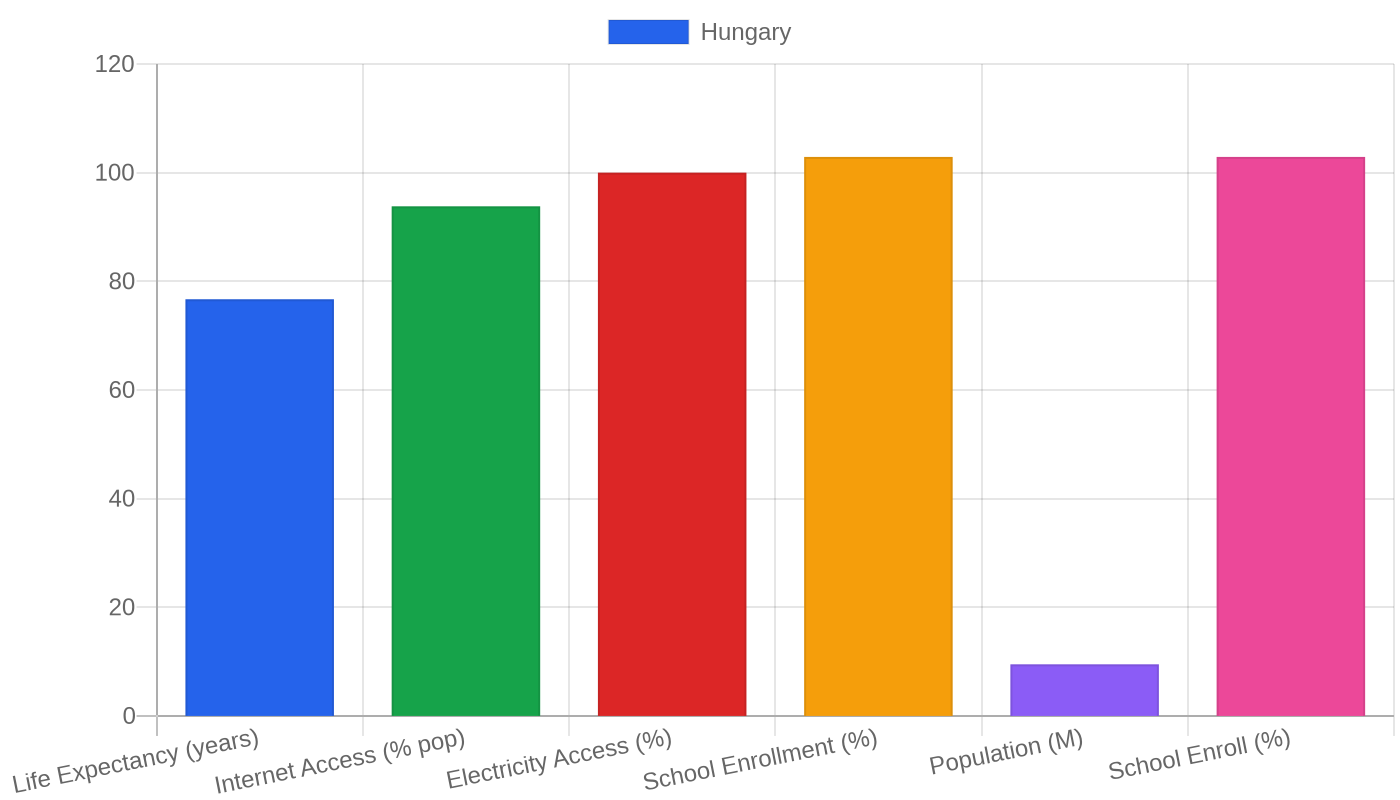
The population of approximately 9.5 million (World Bank) supports a dense, urban-centric economy, particularly around Budapest, where lifestyle costs may vary, but the national average suggests a stable foundation for consumer spending.
Corporate Giants and Sectoral Resilience
Hungary’s business landscape is anchored by a diverse mix of companies that span critical sectors from telecommunications to basic materials.
The presence of major players such as 4iG in telecommunications and CIB Bank in financials indicates a mature domestic corporate structure capable of supporting the national economy.
The list of top companies includes BorsodChem in basic materials and CBA in consumer services, suggesting that the industrial and retail sectors remain vital engines of activity.
Notably, the service sector is well-represented, with entities like ASL Airlines Hungary and BKV Zrt.
(a key transport and logistics player) highlighting the importance of logistics and tourism-related services to the national income.
The inclusion of healthcare firms like AstridBio and consumer goods producers like Ajka Crystal further diversifies the economic base, reducing reliance on any single industry.
This breadth ensures that even if one sector faces headwinds, others can provide a buffer, although the overall economic stagnation suggests that these companies are operating in a constrained market environment.
Governance, Safety, and Social Fabric
Hungary operates as a unitary parliamentary republic, with its political life governed by the Fundamental Law, a constitutional framework that has undergone significant reforms, most recently in 2012.
The constitution features “eternity clauses” that protect core principles such as human dignity, the separation of powers, and the rule of law from amendment, even by supermajority.
This structural rigidity provides a degree of long-term political stability, although it also limits the flexibility of the political system to adapt to rapid changes.
The data provided does not include specific crime or safety indices, which leaves a gap in understanding the current security environment for residents and visitors.
However, the political landscape suggests a centralized system where decision-making is concentrated, which can lead to swift policy implementation but may also concentrate power.
The absence of specific happiness or safety metrics in the provided data requires a cautious approach to assessing quality of life, focusing instead on the economic and political stability factors that typically underpin social well-being.
Current Affairs: Navigating the Slowdown
The most pressing issue for Hungary in 2025 is navigating the economic stall.
With growth hovering at 0.5%, the government and private sector are likely under intense pressure to find new drivers of expansion.
The persistence of inflation at 4.4% suggests that central bank policies are still focused on maintaining price stability, which may limit short-term stimulus options.
Businesses, including major players like CIB Bank and BorsodChem, are likely adjusting their strategies to cope with lower demand growth and higher input costs.
The political framework, with its entrenched constitutional rules, means that significant structural reforms may be difficult to enact quickly, potentially prolonging the period of economic caution.
Investors and observers are watching closely to see if Hungary can leverage its high PPP and strong corporate base to spark a new growth phase, or if the country will remain in a prolonged period of low-growth equilibrium.
The Bottom Line
Hungary presents a complex picture of a developed economy facing a significant growth bottleneck.
While the high purchasing power and low unemployment offer stability, the near-zero GDP growth and persistent inflation pose serious challenges for future prosperity.
Investors and policymakers should watch for signs of sectoral recovery, particularly in logistics and manufacturing, and monitor how the rigid political framework influences economic decision-making.
It is a country of strong fundamentals testing its limits in a challenging macroeconomic environment.
Sources & Methodology
This article is authored by Economic Pulse Net for informational and research purposes.
Economic Pulse Net sources its data from multilateral institutions, national statistics bureaus, and proprietary databases.
All data is believed to be current as of the date of publication. Published: September 04, 2026 |
Category: Research — Hungary
Use these signals in your own platform
Economic Pulse publishes its live signal feed through a documented, read-only API. Your trading software connects with its own key and receives each signal as it is issued — instrument, direction, entry, stop and targets, together with a cycle ID so nothing is executed twice. The feed is independent of this website and cannot change it.
Signals are informational only and are not financial advice.