Economic Pulse Net | Sources: World Bank World Development Indicators, Government Sources | 2026
Key Takeaways
* Resilient Consumer Base: Despite a notable unemployment rate of 8.54%, the Greek economy supports a robust consumer sector, evidenced by a high GDP per capita (PPP) of approximately $45,263 and a GNI per capita of $25,360.
Inflationary Pressures: The country is currently navigating an inflationary environment with a CPI reading of roughly 2.48%, indicating moderate price stability but requiring careful monetary monitoring.
Political Continuity: Operating under the 1975 Constitution, Greece maintains a stable parliamentary republic framework with strong guarantees for civil liberties, providing a predictable backdrop for long-term investment.
Diverse Corporate Landscape: The business environment is anchored by major players across utilities, aviation, and consumer goods, suggesting a diversified economic base beyond traditional tourism dependencies.
Economic Resilience Amidst Moderate Growth
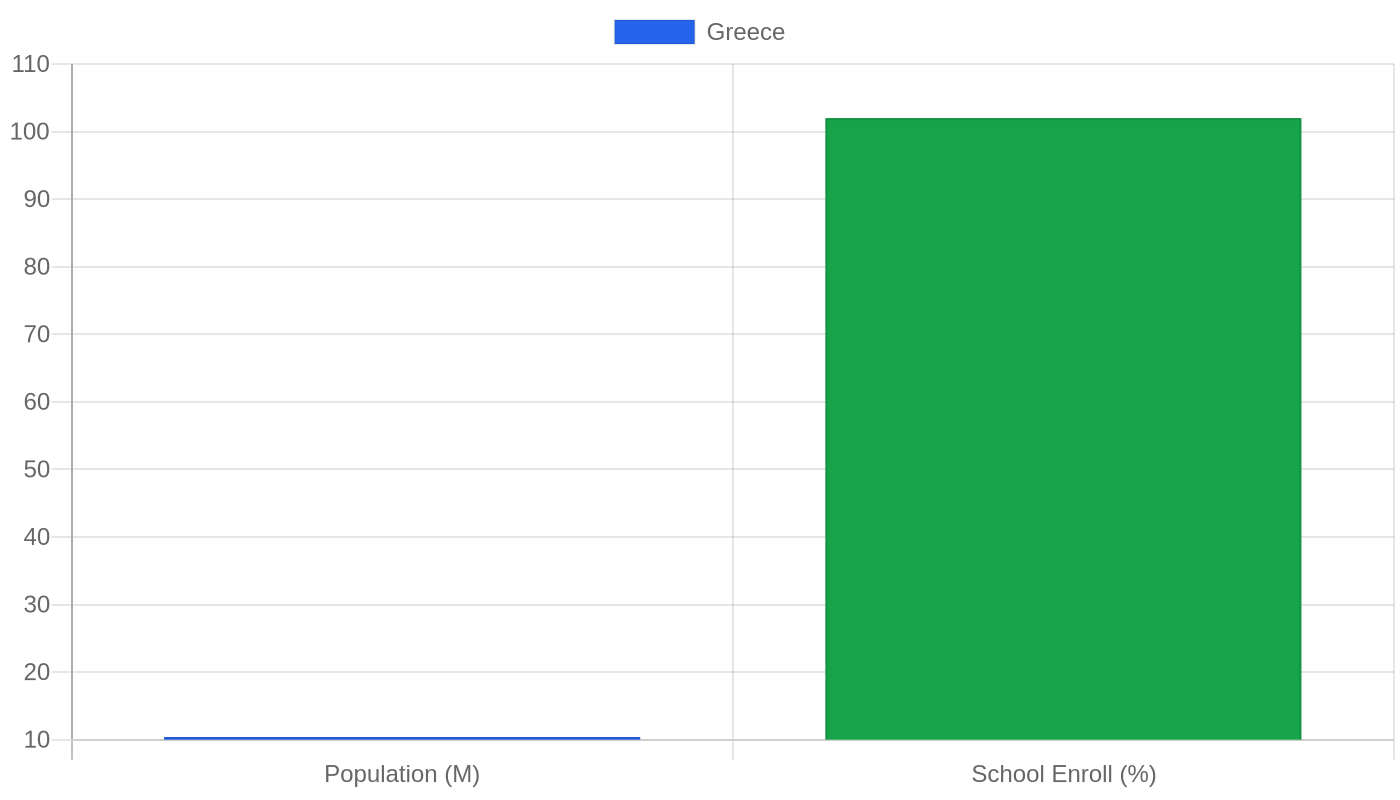
The Greek economy presents a complex picture of structural maturity balanced against lingering labor market challenges. According to World Bank data, the nation boasts a substantial GDP per capita at purchasing power parity (PPP) of $45,263.65, reflecting a significant standard of living relative to many emerging markets. This figure is supported by a Gross National Income (GNI) per capita of $25,360, which underscores the household earning power within a population of over 10.4 million citizens.
However, the labor market remains a critical area of focus; the unemployment rate stands at 8.54%, suggesting that while wealth is distributed, job creation has not fully caught up with the workforce expansion. Inflation, measured by the Consumer Price Index (CPI), is recorded at 2.482%, a level that indicates manageable but persistent cost-of-living pressures for consumers.
While specific GDP growth percentages are currently listed as N/A, the underlying indicators suggest an economy that is stabilizing after years of volatility. The disparity between high per-capita income metrics and the double-digit unemployment gap highlights a structural imbalance where productivity gains may not be evenly translating into broad employment opportunities. Understanding these dynamics is crucial for investors looking at long-term consumption trends versus short-term labor market reforms.
Navigating the Cost of Living and Daily Expenses
For residents and expatriates alike, understanding the daily economic reality in Greece requires looking beyond headline GDP figures to the tangible costs of living. With a CPI of 2.48%, everyday expenses are subject to moderate inflationary pressure, affecting everything from grocery bills to utility payments. The high GDP per capita (PPP) suggests that despite these rising costs, the average Greek citizen retains considerable purchasing power compared to global averages.
Housing costs, while not explicitly quantified in the provided dataset, are implicitly influenced by this income-to-inflation ratio, where asset prices often outpace wage growth in stable European economies. Daily expenses are likely shaped by the strong presence of domestic consumer services and goods industries, which provide local alternatives to imported products.
This creates a unique market dynamic where local production helps stabilize certain sectors of the cost of living, even as broader macroeconomic factors drive general price increases. For businesses, this means pricing strategies must be agile enough to respond to both local competitive pressures and international inflationary trends.
Investment Opportunities and Business Climate
The corporate landscape in Greece offers a diverse array of investment avenues, particularly in sectors that support daily life and infrastructure. Major companies such as ADMIE, a key player in utilities, indicate a strong foundational need for energy and grid management investments. In the consumer space, giants like Alfa-Beta Vassilopoulos and Abea demonstrate the strength of the retail and consumer goods sectors, which are vital for capturing the spending power of the middle class.
The aviation industry, represented by Aegean Airlines and Air Mediterranean, points to a continued reliance on connectivity and tourism, sectors that are historically sensitive to global travel trends. Additionally, industrial firms like Aegean Speed Lines and Achaia Clauss highlight a manufacturing base that contributes to export potential and domestic supply chains.
Financial services are also well-represented by entities such as the Aeolian Investment Fund S.A., suggesting an active capital market ready to facilitate business expansion. For foreign investors, the presence of these established domestic champions provides a stable entry point, whether through partnerships or acquisitions, given the clear separation of powers and legal protections outlined in the national constitution.
Safety, Political Framework, and Quality of Life
Greece operates within a robust political framework established by its 1975 Constitution, which was enacted following the end of the military dictatorship between 1967 and 1974. This constitutional foundation establishes a parliamentary republic with a clear separation of executive, legislative, and judicial powers, ensuring checks and balances that are essential for political stability.
The document, which has been amended four times since its inception, includes extensive guarantees for civil liberties and social rights, further reinforced by amendments in 2001. These legal protections create a predictable environment for businesses and individuals, reducing the risk of arbitrary state intervention. While specific crime and safety indices are currently listed as N/A, the historical shift toward democratic governance suggests a society that prioritizes rule of law and institutional integrity.
The combination of strong civil liberties and a mature democratic system contributes significantly to the overall quality of life, making it an attractive destination for those seeking stability alongside economic opportunity. This political continuity serves as a bedrock for long-term planning, allowing stakeholders to focus on economic rather than political risks.
Current Affairs and Market Dynamics
The current economic narrative in Greece is defined by the interplay between structural reforms and immediate consumer pressures. With inflation hovering around 2.48%, policymakers and central banks are likely focused on maintaining price stability without stifling growth. The persistence of an 8.54% unemployment rate indicates that recent policy shifts may still be working their way through the labor market, necessitating continued attention to job creation initiatives.
The strong performance of consumer-facing companies like Alfa-Beta and Aegean Airlines suggests that domestic demand remains resilient despite these headwinds. As the country continues to operate under its 1975 constitutional framework, the emphasis on civil liberties and social rights provides a safety net that mitigates some of the social friction often associated with economic transitions.
Investors are closely watching how the government balances fiscal responsibility with the need to reduce unemployment, a key metric for future GDP growth recovery. The absence of specific GDP growth figures in the latest reports suggests a period of consolidation, where the economy is stabilizing before entering a new phase of expansion.
The Bottom Line
Greece represents a compelling case study in post-crisis stabilization, offering high per-capita income metrics alongside manageable inflation rates. Investors should watch this country closely for opportunities in consumer services, utilities, and aviation, where established domestic players dominate. The strong constitutional framework and commitment to civil liberties provide a secure environment for long-term capital deployment.
Ultimately, Greece is a market where structural strengths outweigh current labor market weaknesses, making it a strategic hold for diversified portfolios seeking exposure to the Eurozone’s southern flank.
Sources & Methodology
This article is authored by Economic Pulse Net for informational and research purposes. Economic Pulse Net sources its data from multilateral institutions, national statistics bureaus, and proprietary databases. All data is believed to be current as of the date of publication.
Published: October 05, 2026 | Category: Research — Greece
Use these signals in your own platform
Economic Pulse publishes its live signal feed through a documented, read-only API. Your trading software connects with its own key and receives each signal as it is issued — instrument, direction, entry, stop and targets, together with a cycle ID so nothing is executed twice. The feed is independent of this website and cannot change it.
Signals are informational only and are not financial advice.