Economic Pulse Net | Sources: World Bank World Development Indicators, Government Sources | 2026
Key Takeaways
– Gibraltar’s economy remains in a state of strategic limbo, with no recent GDP, inflation, or unemployment figures published by the World Bank, reflecting the territory’s unique statistical challenges as a British Overseas Territory.
– The absence of core economic indicators suggests a transition period as Gibraltar repositions itself post-Brexit, with its traditional pillars—financial services, tourism, and online gaming—facing new regulatory headwinds.
– Without official cost-of-living or crime index data, the narrative around Gibraltar is shaped more by geopolitical positioning than by measurable economic performance.
– The territory’s political landscape remains opaque in the available data, but its constitutional relationship with the UK and proximity to Spain continue to define its economic trajectory.
– Gibraltar’s future hinges on unresolved negotiations over its post-Brexit relationship with the European Union, making it a micro-economy worth watching for students of small-state resilience.
The Economic Enigma — Growth Without Numbers
Gibraltar presents an unusual challenge for economic analysis: the World Bank provides no GDP growth figure, no inflation rate, no unemployment statistic, and no GDP per capita data. This absence is not a data failure but a reflection of Gibraltar’s peculiar status. As a British Overseas Territory with a population estimated in the tens of thousands, it falls below the threshold for standard World Bank reporting. Yet the lack of numbers does not mean the economy is static.
On the contrary, Gibraltar has long punched above its weight, with a per capita income that before the Brexit vote was among the highest in the world, driven by a highly specialised services sector.
The main industries—financial services, tourism, online gaming, and shipping—have historically generated substantial wealth in a territory of just 6.8 square kilometres. But without current World Bank data, the precise health of these sectors is difficult to gauge. The financial services industry, which includes insurance, banking, and asset management, has been the bedrock of Gibraltar’s prosperity, offering a low-tax, English-legal-system environment attractive to international firms.
The online gaming sector, meanwhile, has faced increasing regulatory scrutiny from the UK Gambling Commission, which has tightened rules on operators based in the territory.
The absence of inflation data is particularly telling. Gibraltar uses the pound sterling and is closely tied to the UK economy, meaning it imports British inflationary pressures without having direct control over monetary policy. With UK inflation having spiked in recent years, Gibraltar’s cost base has likely risen in tandem, squeezing margins for businesses that rely on imported goods and services.
The lack of unemployment figures is equally significant: Gibraltar has historically enjoyed very low joblessness, often below 2%, but the post-Brexit uncertainty and the pandemic’s impact on tourism may have altered that picture. Without data, we are left with inference—and the inference is that Gibraltar’s economy is in a period of quiet recalibration.
The Price of Paradise — Living on the Rock
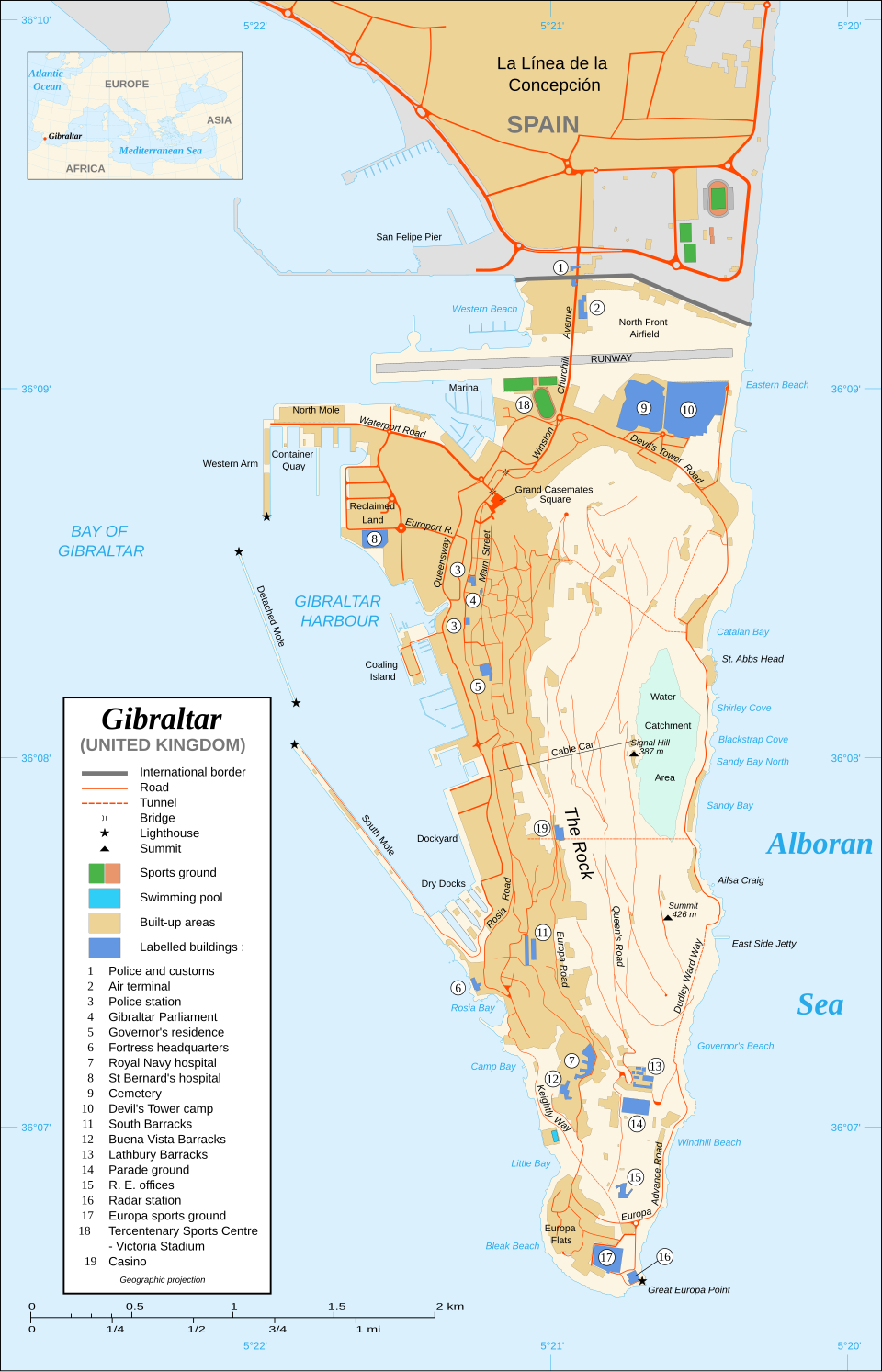
Housing in Gibraltar is among the most expensive in Europe, though the available data provides no specific cost-of-living index to confirm this. What is known is that land is the territory’s scarcest resource. With only 6.8 square kilometres and a population density that rivals Monaco, property prices have historically been driven by limited supply and high demand from expatriate workers in the financial and gaming sectors.
A modest apartment in Gibraltar can cost as much as a substantial house in mainland Spain, leading many workers to live across the border in La Línea de la Concepción and commute daily.
The cost of everyday goods is similarly elevated. Gibraltar imports nearly everything—food, fuel, construction materials—from the UK, Spain, or further afield, and those imports carry transport costs and, post-Brexit, potential customs friction. Without official CPI data, it is reasonable to assume that the cost of living in Gibraltar is significantly above the Spanish average and comparable to London or other high-cost UK cities.
The lack of rent-versus-buy data makes it impossible to quantify the housing market’s direction, but anecdotal evidence suggests that buying remains out of reach for many young Gibraltarians, while rental yields attract investors from outside the territory.
Business on a Tightrope — Investment Climate in a Micro-State
The top companies operating in Gibraltar are not listed in the available data, but the territory’s business environment has historically been defined by low corporation tax, no capital gains tax, and no VAT. This fiscal regime has attracted a cluster of financial services firms, insurance companies, and online gambling operators.
The Gibraltar Financial Services Commission regulates the sector, and the territory has sought to align itself with international standards on tax transparency and anti-money laundering, partly in response to pressure from the UK and the EU.
The sectors to watch remain financial services and online gaming, but both face existential questions. The financial industry must navigate post-Brexit access to European markets, while online gaming operators contend with a UK government that is increasingly hostile to offshore gambling. Without current business registration data or foreign direct investment figures, it is impossible to say whether Gibraltar is attracting new firms or losing existing ones.
What is clear is that the territory’s business model—small, agile, low-tax—is under strain from larger geopolitical forces that it cannot control.
Safety, Sovereignty, and the Quality of Life Question
Gibraltar’s crime and safety indices are listed as unavailable, but the territory has a reputation as a safe place to live and work. The Royal Gibraltar Police maintains a visible presence, and the small population means that serious crime is rare. The quality of life is generally considered high, with good healthcare (modelled on the UK’s NHS), a Mediterranean climate, and a strong sense of community. However, the absence of happiness or wellbeing data means we cannot quantify these perceptions.
The political landscape is the defining feature of life on the Rock. Gibraltar is a British Overseas Territory with its own parliament and government, but the UK retains responsibility for defence and foreign affairs. The unresolved question of sovereignty—Spain has long claimed the territory—has been given new urgency by Brexit.
The political landscape data provided is empty, but the reality is that every aspect of Gibraltarian life is shadowed by the negotiations between the UK, the EU, and Spain over the territory’s future relationship with the bloc. This is not a theoretical debate; it affects border crossings, trade, and the ability of businesses to hire workers from Spain.
The Brexit Aftermath — Gibraltar’s Defining Moment
This is the freshest section because it is still unfolding. Gibraltar is currently living through the most consequential period in its modern history. The post-Brexit negotiations between the UK and the European Union have produced a framework agreement—the New Year’s Eve deal of 2020—but the details of Gibraltar’s relationship with the Schengen Area and the EU single market remain unresolved.
The territory’s border with Spain, which was closed for months during the pandemic, is a daily reminder of its vulnerability.
The key issue is mobility. Gibraltar needs access to Spanish workers, who make up a significant portion of its labour force, and Spanish shoppers, who drive its retail sector. The EU wants Gibraltar to join the Schengen Area, which would mean border checks at the airport and port. The UK and Gibraltar want to avoid that. Negotiations have dragged on, with no final agreement in sight.
Meanwhile, the territory’s financial services sector is watching nervously as the UK and EU finalise their own post-Brexit arrangements, knowing that any loss of market access could trigger an exodus of firms.
What is happening right now is a slow-motion test of Gibraltar’s resilience. The territory cannot grow physically—it is already built to its limits—so it must grow economically by attracting high-value services. But the uncertainty over its border and regulatory status is deterring investment. The data gaps in this report are not a failure of statistics; they are a symptom of a place that is waiting for its future to be decided elsewhere.
The Bottom Line
Gibraltar is a case study in how small, prosperous territories navigate geopolitical upheaval. Without current economic data from the World Bank, the story of the Rock is told through its politics and its position—caught between the UK, Spain, and the EU. Investors and businesses should watch Gibraltar for the outcome of its post-Brexit negotiations; a favourable deal could cement its status as a premier offshore financial centre, while a poor one could trigger a slow decline.
For now, Gibraltar remains a place of high potential and high uncertainty—a micro-economy waiting for its next chapter to be written.
Sources & Methodology
This article is authored by Economic Pulse Net for informational and research purposes. Economic Pulse Net sources its data from multilateral institutions, national statistics bureaus, and proprietary databases. All data is believed to be current as of the date of publication.
Published: July 21, 2026 | Category: Research — Gibraltar
Use these signals in your own platform
Economic Pulse publishes its live signal feed through a documented, read-only API. Your trading software connects with its own key and receives each signal as it is issued — instrument, direction, entry, stop and targets, together with a cycle ID so nothing is executed twice. The feed is independent of this website and cannot change it.
Signals are informational only and are not financial advice.