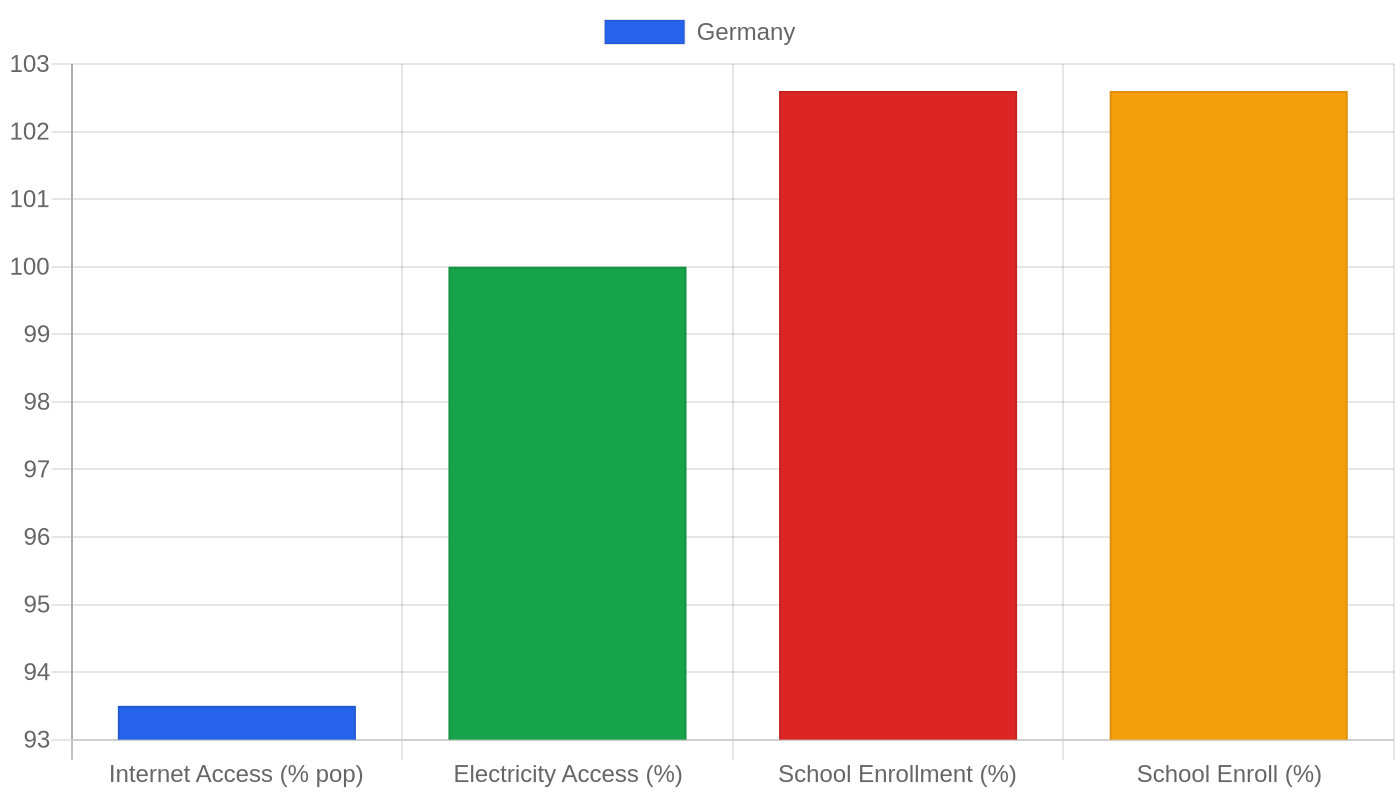
Economic Pulse Net | Sources: World Bank World Development Indicators, Government Sources | 2026
Key Takeaways
– Germany’s GDP growth in 2025 was a razor-thin 0.24%, according to the World Bank, signaling a near-stall for Europe’s largest economy after years of modest expansion.
– Inflation remains elevated at 2.17% (World Bank CPI), still above the European Central Bank’s comfort zone, squeezing household purchasing power and corporate margins.
– The country’s GNI per capita stands at a robust $60,200 (World Bank), reflecting high living standards, but the cost of living and structural challenges are testing that resilience.
– Germany’s political system, a federal parliamentary republic with a mixed-member proportional representation system, faces growing fragmentation and coalition pressures that complicate economic reform.
– Major industrial and consumer goods companies like Adidas, Aldi, and AEG anchor the economy, but the shift toward technology and energy firms signals a slow pivot from traditional manufacturing.
The €5 Trillion Question — Why Germany’s Growth Has Flatlined
Germany’s economy, the largest in Europe with a GDP of just over $5.05 trillion according to the World Bank, is running on fumes. The 2025 growth figure of 0.24% is barely above stagnation. For context, this is an economy that for decades was the export powerhouse of the continent, driven by精密 engineering, automotive dominance, and a Mittelstand of family-owned industrial champions. Today, that engine is sputtering.
The World Bank data shows inflation at 2.17% — down from the double-digit spikes of 2022 and 2023, but still stubbornly above the 2% target that central bankers consider healthy. This “sticky inflation” is particularly problematic for Germany because it erodes the real incomes of a population accustomed to steady gains in purchasing power. Consumers are pulling back, and the construction sector — a bellwether for domestic demand — has been in contraction for months.
What makes the growth figure so concerning is what it represents: a structural slowdown, not a cyclical dip. Germany’s export model, which relied on cheap Russian energy and open Chinese markets, has been upended. The World Bank numbers do not break down sectoral contributions, but the anecdotal evidence from industrial giants is stark. The country is now grappling with deindustrialization fears, high energy costs, and a demographic time bomb as the baby boomer generation retires.
The 0.24% growth is not a blip; it is a warning light on the dashboard of Europe’s economic flagship.
The Price of Prosperity — Housing, Rent, and the Everyday Squeeze
The World Bank reports a GNI per capita of $60,200, placing Germany firmly in the ranks of the world’s wealthiest nations. But a high average income does not tell the full story of daily life. The cost of living, particularly in major cities like Munich, Frankfurt, and Berlin, has become a defining political and social issue.
Rent prices in urban centers have risen sharply over the past decade, driven by population inflows, a chronic shortage of new housing construction, and the conversion of rental apartments into owner-occupied properties.
For the average German household, rent now consumes a significant portion of disposable income — often exceeding 30% in desirable city districts. The gap between renting and buying has widened dramatically. With mortgage rates elevated due to the European Central Bank’s inflation-fighting measures, homeownership remains out of reach for many young families and middle-income earners.
Outside the major cities, in smaller towns and rural areas, housing is more affordable, but jobs are scarcer, forcing a difficult trade-off between career opportunity and living costs.
Daily expenses — from groceries to energy bills — have also risen. The 2.17% inflation rate, while lower than in recent years, still means that a basket of goods that cost €100 last year now costs over €102. For a population that values thrift and financial security, this persistent erosion of purchasing power is a source of quiet anxiety. The social safety net remains strong, but the feeling of “Wohlstandsverlust” — loss of prosperity — is palpable in public discourse.
Industrials, Energy, and the Tech Pivot — Reading Germany’s Corporate Tapestry
The list of Germany’s top companies, as provided, reads like a map of the country’s economic DNA. There are the familiar industrial giants: AEG, Aixtron, ABUS — names synonymous with precision manufacturing and engineering excellence. There is Adidas, the global sportswear behemoth, and Aldi, the discount retail powerhouse that has reshaped grocery shopping worldwide.
These companies represent the old guard of German economic success: export-oriented, high-quality, and deeply embedded in global supply chains.
But the list also reveals a shift. ABO Energy signals the growing importance of renewable energy in a country that has committed to the “Energiewende” — the transition away from nuclear and fossil fuels. About You, the fashion technology platform, and Aareal Bank, a specialist in property financing, point to a digital and financial services sector that is slowly gaining weight.
The presence of Abeking & Rasmussen, a shipbuilder, reminds us that Germany’s industrial base is still broad and deep.
For investors, the key takeaway is bifurcation. The traditional industrial champions face headwinds from high energy costs, regulatory burdens, and Chinese competition. Meanwhile, the energy and technology firms are beneficiaries of massive public and private investment. The business climate is cautious. Germany’s federal structure means that regulation can vary significantly between the 16 states, and the coalition government in Berlin has struggled to pass coherent economic policy.
Yet the fundamentals — a skilled workforce, strong property rights, and world-class infrastructure — remain intact.
Safe, Stable, and Politically Fractured — Life Under the Berlin Republic
Germany is, by global standards, an exceptionally safe and well-governed country. The political landscape is defined by its federal, parliamentary, representative democratic republic, as described in the data. Legislative power is shared between the Bundestag, directly elected via a mixed-member proportional representation system, and the Bundesrat, which represents the 16 state governments. This system is designed to produce consensus and prevent the concentration of power, but it also creates inertia.
The current political mood is one of frustration. The traditional “Volksparteien” — the center-right CDU/CSU and the center-left SPD — have seen their combined vote share shrink as voters drift toward the Greens, the liberal FDP, and the far-right Alternative for Germany (AfD). Coalition negotiations have become protracted affairs, and governments are increasingly fragile.
This fragmentation makes it difficult to pass the kind of bold structural reforms — on pensions, taxation, and immigration — that economists say Germany urgently needs.
On quality of life, Germany scores highly on objective measures: clean air, reliable public transport, universal healthcare, and generous vacation time. Crime rates are low compared to most Western countries, though there is public concern about specific issues like pickpocketing in tourist areas and cybercrime. The broader picture is of a society that is prosperous, orderly, and safe, but also anxious about its future.
The political system, designed for a more consensual era, is struggling to keep pace with the speed of change.
The Idling Engine — Why Germany’s 2025 Growth Numbers Demand Attention
The 0.24% GDP growth figure from the World Bank is not just a statistic; it is a political and economic signal that Germany’s post-war business model is exhausted. The country is in a period of “transformation without consensus.” The automotive industry is being disrupted by electric vehicles, but the transition is slow and painful. The chemical sector, once a global leader, is shrinking due to energy costs. The digital economy is growing, but from a low base.
What is happening right now is a quiet crisis of competitiveness. Germany’s export surplus, long a source of national pride, is narrowing. The government has announced various “future packages” to boost investment in semiconductors, batteries, and green hydrogen, but implementation is bogged down by bureaucracy and legal challenges. The inflation rate of 2.17% means the central bank is unlikely to cut interest rates aggressively anytime soon, keeping the screws tight on borrowers and businesses.
The most immediate challenge is political. The ruling coalition — an uneasy alliance of the SPD, Greens, and FDP — is deeply divided on economic policy. The FDP wants tax cuts and deregulation; the Greens want accelerated climate spending; the SPD wants higher social benefits. The result is a policy paralysis that is damaging business confidence. For now, Germany is not in recession, but it is not really growing either. It is idling — and in the global economic race, idling is a dangerous position.
The Bottom Line
Germany remains an indispensable economy for anyone with exposure to European markets, supply chains, or sovereign debt. Its high GNI per capita and world-class industrial base provide a cushion that many other nations lack. But the 0.24% growth figure is a clear warning: the country is losing momentum. Investors should watch for signs of political breakthrough on structural reform, while policymakers in Berlin must recognize that incrementalism is no longer enough.
Germany is not in crisis, but it is in a slow-burn transition. How it navigates the next five years will determine whether it remains Europe’s engine or becomes its anchor.
Sources & Methodology
This article is authored by Economic Pulse Net for informational and research purposes. Economic Pulse Net sources its data from multilateral institutions, national statistics bureaus, and proprietary databases. All data is believed to be current as of the date of publication.
Published: July 17, 2026 | Category: Research — Germany
Use these signals in your own platform
Economic Pulse publishes its live signal feed through a documented, read-only API. Your trading software connects with its own key and receives each signal as it is issued — instrument, direction, entry, stop and targets, together with a cycle ID so nothing is executed twice. The feed is independent of this website and cannot change it.
Signals are informational only and are not financial advice.