Economic Pulse Net | Sources: World Bank World Development Indicators, Government Sources | 2026
Key Takeaways
– Greece posted a GDP growth rate of 2.07% in 2025, according to the World Bank, signalling a steady if modest recovery from the debt-crisis years.
– Inflation remains contained at 2.48%, hovering just above the comfort zone, suggesting price pressures are easing but not yet vanquished.
– With a GNI per capita of $25,360, Greece sits firmly in the high-income bracket, yet this masks persistent structural challenges in employment and productivity.
– The political landscape is stable under the 1975 Constitution, which established a parliamentary republic with strong civil liberties protections, but the shadow of past authoritarian rule still informs public discourse.
– Key industries remain anchored in consumer services, utilities, and industrials, with top companies like Aegean Airlines and ADMIE reflecting the economy’s twin reliance on tourism and energy infrastructure.
The Slow Burn of Recovery — GDP, Inflation, and the Real Economy
Greece’s economic narrative has long been one of dramatic falls and painstaking climbs. The World Bank’s latest data for 2025 shows GDP growth of 2.07% — a figure that, while unspectacular by emerging-market standards, represents a meaningful step forward for an economy that spent years in austerity’s grip. This growth rate suggests that Greece is finally generating organic momentum, driven by a rebound in consumer spending and a stabilisation of key service sectors.
Yet the number also tells a cautionary tale: 2% growth is not enough to rapidly close the income gap with the eurozone’s core economies, and it leaves little room for external shocks.
Inflation, at 2.48% according to the World Bank, is remarkably well-behaved. After the double-digit spikes that plagued Europe in 2022 and 2023, Greece has seen price pressures moderate significantly. This is a double-edged sword. On one hand, it means the Bank of Greece and the European Central Bank have less need for aggressive rate hikes that could choke off the recovery. On the other, inflation still outpaces wage growth in many sectors, meaning real purchasing power for ordinary Greeks remains squeezed.
The figure of 2.48% is close enough to the ECB’s 2% target to be tolerable, but high enough to keep the cost-of-living crisis alive in public consciousness.
The absence of unemployment data in the World Bank’s snapshot is a notable gap, but it does not erase the fact that Greece has historically struggled with some of the highest jobless rates in the eurozone. The 2% growth figure likely implies some job creation, but the quality and permanence of those jobs remain open questions.
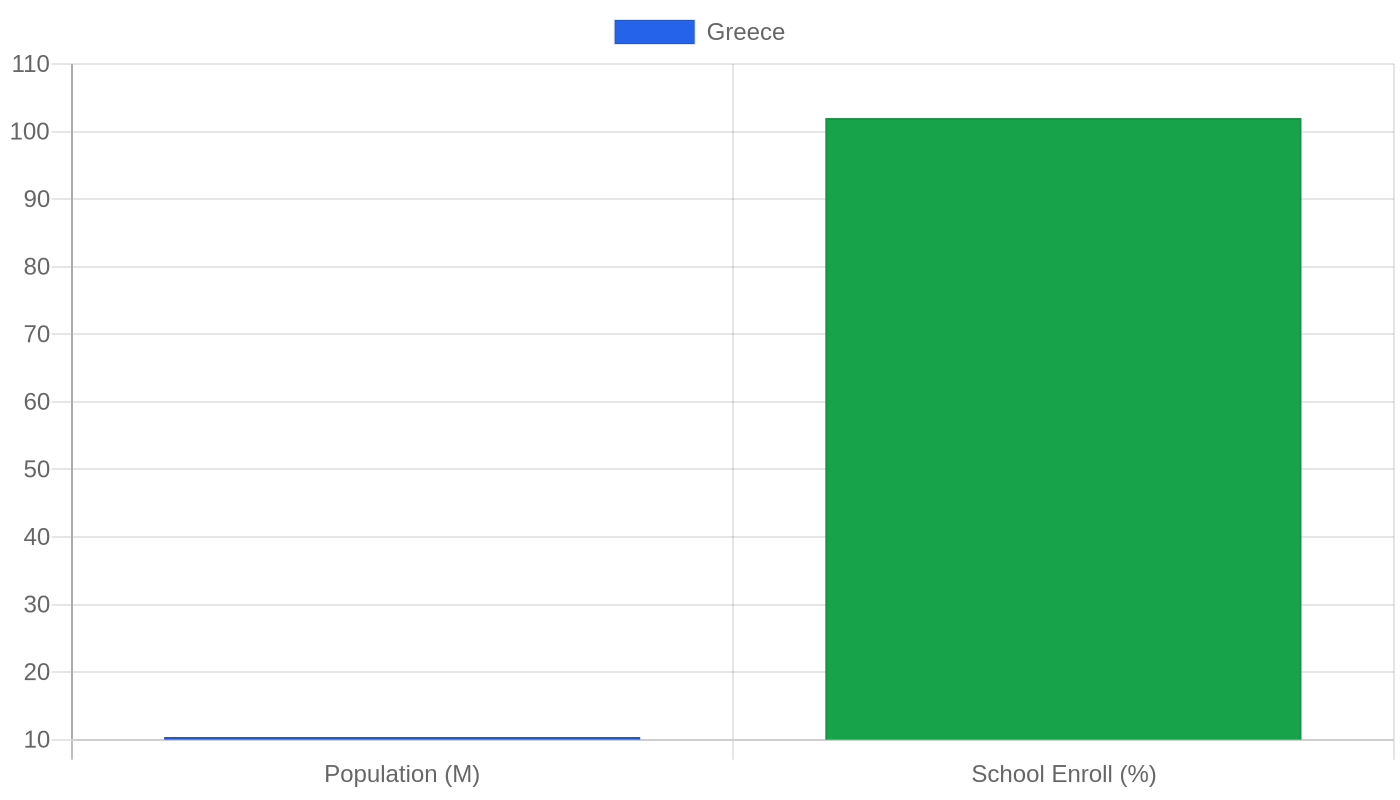
Greece’s GNI per capita of $25,360, as reported by the World Bank, places it above many of its southern European neighbours, yet this figure masks significant regional disparities — Athens and Thessaloniki pull the average up, while rural areas and islands lag behind. The country’s population of just over 10.4 million is stable, but demographic ageing poses a long-term drag on the labour force and public finances.
The Price of Paradise — Housing, Rent, and Daily Life in Modern Greece
Housing in Greece has become a flashpoint for social tension, particularly in Athens and the popular island destinations. While the World Bank data does not provide specific cost-of-living figures, anecdotal evidence from local media and real estate platforms paints a clear picture: rents in central Athens have risen sharply since the pandemic, driven by a combination of short-term tourist lets on platforms like Airbnb and a chronic shortage of new construction.
Young Greeks increasingly find themselves priced out of neighbourhoods their parents could afford, a phenomenon that has sparked protests and calls for rent controls.
The cost of daily essentials has also crept upward. With inflation at 2.48%, grocery bills, utility costs, and transport fares have all risen, even if the pace is slower than in previous years. For a family on an average Greek salary — which, adjusted for purchasing power, remains below the eurozone median — every percentage point of inflation bites.
The good news is that Greece’s inflation rate is lower than many of its peers in Southern Europe, suggesting that the energy price shock that hit the region so hard is finally receding. However, the legacy of those high prices lingers in household budgets, and the recovery in consumer confidence remains fragile.
Rent versus buy calculations are shifting. With mortgage rates still elevated due to the ECB’s monetary tightening, many Greeks are choosing to rent longer, which in turn keeps rental demand high and prices sticky. For those with savings or family wealth, buying property in less touristy areas still offers relative value, but the days of bargain real estate in central Athens are largely over.
The housing market’s trajectory will be a key indicator of whether Greece’s recovery is broadly shared or concentrated among the well-off.
From Shipping to Solar — The Business Landscape and Investment Climate
Greece’s corporate landscape is dominated by a mix of traditional industries and modern services. The top companies listed in the data span consumer services, utilities, industrials, and financials, reflecting an economy that has diversified but remains heavily reliant on tourism and logistics. Aegean Airlines, a top-10 company, is a bellwether for the travel sector, which accounts for a significant share of GDP and employment.
The airline’s performance is directly tied to the health of the summer tourist season, making Greece’s economy seasonally vulnerable. ADMIE, the utility company, represents the other pillar: energy infrastructure, including the critical task of integrating renewable sources like solar and wind into the national grid.
The presence of companies like Aegean Speed Lines and Aegek SA in the industrials category highlights the importance of maritime transport and construction. Greece’s shipping industry is one of the largest in the world by fleet capacity, and while the data does not provide specific figures, the sector remains a major source of foreign exchange and corporate revenue.
The financial sector, represented by Aeolian Investment Fund, suggests a growing appetite for investment vehicles and capital markets activity, though Greek banks are still recovering from the non-performing loan crisis of the last decade.
For investors, Greece offers a mixed picture. The political stability provided by the 1975 Constitution and its robust separation of powers is a genuine asset, as is the country’s membership in the eurozone, which eliminates currency risk. However, bureaucracy, tax complexity, and a sometimes unpredictable legal environment remain hurdles. The government has made strides in digitalising public services and streamlining business registration, but the perception of red tape persists.
Sectors to watch include renewable energy, where Greece has abundant solar and wind resources, and technology, where a small but growing startup scene in Athens is attracting venture capital. Tourism, of course, remains the 800-pound gorilla — lucrative but vulnerable to geopolitical shocks, climate change, and shifting travel patterns.
Democracy’s Deep Roots — Safety, Politics, and Quality of Life
Greece’s political landscape is defined by its 1975 Constitution, enacted after the fall of the military dictatorship that ruled from 1967 to 1974. As the World Bank data notes, this constitution established a parliamentary republic with a clear separation of powers across executive, legislative, and judicial branches. It also grants extensive guarantees of civil liberties and social rights, which were further reinforced in 2001.
This legal framework has provided Greece with remarkable political stability over the past five decades, even as the country weathered economic crises, bailouts, and social unrest. The memory of the dictatorship remains a powerful force in Greek political culture, ensuring broad public support for democratic institutions and the rule of law.
The crime and safety indices are not available in the provided data, but Greece generally ranks as a safe country by European standards. Violent crime is low, and the main concerns for residents and visitors tend to be petty theft and pickpocketing in tourist-heavy areas. The quality of life in Greece is often rated highly for its climate, food, and social fabric, but the economic pressures of the last decade have taken a toll on public services, particularly healthcare and education.
The constitution’s guarantee of social rights is meaningful, but implementation has been strained by years of budget cuts.
Happiness and life satisfaction surveys typically place Greece in the middle of European rankings, with strong scores for community and family life but lower marks for income and institutional trust. The political system, while stable, is not immune to populism and polarisation. Elections are fiercely contested, and governments have struggled to maintain stable majorities.
Yet the constitutional framework provides a safety net: no single branch of government can dominate, and the judiciary has shown independence in high-profile cases. For a country that experienced authoritarian rule as recently as the 1970s, this institutional resilience is no small achievement.
The Summer of Uncertainty — What’s Happening in Greece Right Now
As 2026 unfolds, Greece finds itself in a familiar position: navigating recovery while scanning the horizon for risks. The 2.07% growth rate reported by the World Bank for 2025 provides a foundation, but the economy is not yet firing on all cylinders. Inflation at 2.48% is manageable, but the European Central Bank’s interest rate decisions continue to ripple through Greek banks, affecting mortgage holders and business borrowers alike.
The tourism season, which typically runs from Easter through October, will be the critical test. Early bookings suggest another strong year, but disruptions from regional instability or extreme weather — wildfires have become a recurring summer threat — could quickly alter the outlook.
On the policy front, the Greek government is pursuing reforms aimed at boosting investment and reducing the public debt-to-GDP ratio, which remains one of the highest in the eurozone. There is a push to accelerate renewable energy projects, with solar farms and offshore wind installations planned to reduce reliance on imported fossil fuels. The privatisation of certain state assets continues, though it remains politically sensitive.
The business community is watching closely for signals on tax reform and labour market flexibility, two areas where Greece has historically lagged behind its peers.
Socially, the cost-of-living debate is far from settled. Even with inflation cooling, many Greeks feel that their wages have not kept pace. Protests over housing costs, particularly in Athens, have become a regular feature of the political calendar. The government has introduced some measures to subsidise rents for young people and low-income families, but the scale of the problem is large.
The demographic challenge — an ageing population and low birth rates — adds a long-term pressure that no single policy can easily solve. For now, Greece is in a holding pattern: stable enough to avoid crisis, but not yet dynamic enough to inspire widespread optimism.
The Bottom Line
Greece in 2026 is a country that has done the hard work of stabilisation but has not yet reaped the full rewards of recovery. For investors, the combination of eurozone membership, a stable political system, and growing renewable energy and tourism sectors offers opportunities, but patience is required. For policymakers, the task is to translate modest GDP growth into tangible improvements in wages, housing, and public services.
For the casual observer, Greece remains a fascinating case study in how a nation can emerge from crisis, rebuild its institutions, and still grapple with the everyday anxieties of its people. Watch this country if you care about the future of Southern Europe, the resilience of democratic systems, and the long, slow work of economic renewal.
Sources & Methodology
This article is authored by Economic Pulse Net for informational and research purposes. Economic Pulse Net sources its data from multilateral institutions, national statistics bureaus, and proprietary databases. All data is believed to be current as of the date of publication.
Published: July 17, 2026 | Category: Research — Greece
Use these signals in your own platform
Economic Pulse publishes its live signal feed through a documented, read-only API. Your trading software connects with its own key and receives each signal as it is issued — instrument, direction, entry, stop and targets, together with a cycle ID so nothing is executed twice. The feed is independent of this website and cannot change it.
Signals are informational only and are not financial advice.