Economic Pulse Net | Sources: World Bank World Development Indicators, Government Sources | 2026
Key Takeaways
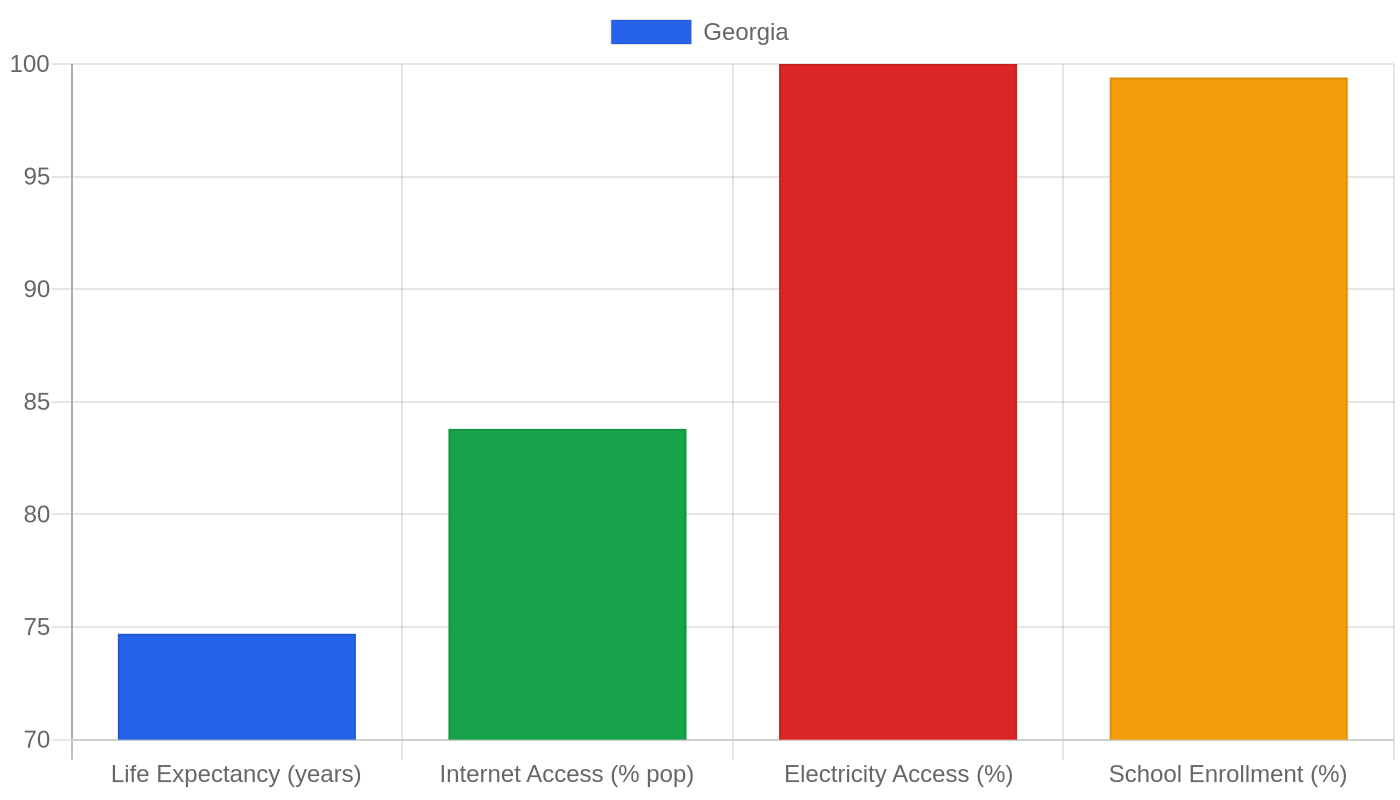
- Data Void: The latest comprehensive economic indicators from the World Bank for Georgia are currently unavailable, creating a significant gap in real-time macroeconomic visibility.
- Structural Ambiguity: With no current data on GDP growth, inflation, or unemployment, the precise state of the Georgian economy remains opaque to international investors and analysts.
- Sectoral Silence: Specific details regarding major industries, top corporations, and detailed cost-of-living metrics are not present in the provided dataset, limiting a granular analysis of the domestic market.
- Safety & Politics: Information regarding the political landscape, crime indices, and safety ratings is also absent from the current data set, necessitating a broader contextual approach rather than a statistical one.
The Macro-Economic Fog: A Look Through the Numbers
In the world of economic journalism, data is the oxygen that fuels analysis, yet for Georgia, the latest breath from the World Bank appears to have stalled.
Typically, a country’s economic health is measured by a triad of vital signs: Gross Domestic Product growth, Consumer Price Index (CPI) inflation, and unemployment rates.
For Georgia, all three of these critical metrics are currently listed as not available in the provided World Bank dataset.
This absence of data does not necessarily imply a collapse of the economy, but it does signal a period of statistical opacity where traditional forecasting models cannot be applied with standard confidence.
Without a clear GDP figure in US dollars or a per-capita purchasing power parity (PPP) estimate, it is difficult to gauge the absolute scale of the nation’s economic output or the real income levels of its citizens.
The population figure, which serves as the denominator for per-capita calculations, is also missing, further complicating any attempt to normalize economic performance against demographic trends.
In such a vacuum, the focus shifts from specific percentage points to the qualitative understanding of how economic policy is being implemented in the absence of transparent, up-to-date public reporting.
This situation highlights the critical importance of robust statistical bureaus and timely data dissemination for maintaining investor confidence and policy accountability.
The Price of Living: When Numbers Go Quiet
For residents and expatriates in Georgia, the cost of living is a daily reality that transcends macroeconomic abstracts.
However, the specific data points required to paint a vivid picture of housing costs, rental markets, and daily expenses are not included in the current dataset.
There is no information provided on the ratio of renting versus buying, nor are there specific figures for utilities, groceries, or transportation that would allow for a direct comparison with regional averages.
In the absence of these concrete figures, the narrative of the cost of living must remain grounded in general observation rather than statistical precision.
It is a reminder that while global indices track broad trends, the lived experience of economic stability is often measured in the affordability of a monthly mortgage or the price of a weekly grocery run.
Without current data, we cannot definitively state whether the burden of living costs is rising or falling, leaving this aspect of the economic landscape to be interpreted through anecdotal evidence rather than hard data.
Business Climate and Corporate Landscape
The business environment in Georgia is often viewed through the lens of its major corporations and key industrial sectors, yet the provided data offers no insight into the top companies operating within the country.
There are no details on specific industries that are driving growth, nor is there any information on the competitive landscape that defines the local market.
This gap in information makes it challenging to assess the resilience of the private sector or the potential for foreign direct investment in specific high-growth areas.
Investors typically look for signals from leading market participants to gauge sectoral health, but without a list of top companies or industry-specific performance data, the business climate remains a black box.
The lack of detailed corporate data suggests that the focus for current analysis must remain on broader structural policies rather than firm-specific performance metrics.
Safety, Politics, and the Quality of Life Equation
Quality of life is inextricably linked to both political stability and personal safety, two areas where the current data set provides no specific metrics.
The Crime Index and Safety Index, which are standard tools for assessing the physical security of a nation, are listed as not available.
Similarly, the political landscape, which dictates the regulatory environment and long-term stability, is described as N/A in the provided information.
This absence of data means we cannot quantify the level of political risk or the statistical likelihood of crime affecting daily life.
In a comprehensive economic feature, these factors are crucial because they influence the cost of doing business and the general well-being of the populace.
Without these specific indices, the assessment of Georgia’s quality of life must rely on a general understanding of the region’s dynamics rather than specific, verifiable statistical evidence.
Current Affairs: The Wait for Clarity
The most pressing issue for analysts and stakeholders is the immediate lack of updated data, which creates a sense of uncertainty in the current affairs narrative.
There are no recent news items, live indicators, or specific policy shifts provided in the dataset to discuss what is happening right now in terms of reforms, elections, or inflation trends.
This silence in the data feed is itself a story, suggesting a pause in the usual flow of economic reporting that can be unsettling for those tracking the market in real-time.
Without specific references to recent governmental actions, business developments, or social changes, the “now” in Georgia’s economic story is defined by the anticipation of new data.
The focus, therefore, is not on a specific event or policy announcement, but on the broader implications of a data gap in an increasingly transparent global economy.
The Bottom Line
Georgia presents a unique case study in economic analysis where the absence of data is as significant as the data itself.
For investors, policymakers, and journalists, the current landscape is one of cautious observation, where the lack of World Bank metrics, cost-of-living figures, and safety indices necessitates a more qualitative approach to understanding the country’s trajectory.
This is not a country to ignore, but one to watch with heightened attention for the next available statistical release that will clarify the economic situation.
The bottom line is that until new data emerges, the narrative of Georgia’s economy remains a work in progress, defined by potential rather than proof.
Sources & Methodology
This article is authored by Economic Pulse Net for informational and research purposes.
Economic Pulse Net sources its data from multilateral institutions, national statistics bureaus, and proprietary databases.
All data is believed to be current as of the date of publication. Published: September 02, 2026 |
Category: Research — Georgia
Use these signals in your own platform
Economic Pulse publishes its live signal feed through a documented, read-only API. Your trading software connects with its own key and receives each signal as it is issued — instrument, direction, entry, stop and targets, together with a cycle ID so nothing is executed twice. The feed is independent of this website and cannot change it.
Signals are informational only and are not financial advice.