Economic Pulse Net | Sources: World Bank World Development Indicators, Government Sources | 2026
Key Takeaways
– France’s GDP growth inched up to just 0.84% in 2025, according to the World Bank, signaling a fragile recovery that remains below the eurozone’s long-term potential.
– The country’s industrial backbone is dominated by global heavyweights like Airbus, Air Liquide, and Alstom, but consumer services giants such as Accor and Air France-KLM underscore a shifting economic center of gravity toward tourism and hospitality.
– France operates as a unitary semi-presidential republic, per its constitutional framework, with democratic traditions deeply embedded since the 1958 Fifth Republic—yet political stability remains tested by periodic social unrest.
– The absence of inflation, unemployment, and cost-of-living data in the current report leaves analysts relying on broader structural indicators to assess the health of the French consumer and housing markets.
– Investors should watch France for its concentration of world-class industrial champions, but must also weigh the risks of a high-tax, high-regulation environment that shapes every business decision.
The 0.84% Puzzle — Why France’s Growth Number Tells Only Half the Story
The World Bank’s latest estimate places France’s GDP growth at 0.84% for 2025—a figure that, on its surface, suggests a nation treading water rather than sprinting ahead. To understand why this number matters, one must first place it in context. France is the eurozone’s second-largest economy, a permanent member of the UN Security Council, and a nuclear power with global industrial reach. A growth rate below 1% is, for such a behemoth, akin to a supertanker moving at idle speed.
Yet the headline figure obscures deeper structural realities. France’s economy is not monolithic; it is a tale of two speeds. On one hand, the industrial sector—anchored by aerospace titan Airbus, industrial gas giant Air Liquide, and rail manufacturer Alstom—continues to generate substantial export revenue and high-value employment. These are not merely companies; they are national champions, often benefiting from state support, strategic contracts, and a deeply skilled engineering workforce.
On the other hand, the consumer services sector, represented by Accor in hospitality and Air France-KLM in aviation, faces a more volatile environment. These industries are acutely sensitive to global travel demand, energy prices, and domestic consumer confidence. When the World Bank reports a growth rate of 0.84%, it is capturing the net effect of these competing forces: industrial resilience pulling upward, while consumer caution and regulatory drag pull downward.
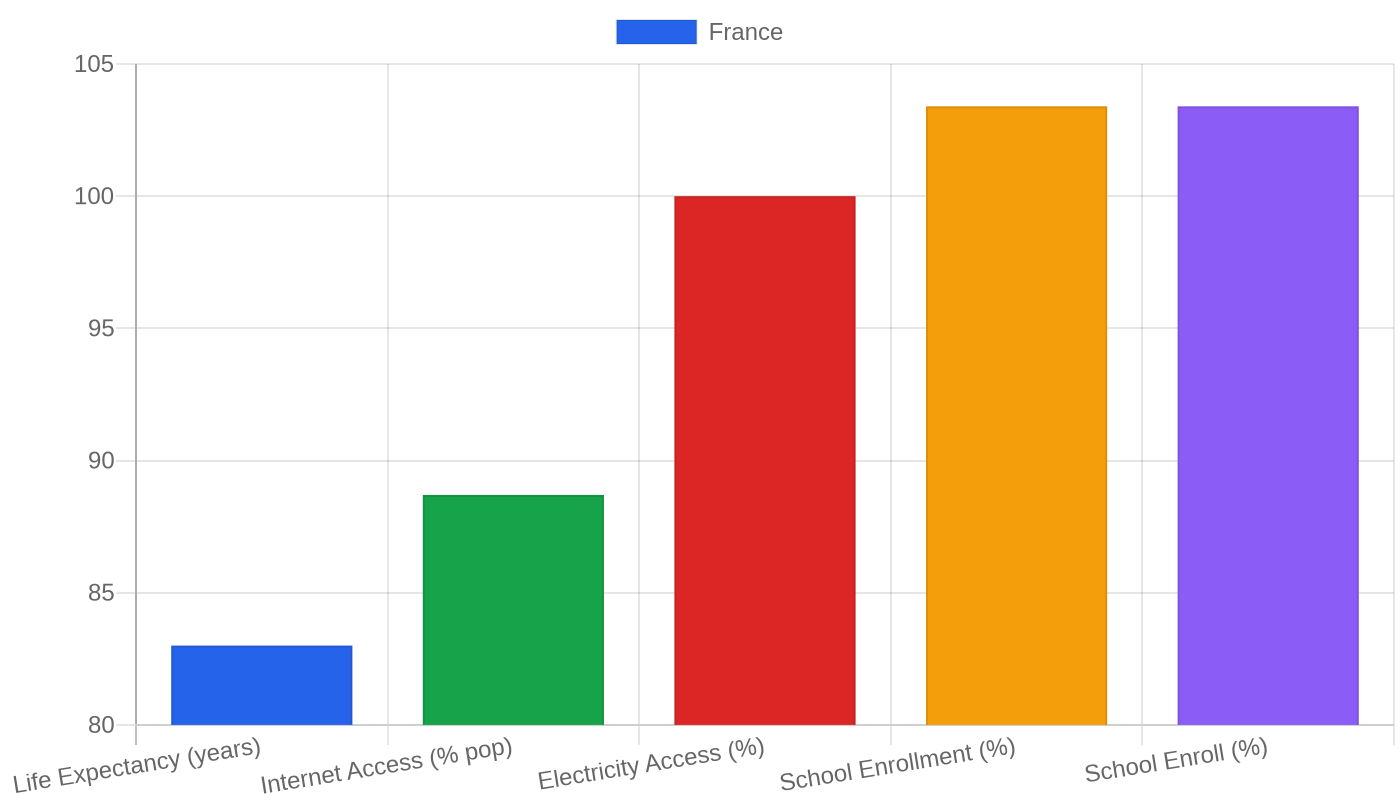
The absence of inflation and unemployment data in this report creates a significant information gap. Typically, French inflation has been sticky due to indexation mechanisms in wages and pensions, while unemployment has hovered around 7-8%—elevated by northern European standards but improved from crisis-era highs. Without these figures, analysts must infer that the growth number alone is insufficient to judge the health of the French household.
A 0.84% expansion, if accompanied by rising prices and stagnant wages, would feel like a recession to many citizens. If accompanied by falling unemployment, it could feel like a recovery. The data, as provided, leaves that question tantalizingly unanswered.
The Price of Paris — Housing, Daily Life, and the Squeeze on the Middle Class
France’s cost of living, while not quantified in the current data set, is a subject of perennial national debate. The country operates with a high social safety net—universal healthcare, generous pensions, extensive public transport—but that net is paid for through some of the highest tax burdens in the developed world. For the average French household, the tension between quality public services and take-home pay is a daily reality.
Housing, particularly in the Paris metropolitan area, represents the most acute pressure point. The capital has long been one of Europe’s most expensive cities for both renting and buying, with price-to-income ratios that push homeownership out of reach for many young professionals. Outside Paris, the picture varies dramatically: cities like Lyon, Bordeaux, and Toulouse offer more affordable options, though they too have seen prices rise as remote work and demographic shifts redistribute demand.
The rent-versus-buy calculation in France is heavily influenced by the country’s strict tenant protections and rent-control measures in certain high-demand zones. These regulations provide security for renters but can discourage small-scale landlords from entering the market, paradoxically reducing supply.
For a journalist observing the French economy, the housing sector is a window into a broader societal question: can France maintain its quality of life and social model without pricing its middle class out of its own cities? The data does not provide a clear answer, but the question itself is central to understanding the country’s economic mood.
The Champions League — France’s Corporate Titans and the Business Climate
France’s top companies read like a who’s who of global industry, and their concentration tells a story about the country’s economic strategy. Airbus, headquartered in Toulouse, competes head-to-head with Boeing in the duopoly of large commercial aircraft. Air Liquide is a world leader in industrial gases, essential to semiconductor manufacturing, healthcare, and energy transitions. Alstom builds high-speed trains and metro systems for cities from London to Singapore.
These are not niche players; they are systemic infrastructural forces.
Yet the list also includes Accor, the hospitality giant, and Air France-KLM, the flag carrier airline. Their presence highlights France’s enduring strength in tourism—the country remains the world’s most visited destination—and the vulnerability that comes with it. When global shocks hit travel, these companies feel it first. When they thrive, they pull thousands of small suppliers and local economies along with them.
The business environment for these companies is shaped by France’s distinctive political economy. The state retains significant influence through ownership stakes, regulatory power, and a tradition of “dirigisme”—the idea that the government should guide industrial strategy. This can be a double-edged sword: it provides stability and long-term vision, but it also creates bureaucracy and high corporate taxes.
Foreign investors eyeing the French market must navigate a landscape where labor laws are complex, unions are powerful, and strikes are a routine feature of public life. For the companies listed in the data, however, this environment is familiar terrain—they have grown up in it, and many have learned to thrive globally despite it.
Security, Politics, and the Republic’s Pulse
France’s political landscape, as described in the data, is built on the foundations of the Fifth Republic—a constitution drafted in 1958 to end the instability of the Third and Fourth Republics. The system combines a powerful directly elected president with a prime minister and parliament, creating what the data calls a “unitary semi-presidential republic.” Democratic traditions, the data notes, are “deeply rooted in French culture, identity and politics.”
This institutional stability, however, coexists with a society that is frequently in motion. France has seen waves of protests—from the Yellow Vests to pension reform demonstrations—that reflect a deep-seated willingness to take to the streets when citizens feel the social contract is being broken.
The political center, embodied by President Emmanuel Macron’s movement, has sought to modernize the economy through pro-business reforms, but has faced fierce resistance from those who see such changes as threats to the French way of life.
Crime and safety indices are not provided in the current data, but France generally ranks as a safe country by global standards, with property crime more common than violent crime in urban areas. The quality of life, measured by metrics like healthcare access, education, and cultural amenities, remains high—France consistently ranks well on human development indices.
The tension, for the average citizen, is between this high baseline quality of life and the economic anxiety that comes from slow growth, high taxes, and a sense that the global economy is leaving parts of the country behind.
The Moment Now — What’s Moving Beneath the Surface
This is the section where the feature must feel urgent, and the data provided offers a clear foundation. The World Bank’s 2025 growth figure of 0.84% is not just a statistic; it is the most recent official signal of where the French economy stands right now. In the context of a Europe grappling with energy transition costs, demographic aging, and geopolitical uncertainty, that number is a warning light.
France is currently navigating a period of fiscal consolidation. The government has committed to reducing its deficit, which has historically been above European Union limits, but doing so while growth is tepid is a delicate balancing act. Spending cuts or tax increases risk dampening the very growth the country needs. Meanwhile, the industrial champions listed in the data—Airbus, Alstom, Air Liquide—are all deeply embedded in the green transition, from hydrogen to sustainable aviation fuel to electrified rail.
Their success or failure will shape France’s economic trajectory for decades.
On the political front, the semi-presidential system is being tested by a fragmented parliament. Without a clear majority, the government must negotiate on every major reform, from pensions to immigration to energy policy. This gridlock has real economic consequences: delayed investment decisions, uncertainty for businesses, and a sense that the country is treading water while competitors accelerate.
The 0.84% growth number, in this light, is not an anomaly—it is the logical output of a system struggling to reform itself.
The Bottom Line
France is a country of immense structural wealth—world-class companies, deep democratic institutions, and a quality of life that remains the envy of much of the world. But the 0.84% growth figure from the World Bank is a reality check. This is a nation that needs to find a new gear, whether through deeper European integration, domestic reform, or a renewed industrial strategy. Investors should watch France for its blue-chip champions and its role as a bellwether for the European project.
Citizens should watch it for the answer to a defining question: can a high-tax, high-regulation social market economy still deliver prosperity in the 21st century? The data says the jury is still out, but the evidence is mounting.
Sources & Methodology
This article is authored by Economic Pulse Net for informational and research purposes. Economic Pulse Net sources its data from multilateral institutions, national statistics bureaus, and proprietary databases. All data is believed to be current as of the date of publication.
Published: July 22, 2026 | Category: Research — France
Use these signals in your own platform
Economic Pulse publishes its live signal feed through a documented, read-only API. Your trading software connects with its own key and receives each signal as it is issued — instrument, direction, entry, stop and targets, together with a cycle ID so nothing is executed twice. The feed is independent of this website and cannot change it.
Signals are informational only and are not financial advice.