Economic Pulse Net | Sources: World Bank World Development Indicators, Government Sources | 2026
Key Takeaways
– Denmark’s economy is expanding at a robust 2.93% GDP growth rate (World Bank, 2025), outpacing most of its European peers and demonstrating remarkable post-inflation resilience.
– Inflation has cooled to a manageable 1.89%, giving Danish households breathing room after a period of global price shocks.
– The country maintains a 5.53% unemployment rate — a figure that reflects a tight, competitive labour market with strong worker protections.
– With a GDP per capita (PPP) of $83,218, Denmark ranks among the wealthiest nations on Earth, underpinned by a diversified industrial base ranging from pharmaceuticals to consumer goods.
– A stable constitutional monarchy with a parliamentary system provides the political predictability that investors and citizens have come to expect from Scandinavia’s southernmost nation.
The Danish Engine — Growth, Prices, and the Jobs Machine
The headline numbers from the World Bank tell a story of quiet confidence. Denmark’s economy expanded by 2.93% in 2025, a figure that would make many larger European economies envious. This growth is not accidental; it is the product of a sophisticated, export-oriented economy that has successfully navigated the turbulent waters of recent global economic disruption.
When inflation peaked across the continent, Denmark’s **1.89% CPI reading** now signals a return to price stability, allowing the central bank to focus on supporting growth rather than fighting fires.
The labour market remains a cornerstone of the Danish model. With unemployment at 5.53%, the country sits in a “Goldilocks” zone — low enough to indicate full employment and high wages, yet with enough flexibility to allow companies to hire without triggering wage-price spirals. This is the famous “flexicurity” model in action: employers can adjust their workforce with relative ease, while generous social benefits protect workers in transition.
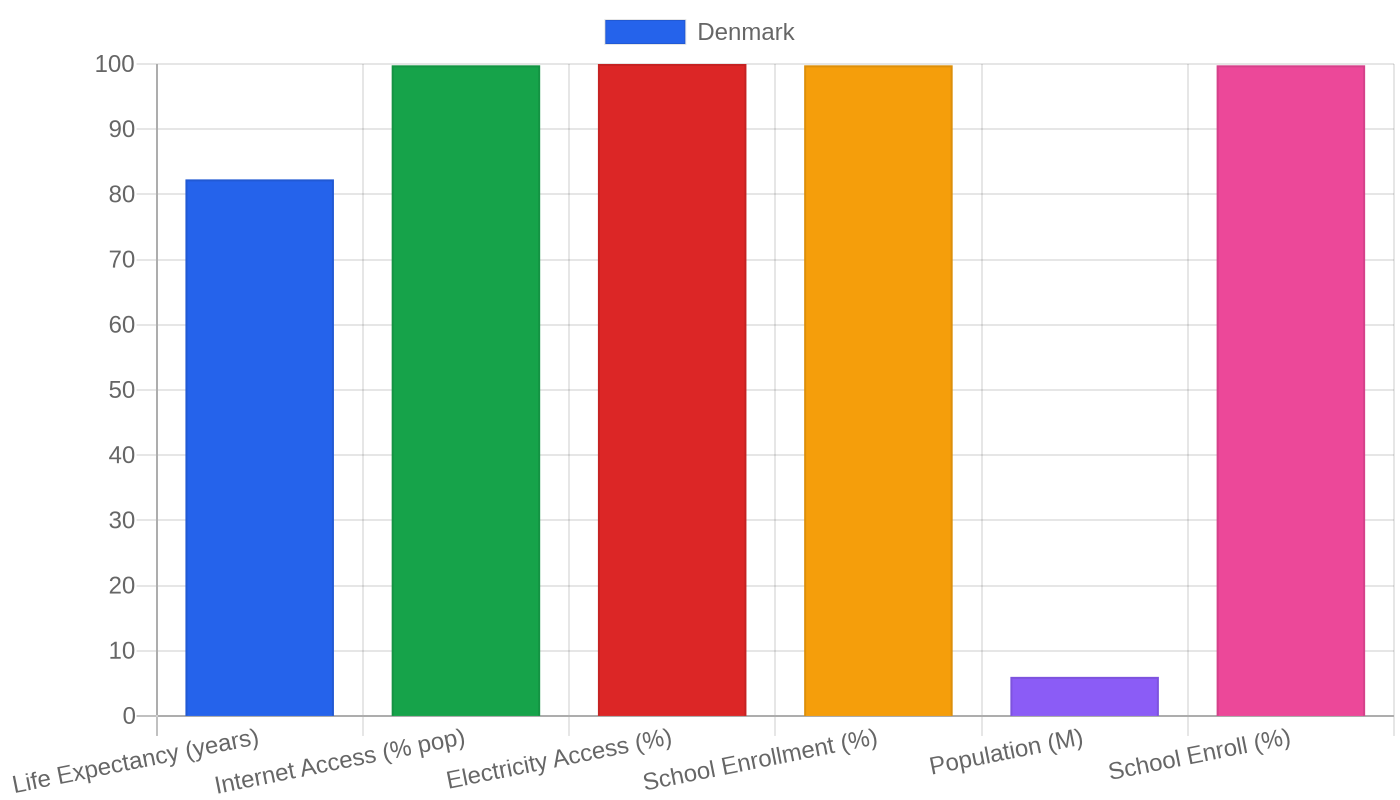
Denmark’s total GDP of $462.5 billion supports a population of just over **6 million people**, translating to a per capita income of **$77,190 (GNI)** and an impressive **$83,218 in GDP per capita (PPP)**. These figures place Denmark firmly in the top tier of global prosperity, and they explain why the country consistently ranks among the most competitive and innovative economies in the world.
The industrial base is broad and sophisticated — from pharmaceutical giants like **ALK-Abelló** and **Ambu** in health care, to consumer powerhouses like **Arla Foods** and **Bang & Olufsen** in consumer goods.
The Price of Danish Living — Housing, Costs, and Quality of Life
Denmark is famously expensive, and the cost of living reflects the country’s high wages, generous welfare state, and commitment to quality. Housing, particularly in Copenhagen, commands a significant premium — both for purchase and rental. The gap between renting and buying has narrowed in recent years as property values have climbed steadily, making homeownership an increasingly attractive long-term investment for those who can secure financing.
Daily expenses for groceries, transportation, and dining out are among the highest in Europe. However, these costs are offset by a comprehensive social safety net that includes universal healthcare, free education, and extensive public services. When comparing Denmark to its regional neighbours, the price levels are broadly similar to other Nordic capitals, though the overall package — what you get for your money — is arguably superior in terms of public infrastructure and services.
The Danish approach to urban planning means that even expensive cities offer excellent public transport, green spaces, and cycling infrastructure, reducing the need for car ownership and its associated costs. For expatriates and locals alike, the high cost of living is a trade-off: you pay more, but you receive a standard of living and social cohesion that is difficult to match elsewhere.
Where the Money Moves — Investment and Business Climate
Denmark’s corporate landscape is a fascinating mix of global giants and innovative mid-caps. The top companies list reveals a sophisticated economy with strength across multiple sectors. **Alectia** and **Arkitema Architects** represent the industrials and engineering sector, pointing to Denmark’s strengths in infrastructure and sustainable design.
The health care sector is particularly robust, with **ALK-Abelló**, **Ambu**, and **ALK** leading in pharmaceuticals and medical devices — a sector that has proven resilient regardless of economic cycles.
Consumer goods and services are equally well represented. Arla Foods is a global dairy cooperative with international reach, while **Bang & Olufsen** continues to command premium pricing in audio equipment. **Bestseller A/S** operates in the fast-fashion space, and **Arp-Hansen Hotel Group** capitalises on Copenhagen’s booming tourism sector. The financial system, anchored by **Alm. Brand**, provides stability and capital for expansion.
For foreign investors, Denmark offers a transparent regulatory environment, low corruption, and a highly educated workforce. The country’s commitment to green technology and sustainability creates opportunities in renewable energy, clean transportation, and circular economy initiatives.
The business climate is characterised by digital sophistication — Denmark is consistently ranked among the most digitised nations, with a government that actively supports innovation through research funding and tax incentives for R&D.
Safe, Stable, and Content — The Danish Social Contract
Denmark’s political system is a constitutional monarchy with a parliamentary framework, first established in 1849. The monarch’s role is today strictly ceremonial, with executive power exercised by the Prime Minister and cabinet, all accountable to the Folketing, the unicameral parliament. This institutional stability provides a predictable environment for business and a reassuring backdrop for citizens.
The safety situation in Denmark is exemplary. While specific crime indices are not available in the current data, the country’s reputation for safety is well-established and reflected in its consistently high rankings in global peace and security indices. Violent crime is rare, and the police force is professional and trusted.
This sense of security extends beyond crime statistics to encompass social safety — Denmark’s welfare state ensures that few fall through the cracks, reducing the desperation that often fuels criminality.
Quality of life in Denmark extends beyond material wealth. The country’s famous “hygge” culture — a concept of cosy contentment — reflects a society that values work-life balance, community, and well-being. The Danish model of social trust, where citizens have high confidence in each other and in public institutions, creates an environment where people feel secure enough to take entrepreneurial risks and pursue ambitious goals.
What’s Happening Right Now — Denmark in 2026
The current moment in Denmark is one of cautious optimism tempered by global uncertainties. The 2.93% GDP growth figure for 2025 indicates an economy firing on all cylinders, but the government remains vigilant about external headwinds — supply chain disruptions, energy prices, and geopolitical tensions in Europe all pose potential risks.
Inflation at 1.89% gives policymakers room to manoeuvre, and there is growing discussion about how to channel Denmark’s prosperity into long-term investments in green infrastructure, digital transformation, and education. The pharmaceutical and health care sectors continue to expand, driven by global demand for Danish innovation in treatments and medical devices.
The labour market remains tight, with unemployment at 5.53%, and businesses report difficulty finding skilled workers — a challenge that has sparked debate about immigration policy and workforce development. The government is actively promoting vocational training and lifelong learning to address skills gaps.
Consumer confidence is buoyant, supported by rising real wages and stable prices. The housing market in Copenhagen remains competitive, with demand outstripping supply in desirable neighbourhoods. Meanwhile, Denmark continues to position itself as a leader in the green transition, with ambitious targets for renewable energy and carbon neutrality that are attracting international attention and investment.
The Bottom Line
Denmark is a country that has mastered the art of steady, sustainable progress. For investors, it offers a stable, transparent, and innovative business environment with exposure to high-growth sectors like pharmaceuticals and green technology. For policymakers, it provides a model of how social welfare and economic dynamism can coexist. And for anyone interested in how a small, open economy navigates global challenges while maintaining domestic harmony, Denmark in 2026 is a case study worth watching closely.
The numbers are strong, the institutions are solid, and the future — while never certain — looks characteristically Danish: measured, confident, and bright.
Sources & Methodology
This article is authored by Economic Pulse Net for informational and research purposes. Economic Pulse Net sources its data from multilateral institutions, national statistics bureaus, and proprietary databases. All data is believed to be current as of the date of publication.
Published: August 01, 2026 | Category: Research — Denmark
Use these signals in your own platform
Economic Pulse publishes its live signal feed through a documented, read-only API. Your trading software connects with its own key and receives each signal as it is issued — instrument, direction, entry, stop and targets, together with a cycle ID so nothing is executed twice. The feed is independent of this website and cannot change it.
Signals are informational only and are not financial advice.