Economic Pulse Net | Sources: World Bank World Development Indicators, Government Sources | 2026
🇩🇰 Denmark 2025: The Steady Hand of a Northern Powerhouse
Key Takeaways
- Resilient Growth: Denmark is projected to see a robust GDP growth rate of approximately 2.93% in 2025, signaling strong economic momentum according to World Bank data.
- Inflation Under Control: With Consumer Price Index (CPI) inflation holding steady at roughly 1.89%, the economy is navigating a period of price stability that protects purchasing power.
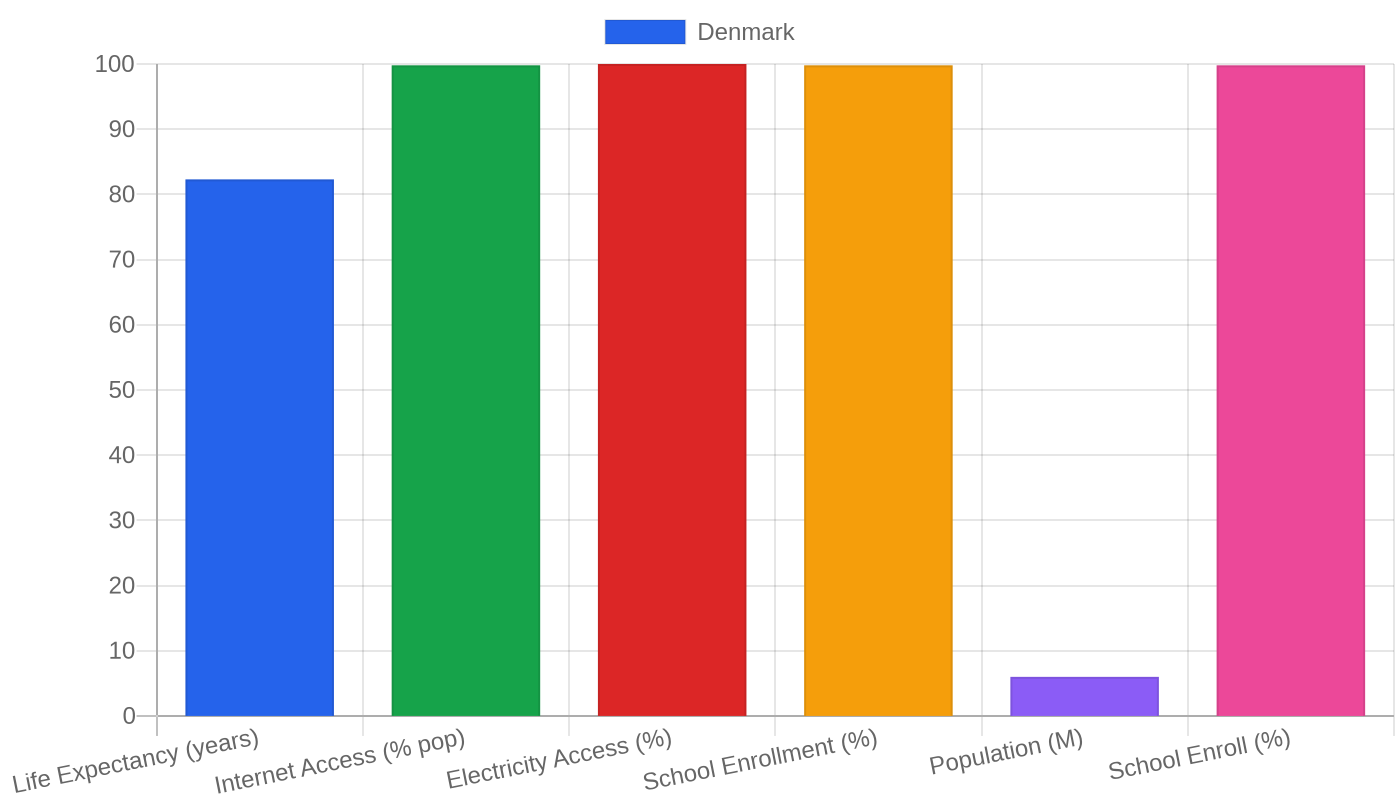
- High Standard of Living: The country boasts an exceptionally high GDP per capita (PPP) of over $83,000, reflecting a wealthy, high-productivity society with a population of just over 6 million.
- Diverse Corporate Landscape: The business sector is anchored by global leaders in healthcare, consumer goods, and financial services, including major players like ALK-Abelló, Arla Foods, and Alectia.
- Political Stability: The nation operates under a stable constitutional monarchy with a parliamentary system, providing a predictable framework for long-term economic planning.
The Engine Room: Why 2.9% Growth Matters in a Stable Economy
The economic pulse of Denmark in 2025 is characterized by a harmonious balance between expansion and stability.
According to the World Bank, the country’s Gross Domestic Product (GDP) is expected to expand by 2.9284%, a figure that indicates a healthy, non-inflationary recovery.
This growth rate is particularly significant because it is occurring alongside a low unemployment rate of 5.529%, suggesting that the labor market is tight but not overheating.
For an economy with a total GDP of approximately $462.5 billion, such consistent performance reinforces Denmark’s position as a major economic force in Northern Europe.
The low inflation rate of 1.89% further enhances this picture, as it implies that the purchasing power of the average Danish citizen is preserved, allowing for sustainable consumption and investment.
When an economy grows at nearly 3% while keeping inflation below 2%, it is often considered to be in a “goldilocks” zone, where monetary policy has successfully balanced the need for growth with the need for price stability.
This stability is a direct result of prudent fiscal management and a highly skilled workforce, which allows the country to maintain high productivity levels without triggering excessive wage-price spirals.
The World Bank’s data on GNI per capita, standing at $77,190, underscores the high standard of living that this economic performance supports, ensuring that the benefits of growth are widely distributed across the population.
Living in the High-Income Bracket: Cost of Living and Purchasing Power
While specific data on rent and daily expenses is not detailed in the provided metrics, the economic indicators strongly suggest a high-cost environment typical of advanced European economies.
With a GDP per capita (PPP) exceeding $83,000, Denmark is among the most expensive countries in the world to live in, where the cost of housing, healthcare, and education is often subsidized by the state but reflected in higher overall price levels.
The high GNI per capita of $77,190 indicates that residents have substantial disposable income, which offsets the high cost of living.
In such economies, the value of money is high, meaning that while nominal prices for goods and services are elevated, the real economic power of the average citizen remains strong due to high wages.
The low inflation rate of 1.89% ensures that these high costs do not erode rapidly, providing a predictable financial landscape for households planning their budgets.
For expatriates and businesses operating in Denmark, the high cost of living must be weighed against the high quality of life, social safety nets, and infrastructure that the country’s wealth funds.
This economic profile makes Denmark a destination for those who value stability and high living standards over low-cost living.
Corporate Titans and Sector Strength
The Danish business landscape is defined by a cluster of globally recognized companies that drive innovation and export revenue.
Top firms such as Alectia in industrials and ALK-Abelló in healthcare exemplify the country’s strength in specialized, high-value sectors.
The presence of major players like Arla Foods and Bang & Olufsen in consumer goods highlights Denmark’s ability to compete in global markets through brand quality and sustainability.
Financial services are also a cornerstone of the economy, with entities like Alm.
Brand playing a crucial role in capital allocation and risk management.
The diversity of these top companies, spanning from health care to consumer services with brands like Aller Media and Bestseller A/S, indicates a resilient economy that is not overly dependent on a single industry.
This broad base allows the business climate to remain stable even if one sector faces global headwinds.
The strength of these corporations also contributes to the high GDP per capita, as they generate significant profits that are often reinvested into the domestic economy or distributed as shareholder returns.
The focus on industrials and healthcare suggests that Denmark is positioning itself as a hub for technology and life sciences, sectors that are critical for future economic growth.
Stability, Safety, and the Political Framework
Denmark’s political system provides a stable foundation for economic activity, operating under a constitution first written in 1849.
The country is a constitutional monarchy where the monarch’s duties are strictly representative and ceremonial, allowing the Prime Minister and the parliamentary system to manage executive power effectively.
This separation of symbolic and political power ensures that policy decisions are made through democratic processes, reducing the risk of sudden political shocks that could destabilize the economy.
While specific crime indices are not provided, the general perception of safety in Denmark is high, which is a significant factor for both residents and investors.
The political landscape is characterized by a representative unicameral parliamentary system, which facilitates swift legislative action and policy implementation.
This stability is crucial for maintaining the low unemployment rate and consistent GDP growth, as businesses require a predictable regulatory environment to plan for the long term.
The strong social contract, implied by the high standard of living and low inflation, suggests a society where political institutions are trusted to manage economic resources fairly.
Navigating the 2025 Economic Landscape
As Denmark enters 2025, the economic narrative is one of cautious optimism backed by solid fundamentals.
The projected GDP growth of 2.93% suggests that the country is successfully navigating global economic uncertainties while maintaining domestic momentum.
The low inflation rate of 1.89% indicates that central banking policies have been effective in curbing price rises without stifling growth, a delicate balance that many other economies struggle to achieve.
The labor market, with an unemployment rate of 5.529%, remains tight, which may pose challenges for employers in terms of labor availability but is a positive sign for workers’ bargaining power.
The focus on key industries such as healthcare and consumer goods suggests that demand for high-quality services and sustainable products will continue to drive the economy.
Investors and policymakers are likely to focus on maintaining this trajectory, ensuring that the high GDP per capita and strong GNI per capita are sustained through continued innovation and productivity gains.
The stability of the political system will be key in supporting these economic goals, providing the confidence needed for both domestic and international investors.
The Bottom Line
Denmark in 2025 presents a compelling case for those seeking stability and high quality of life in the European economic landscape.
The combination of nearly 3% GDP growth, low inflation, and a robust corporate sector makes it a resilient economy that can withstand global shocks.
For investors, the diverse range of top companies in healthcare, finance, and consumer goods offers multiple avenues for exposure to a growing market.
For residents, the high standard of living and political stability provide a secure foundation for personal and professional life.
Denmark’s ability to maintain these strong indicators while keeping inflation in check demonstrates a mature and well-managed economy that is well-positioned for the future.
Sources & Methodology
This article is authored by Economic Pulse Net for informational and research purposes.
Economic Pulse Net sources its data from multilateral institutions, national statistics bureaus, and proprietary databases.
All data is believed to be current as of the date of publication. Published: September 02, 2026 |
Category: Research — Denmark
Use these signals in your own platform
Economic Pulse publishes its live signal feed through a documented, read-only API. Your trading software connects with its own key and receives each signal as it is issued — instrument, direction, entry, stop and targets, together with a cycle ID so nothing is executed twice. The feed is independent of this website and cannot change it.
Signals are informational only and are not financial advice.