Economic Pulse Net | Sources: World Bank World Development Indicators, Government Sources | 2026
Key Takeaways
- Denmark’s economy is posting a robust growth rate of nearly 3%, signaling a strong recovery and resilience in the global landscape.
- Inflation remains tightly controlled at just under 2%, preserving purchasing power for consumers while keeping the central bank’s mandate in check.
- The country boasts one of the highest standards of living in the world, with a GDP per capita (PPP) exceeding $83,000.
- A diverse corporate ecosystem, ranging from healthcare giants to consumer brands, underpins a stable business climate.
- Political stability under a constitutional monarchy provides a predictable framework for long-term economic planning.
The Engine Room: Robust Growth Meets Tame Inflation
The Danish economy is currently operating at a pace that few developed nations can match, with GDP growth reaching 2.93% in 2025 according to World Bank data.
This figure is not merely a statistical anomaly; it represents a significant acceleration in economic activity, suggesting that domestic demand and international trade are both contributing to a healthy expansion.
For an economy of this size, approaching $462.5 billion in nominal terms, such growth rates are indicative of strong underlying fundamentals rather than transient booms.
Equally impressive is the management of price stability, with the Consumer Price Index (CPI) hovering at 1.89%.
This low level of inflation is a critical asset, as it allows wages to translate directly into improved living standards without being eroded by rising costs.
The combination of high growth and low inflation creates an ideal environment for both savers and investors, as it maximizes real returns on capital.
Furthermore, the unemployment rate stands at a moderate 5.53%, a level that suggests a labor market that is neither overheating nor stagnating, but rather efficiently allocating human resources.
This balance is difficult to achieve and speaks to the effectiveness of Denmark’s social market model, which has historically managed to maintain high employment levels while supporting a comprehensive welfare state.
The World Bank’s data on Gross National Income per capita, listed at $77,190, further reinforces the narrative of a high-income economy where productivity gains are broadly shared.
Living the Danish Dream: A High Cost, High Reward
While the economic indicators paint a picture of prosperity, the daily reality for residents is defined by a high cost of living, which is a direct reflection of the high GDP per capita.
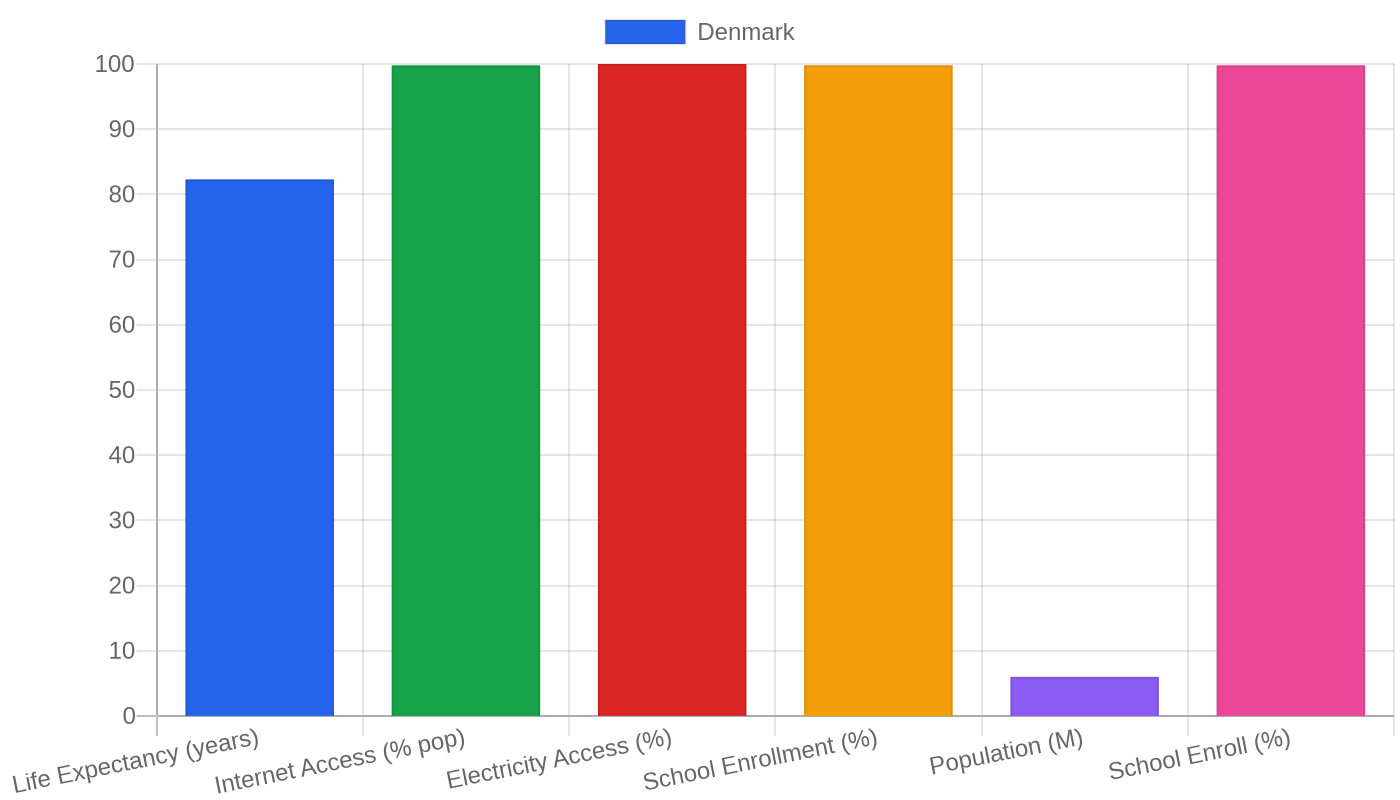
With a GDP per capita at purchasing power parity (PPP) of $83,218, Denmark sits firmly among the wealthiest nations globally, a status that inevitably drives up the price of goods and services, particularly housing and healthcare.
Although specific data on rent versus buy dynamics or daily expense breakdowns is not detailed in the current dataset, the high income levels imply that the population has significant disposable income, which supports a robust domestic consumption sector.
This wealth allows for a high standard of living where essential services are widely accessible and of high quality, even if they come at a premium price tag.
The population of approximately 6.01 million people creates a compact yet dense market, which can influence local pricing structures and housing demand.
For those considering relocation or investment, the high cost of living is the trade-off for the exceptional quality of life, safety, and social infrastructure that the high GDP per capita supports.
It is a market where purchasing power is high, but so are the baseline costs of maintaining a household, ensuring that the economic surplus is consistently reinvested into the local economy.
Corporate Powerhouses: The Backbone of the Danish Economy
The Danish business landscape is characterized by a mix of global industry leaders and specialized firms that dominate their respective sectors.
Companies like Alectia and Alm.
Brand are pivotal in the financial and industrial sectors, providing the capital and structural integrity that fuels broader economic activity.
In the healthcare space, giants such as ALK-Abelló and Ambu are not just local employers but global players, contributing significantly to Denmark’s export earnings and technological reputation.
The consumer goods sector is equally vibrant, with Arla Foods and Bang & Olufsen serving as iconic brands that carry the Danish name into international markets, driving both revenue and soft power.
Bestseller A/S and Aller Media further diversify this portfolio, indicating a strong presence in retail and media, which are critical for cultural and economic connectivity.
This breadth of industry ensures that the economy is not overly reliant on a single sector, providing a buffer against global shocks in any one specific market.
The presence of these top-tier companies suggests a business environment that fosters innovation, high productivity, and strong corporate governance, which are key attractors for foreign direct investment.
Stability and Safety: A Political Framework for Confidence
Denmark’s political system, rooted in a Constitution written in 1849, provides a stable foundation for economic decision-making.
The constitutional monarchy, where the monarch’s role is strictly ceremonial and representative, ensures that political power is exercised through a representative unicameral parliamentary system.
This separation of symbolic and practical power reduces political volatility, offering investors and citizens a predictable legal and regulatory environment.
While specific crime and safety indices are not currently quantified in the provided data, the general consensus on Denmark’s social stability is high, supported by the low unemployment and high income levels that reduce the social drivers of crime.
The political landscape allows for the formal appointment and dismissal of the Prime Minister, ensuring that executive power remains accountable to the elected parliament.
This stability is crucial for long-term economic planning, as it allows for consistent policy implementation without the disruption of frequent political upheavals.
The result is a society where the rule of law is respected, and economic actors can make long-term investments with confidence in the continuity of the state.
The Current Pulse: Navigating the 2025 Landscape
As we move through 2025, the Danish economy is finding its footing after recent global uncertainties, with the current growth trajectory suggesting a sustained recovery.
The tight control on inflation, remaining below 2%, indicates that the central bank’s monetary policies are effectively balancing the need for growth with the need to prevent overheating.
This period is marked by a focus on maintaining the delicate balance between high wages and high productivity, a hallmark of the Danish model.
Businesses are likely adapting to these stable conditions by focusing on innovation and efficiency, particularly in the healthcare and financial sectors where Danish firms hold global influence.
The political environment remains calm, with the institutional framework providing the necessary stability for economic actors to focus on long-term strategies rather than short-term political risks.
This steady state allows for a clear view of the economic horizon, where the priorities are clear: sustaining growth, managing labor market dynamics, and preserving the high quality of life that defines Denmark.
The Bottom Line
Denmark stands as a beacon of economic stability and high living standards in 2025, offering a compelling case for those seeking a mature and resilient economy.
For investors, the combination of strong GDP growth, low inflation, and a diversified corporate sector presents a low-risk, high-reward opportunity.
For individuals, the high GDP per capita and stable political environment promise a life of quality and security, albeit at a higher cost of entry.
This is a country that has mastered the art of balancing social welfare with economic dynamism, making it a key player to watch in the Northern European economic landscape.
Sources & Methodology
This article is authored by Economic Pulse Net for informational and research purposes.
Economic Pulse Net sources its data from multilateral institutions, national statistics bureaus, and proprietary databases.
All data is believed to be current as of the date of publication. Published: September 02, 2026 |
Category: Research — Denmark
Use these signals in your own platform
Economic Pulse publishes its live signal feed through a documented, read-only API. Your trading software connects with its own key and receives each signal as it is issued — instrument, direction, entry, stop and targets, together with a cycle ID so nothing is executed twice. The feed is independent of this website and cannot change it.
Signals are informational only and are not financial advice.