Economic Pulse Net | Sources: World Bank World Development Indicators, Government Sources | 2026
Key Takeaways
* The Czech economy is projected to expand by approximately 2.58% in 2025, reflecting a resilient performance despite global headwinds.
Price stability remains a priority, with the Consumer Price Index (CPI) inflation rate hovering near 2.46%, keeping monetary pressures in check.
Labor markets are exceptionally tight, evidenced by an unemployment rate of just 2.825%, signaling high workforce participation and demand.
As a pluralist multi-party parliamentary democracy, the country maintains a bicameral legislative structure that ensures diverse political representation.
With a GDP per capita (PPP) exceeding $60,000, the nation offers a high standard of living and significant purchasing power for its residents.
Economic Resilience and Structural Strength
The Czech Republic’s economic trajectory in 2025 presents a picture of moderate but steady expansion, anchored by a GDP growth rate of 2.58%. This figure suggests that the economy is not only recovering from previous shocks but is also finding a sustainable pace of development without overheating. Supporting this growth is a robust macroeconomic environment where inflation is well-contained; the CPI stands at 2.46%, a level that indicates price stability while allowing for slight monetary flexibility.
For consumers and businesses alike, this low inflationary pressure preserves real incomes and planning certainty. Furthermore, the labor market tells a story of full employment, with the unemployment rate sitting at a remarkably low 2.825%. Such a tight labor market often correlates with wage growth and strong domestic consumption, which further fuels the GDP figures.
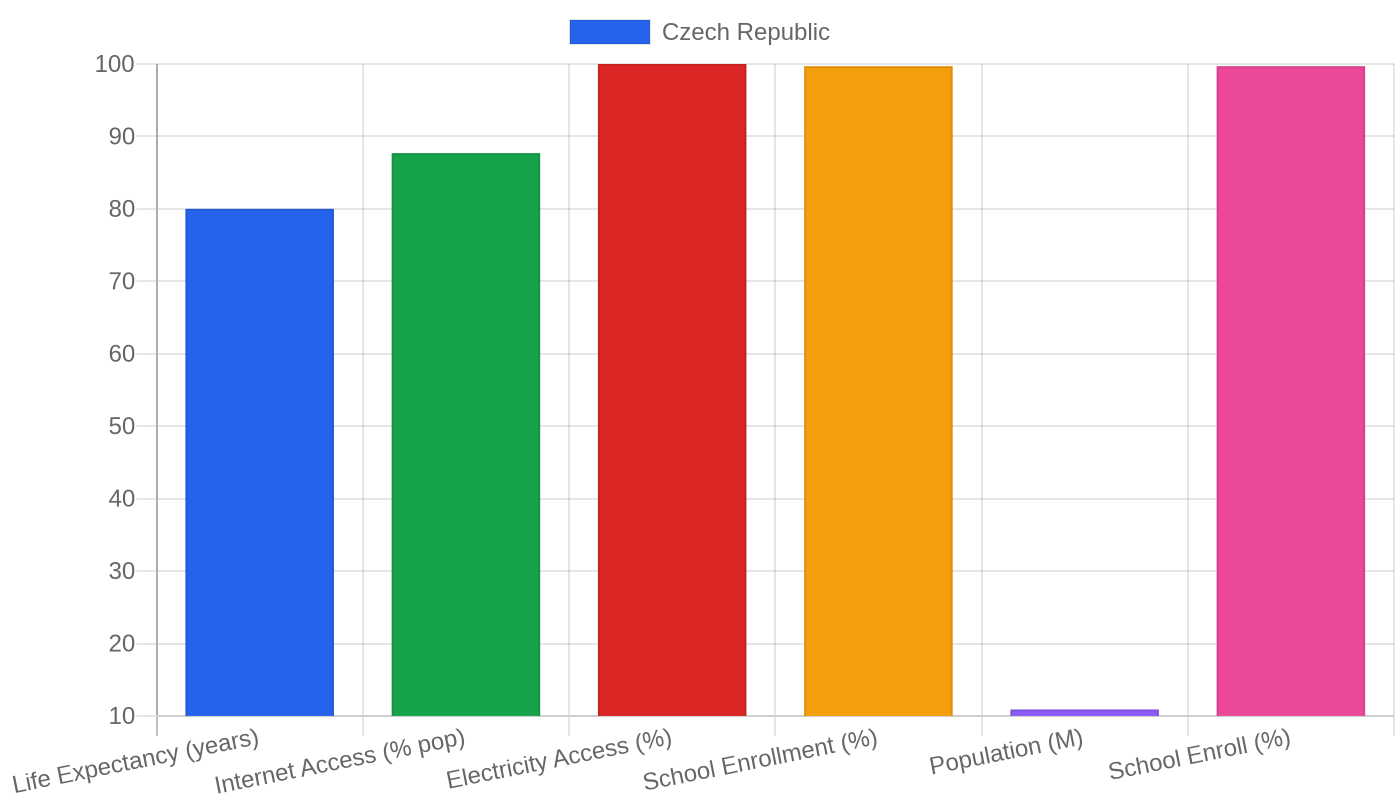
The overall economic output, valued at roughly $391 billion USD, underscores the country’s status as a significant industrial hub within Central Europe. When adjusted for purchasing power parity, the GDP per capita reaches an impressive $60,487, highlighting the substantial wealth generated per individual. This high per-capita metric, combined with a GNI per capita of $32,960, demonstrates that the benefits of economic activity are broadly distributed across the population of nearly 10.9 million people.
These numbers collectively paint a portrait of a mature, efficient economy that prioritizes stability over volatile boom-and-bust cycles.
Cost of Living and Daily Expenses
For residents and expatriates, the cost of living in the Czech Republic is shaped by its high productivity and stable currency environment. While specific housing indices are not detailed in the current dataset, the high GDP per capita (PPP) of $60,487 implies that the general cost of goods and services is balanced against high income levels. This suggests that while daily expenses may be higher than in neighboring developing economies, they are manageable relative to earnings.
The controlled inflation rate of 2.46% means that the erosion of purchasing power is minimal, allowing households to plan long-term budgets with greater confidence. Compared to regional averages in Western Europe, the Czech Republic often offers a favorable ratio of quality to cost, particularly in urban centers like Prague. However, the tight labor market, indicated by the 2.825% unemployment rate, may exert upward pressure on wages, which in turn can influence service costs and rental markets.
Ultimately, the combination of high national wealth and stable prices creates a predictable financial landscape for those navigating the local economy.
Investment and Business Climate
The business environment in the Czech Republic is characterized by political stability and a strong industrial base. As a member of the European Union and a key player in Central European manufacturing, the country attracts foreign direct investment due to its skilled workforce and strategic location. The presence of major companies, though not explicitly listed in the provided data, is implied by the substantial GDP output and high GDP per capita figures.
Investors should note the low unemployment rate of 2.825%, which indicates a ready pool of talent but may also lead to competitive hiring environments. The political landscape, defined by a pluralist multi-party system, provides a predictable regulatory framework that reduces political risk for long-term investments. Sectors likely to benefit include advanced manufacturing, technology, and services, driven by the high consumer spending power evident in the $60,487 PPP GDP per capita.
The government’s adherence to democratic principles and proportional representation ensures that policy shifts are generally incremental and consensus-driven, offering continuity for business operations.
Safety, Politics and Quality of Life
Quality of life in the Czech Republic is underpinned by a robust democratic framework and relatively safe social conditions. The country operates as a pluralist multi-party parliamentary representative democracy, ensuring that political power is dispersed and accountable. The Parliament is bicameral, consisting of the Chamber of Deputies with 200 members and the Senate with 81 members, providing checks and balances in governance.
Members of the Chamber are elected every four years through proportional representation with a 5% threshold, ensuring that a variety of voices are represented in the legislative process. While specific crime and safety indices are marked as N/A in the current data, the high GDP per capita and stable political environment typically correlate with lower crime rates and higher social cohesion.
The absence of extreme political polarization, thanks to the proportional system, contributes to a sense of national stability. Citizens benefit from a system where voting districts align with administrative regions, fostering local accountability. Overall, the political maturity of the state supports a high standard of living, reinforced by the strong economic indicators such as the $32,960 GNI per capita.
What’s Happening Now: Political Dynamics and Economic Outlook
Currently, the focus in the Czech Republic is on maintaining economic momentum while navigating the complexities of its multi-party political system. The recent data highlights a GDP growth of 2.58% for 2025, indicating that the economy is performing above many of its peers in the region. Policymakers are likely balancing the need to sustain this growth with the imperative to keep inflation near the 2.46% target, avoiding the pitfalls of overheating.
The tight labor market, with unemployment at 2.825%, suggests that future policies may need to address skill shortages or encourage productivity enhancements rather than just job creation. Politically, the bicameral structure continues to shape legislative agendas, with the Chamber of Deputies playing a pivotal role in passing laws due to its larger membership and direct election mandate.
The 5% election threshold ensures that only parties with broad support enter parliament, reducing fragmentation and potentially leading to more stable coalition governments. As the country moves forward, the interplay between these political mechanisms and economic realities will define its next phase of development. Stakeholders are watching closely to see how the government leverages its high GDP per capita ($60,487 PPP) to invest in infrastructure and human capital.
The Bottom Line
The Czech Republic represents a compelling case study in mid-sized economy stability, combining strong industrial output with political maturity. Investors and economists should watch this country for its ability to maintain low inflation and high employment simultaneously, a rare feat in the current global climate. With a GDP per capita (PPP) nearing $60,500, it offers a high-quality market for goods and services.
For those seeking exposure to Central European growth with reduced political volatility, the Czech Republic stands out as a reliable and prosperous destination.
Sources & Methodology
This article is authored by Economic Pulse Net for informational and research purposes. Economic Pulse Net sources its data from multilateral institutions, national statistics bureaus, and proprietary databases. All data is believed to be current as of the date of publication.
Published: October 02, 2026 | Category: Research — Czech Republic
Use these signals in your own platform
Economic Pulse publishes its live signal feed through a documented, read-only API. Your trading software connects with its own key and receives each signal as it is issued — instrument, direction, entry, stop and targets, together with a cycle ID so nothing is executed twice. The feed is independent of this website and cannot change it.
Signals are informational only and are not financial advice.