Economic Pulse Net | Sources: World Bank World Development Indicators, Government Sources | 2026
Key Takeaways
* Political Instability as Economic Anchor: The nation’s history is defined by executive turnover, with no president successfully completing a full five-year term since independence in 1974 until Jose Mario Vaz ended his term in June 2019.
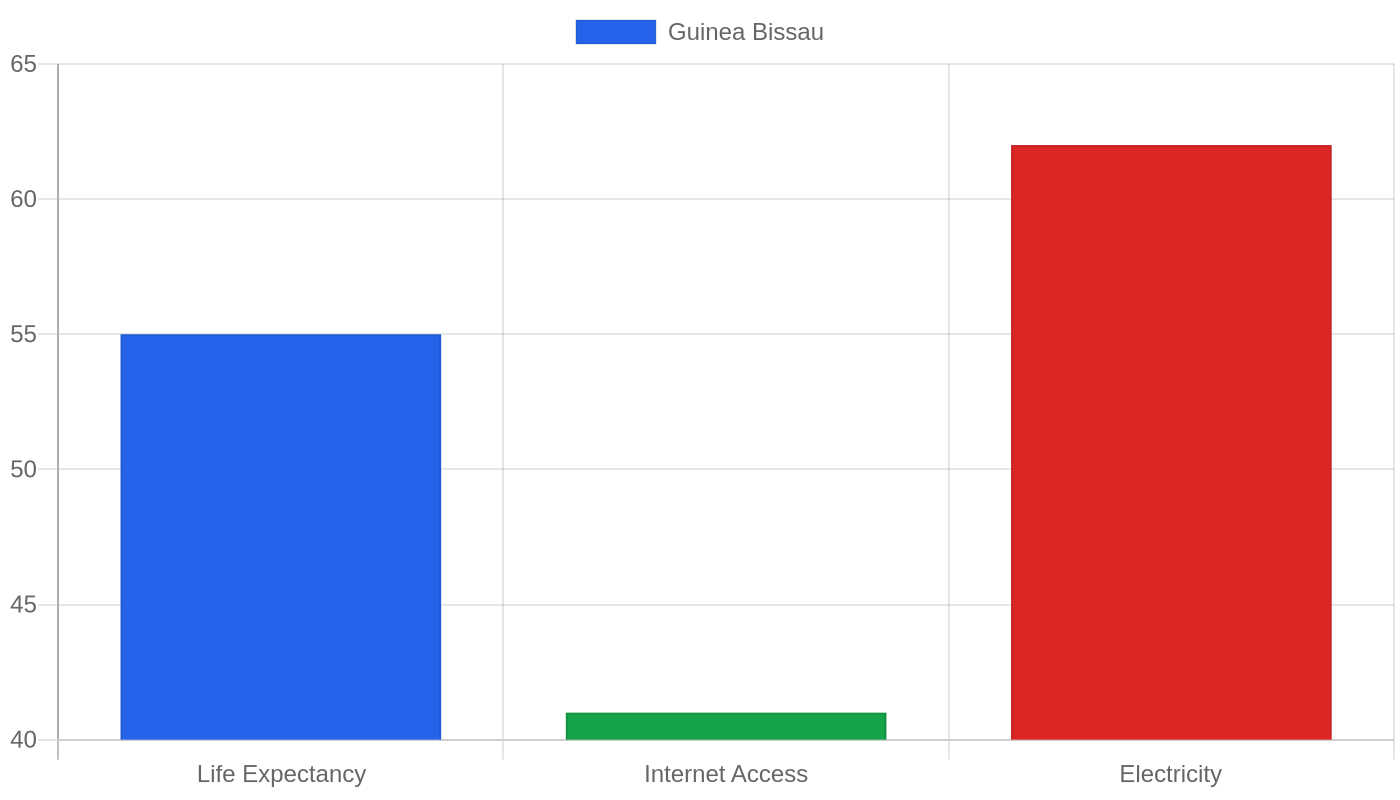
Structural Data Gaps: Comprehensive macroeconomic indicators such as GDP growth, inflation rates, and unemployment figures are currently listed as N/A by the World Bank, reflecting significant challenges in data collection and reporting.
Semi-Presidential Governance: Power is shared between a president (head of state) and a prime minister (head of government), a system established only after multi-party governance was introduced in mid-1991.
Centralized Legacy: Despite recent democratic shifts, the government retains a highly centralized structure inherited from its post-independence era.
The Shadow of Political Volatility
The economic trajectory of Guinea-Bissau cannot be understood without first examining the political architecture that governs it. For decades, the country operated under a highly centralized government model that concentrated power at the top levels of the state. This centralization created an environment where policy continuity was often sacrificed for political expediency.
It was not until the mid-1991 reforms that multi-party governance was finally established, marking a tentative step toward democratic normalization. However, the transition to stability has been fraught with difficulty. Under the current semi-presidential system, authority is divided between a president who serves as head of state and a prime minister who acts as head of government. This dual-executive structure is intended to balance power, but historically, it has struggled to ensure long-term leadership tenures.
From gaining independence in 1974 up until June 24, 2019, when Jose Mario Vaz concluded his five-year term, no single president managed to serve a complete constitutional term. This pattern of premature executive exit suggests a persistent institutional fragility that likely impacts investor confidence and long-term economic planning. When leadership changes frequently or prematurely, it disrupts fiscal policies and deters sustained foreign direct investment.
Consequently, the political landscape remains a primary variable in any assessment of the country’s economic health, overshadowing even the most basic industrial metrics.
The Mystery of Missing Macroeconomic Indicators
For economists and investors attempting to gauge the pulse of Guinea-Bissau’s economy, the available data presents a stark challenge: critical indicators are largely absent. According to the latest reports from the World Bank, key metrics including GDP growth, inflation CPI, unemployment rates, total GDP in USD, GDP per capita in PPP, GNI per capita, and even population figures are listed as N/A.
This absence of data is not merely a statistical gap; it reflects deeper structural issues within the national statistical infrastructure. Without reliable GDP growth figures, it is impossible to measure the velocity of economic expansion or contraction. Similarly, the lack of inflation data obscures the purchasing power of the local currency and the cost pressures facing households. Unemployment statistics being unavailable means policymakers lack a clear view of labor market slack or surplus.
These missing numbers create a fog around the country’s economic reality, making comparative analysis with regional peers nearly impossible. In economies where formal sector data is scarce, informal trade and agriculture often drive activity, yet these sectors rarely translate into precise macroeconomic aggregates. Therefore, the “N/A” labels serve as a warning sign: they indicate that the standard tools for economic diagnosis are blunt or non-existent.
Investors must rely on qualitative assessments rather than quantitative models, recognizing that the silence in the data is itself a significant economic signal.
Daily Realities and Industrial Ambiguity
Beyond the high-level macro indicators, the daily economic life of citizens in Guinea-Bissau operates in a realm where specific cost structures are difficult to quantify. Detailed information regarding the cost of living, housing markets, and rent-versus-buy dynamics is not provided in current datasets. Similarly, the main industries driving the economy are listed without specific breakdowns, leaving the composition of national output unclear.
Top companies operating within the territory are also unidentified in the available records. This lack of granular detail about commercial entities and consumer prices makes it challenging to assess the competitive landscape for businesses. Typically, such gaps suggest an economy heavily reliant on subsistence agriculture and informal commerce, where transactions occur outside formal corporate registries.
Without knowing the primary industries, one cannot determine which sectors offer the highest growth potential or face the most regulatory hurdles. Furthermore, the absence of company names prevents an analysis of market concentration or monopolistic tendencies. For expatriates or new entrants, the unknown nature of housing costs and daily expenses adds a layer of risk to relocation or business setup decisions.
The narrative here is one of opacity; while the potential for resource-based growth may exist, the actual mechanics of how wealth is generated and distributed remain obscured by a lack of reported industrial and consumer data.
Safety, Governance, and Social Stability
When evaluating the quality of life and security environment, the indices for crime and safety in Guinea-Bissau are similarly marked as N/A. This absence of a Crime Index and Safety Index complicates risk assessments for both residents and international observers. However, the political landscape offers some contextual clues regarding social stability. The historical inability of presidents to serve full terms suggests a level of political tension that could spill over into civil unrest or institutional friction.
While the shift to a semi-presidential system aimed to stabilize governance, the legacy of centralized control and frequent leadership changes implies that social contracts may still be fragile. Happiness data and broader quality-of-life metrics are not included in the current dataset, leaving a void in understanding the societal well-being of the population. In the absence of hard safety statistics, potential stakeholders must look to political history as a proxy for risk.
The fact that multi-party democracy was only achieved in 1991 indicates that the foundations of civic trust and institutional reliability are still maturing. For individuals considering residence or investment, the combination of uncertain safety indices and a volatile political track record necessitates extreme caution. The interplay between political instability and unmeasured social safety nets creates an environment where unpredictability is the only constant.
What’s Happening Now: A Legacy of Transition
The most defining feature of the current affairs in Guinea-Bissau is the enduring impact of its political transitions. The most significant recent benchmark is the conclusion of Jose Mario Vaz’s presidency on June 24, 2019, which ended a long streak of incomplete presidential terms. This event marked a rare moment of constitutional completion in a country accustomed to early political departures.
However, the question remains whether this stability has translated into sustained economic reform or if the cycle of volatility will resume. With no recent news items detailing specific policy shifts, election outcomes post-2019, or immediate business developments, the current atmosphere appears to be one of waiting. The lack of live indicators for inflation trends or immediate reforms suggests that major economic announcements are either infrequent or poorly publicized.
Business developments are similarly silent, indicating that large-scale commercial activity may be low-key or undocumented. For observers, the “now” is characterized by a pause in dramatic political events, but not necessarily a resolution of underlying structural weaknesses. The focus remains on whether the semi-presidential framework can hold against the centrifugal forces of centralized power struggles.
Until new data emerges on governance continuity or economic output, the story of Guinea-Bissau is one of cautious observation following a historic, albeit isolated, moment of political endurance.
The Bottom Line
Guinea-Bissau presents a complex case study in political resilience amid economic opacity. Investors and researchers should watch this country primarily for signals of political stabilization, specifically whether future presidents can complete their terms, thereby breaking the historical cycle of disruption. Due to the complete absence of standard economic data, traditional financial modeling is ineffective; instead, success depends on navigating informal networks and understanding local power dynamics.
Those interested in frontier markets with high political risk and low informational transparency may find Guinea-Bissau a relevant, albeit challenging, area of interest.
Sources & Methodology
This article is authored by Economic Pulse Net for informational and research purposes. Economic Pulse Net sources its data from multilateral institutions, national statistics bureaus, and proprietary databases. All data is believed to be current as of the date of publication.
Published: October 02, 2026 | Category: Research — Guinea Bissau
Use these signals in your own platform
Economic Pulse publishes its live signal feed through a documented, read-only API. Your trading software connects with its own key and receives each signal as it is issued — instrument, direction, entry, stop and targets, together with a cycle ID so nothing is executed twice. The feed is independent of this website and cannot change it.
Signals are informational only and are not financial advice.