Economic Pulse Net | Sources: World Bank World Development Indicators, Government Sources | 2026
Key Takeaways
* Stagnant Growth Amidst Wealth: Belgium faces a significant divergence between its high GDP per capita (PPP) of $74,675 and sluggish GDP growth of just 0.98% in 2025, signaling structural headwinds.
Inflation Cooling but Persistent: Consumer price inflation has settled at 2.47%, a manageable level for consumers but one that still pressures household budgets compared to pre-pandemic norms.
Tight Labor Market: With unemployment holding steady at roughly 5.9%, the labor market remains resilient despite the broader economic slowdown.
Complex Governance: As a federal parliamentary democracy with compulsory voting, Belgium’s political landscape is inherently complex, influencing policy consistency and business regulation.
Economic Headwinds in a Wealthy Nation
Belgium’s economic profile in 2025 presents a compelling paradox: it is a nation of considerable wealth grappling with near-stagnant expansion. According to World Bank data, the country’s GDP growth is projected at a modest 0.983%, a figure that suggests the economy is barely moving forward rather than accelerating.
This low growth rate contrasts sharply with the nation’s high standard of living; the GDP per capita based on purchasing power parity stands at an impressive $74,675.61, indicating that while the aggregate economy is slow, individual prosperity remains robust. Furthermore, the Gross National Income (GNI) per capita is recorded at $59,500, reinforcing the picture of a mature, high-income economy where wealth distribution, while likely uneven, supports a strong middle class.
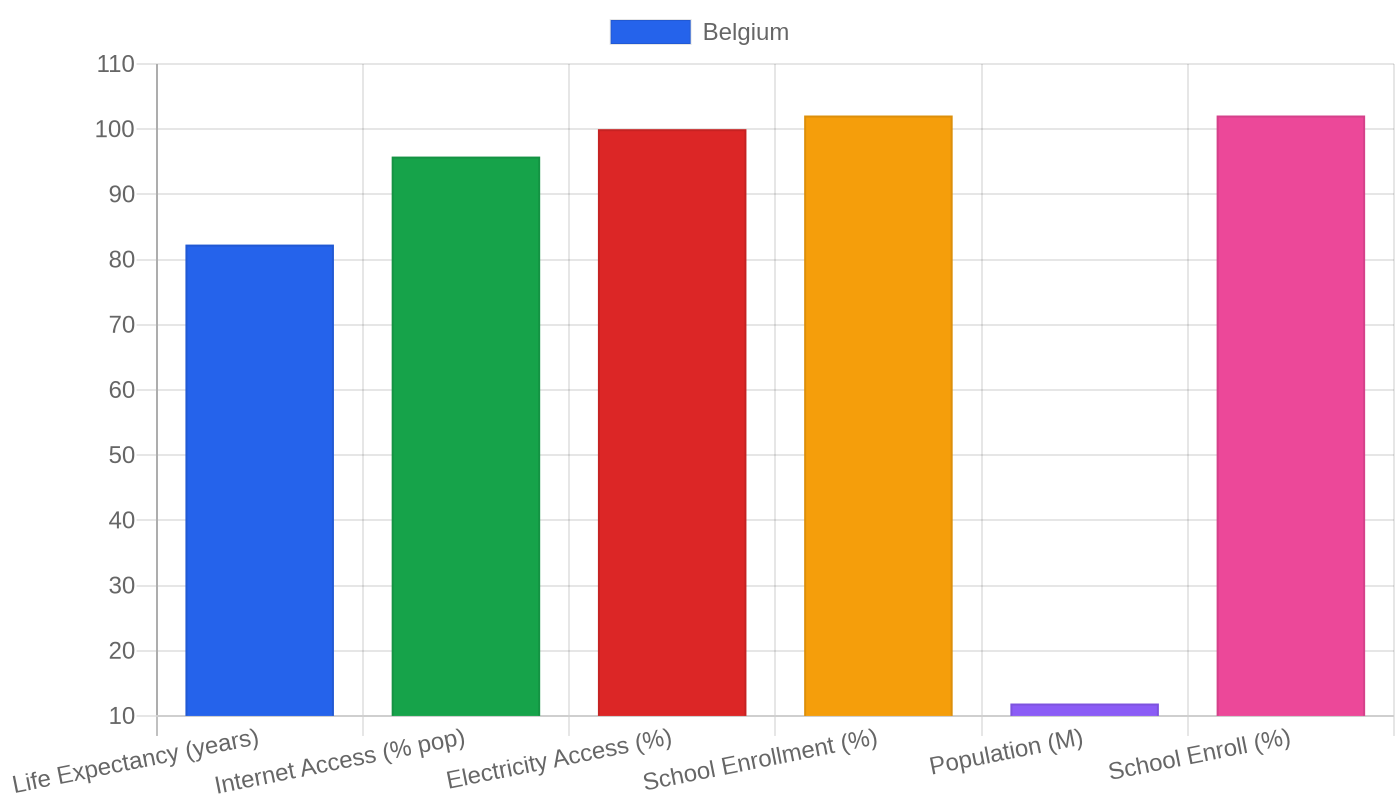
However, this wealth is not translating into rapid macroeconomic expansion, which could be attributed to demographic shifts or structural rigidities within the federal system. The population of approximately 11.94 million people provides a stable domestic base, yet the low growth figure warns investors that quick returns may be scarce in the near term.
Inflation, measured by the CPI at 2.466%, is relatively contained, suggesting that the central bank’s monetary policies are effective in keeping price shocks in check, though not eliminating them entirely. This stability allows for long-term planning, even if short-term gains are limited.
Cost of Living and Housing Dynamics
While specific housing cost metrics are not explicitly detailed in the provided datasets, the high GNI per capita of $59,500 implies a correspondingly high cost of living environment. Residents in Belgium likely face premium prices for daily expenses, aligning with the expectations of a Western European hub. The inflation rate of 2.47% indicates that the pace of price increases has moderated, offering some relief to households who were previously squeezed by higher volatility.
For renters and buyers alike, the balance between income and expenditure is critical; with such high per-capita incomes, housing affordability is likely tied more to location and property type than to absolute inability to pay. However, the absence of explicit rent-to-income ratios in the current data suggests that prospective residents should look toward local municipal reports for granular housing insights.
Generally, the cost structure in Belgium reflects its status as a wealthy industrialized nation, where services and goods command higher premiums than in emerging markets. The moderate inflation rate helps preserve the purchasing power of the average citizen, preventing a rapid erosion of savings. Consequently, while entering the Belgian market requires significant capital, the sustained high income levels provide a buffer against the rising costs of urban living.
Investment & Business Climate
The Belgian corporate landscape is anchored by a diverse array of major players across key sectors, offering varied opportunities for investment and partnership. Anheuser-Busch InBev dominates the consumer goods sector, leveraging global reach from its Belgian headquarters, while Ageas and AG Real Estate represent strength in financials and real estate assets respectively.
In the technology and healthcare spaces, companies like AIM Productions and Ablynx highlight Belgium’s innovation capacity beyond traditional industries. Industrial giants such as Agfa-Gevaert and Agoria underscore the country’s enduring manufacturing and technological infrastructure. Ackermans & van Haaren, operating as a conglomerate, illustrates the diversified nature of Belgian capital, spanning multiple verticals to mitigate sector-specific risks.
Abelag Aviation adds a niche layer to the consumer services portfolio, reflecting the country’s logistical importance in Europe. These entities operate within a framework of compulsory voting and proportional representation, which can lead to coalition governments that prioritize stability over radical deregulation. Investors should note that while the business environment is mature and legally robust, the political complexity may result in slower legislative changes.
The presence of these top-tier companies suggests a resilient ecosystem where established brands continue to drive value despite the broader 0.98% GDP growth constraint.
Safety, Politics & Quality of Life
Belgium offers a high degree of political stability rooted in its constitutional monarchy and federal parliamentary democracy. The bicameral federal parliament, consisting of a Senate and a Chamber of Representatives, ensures that regional and community interests are represented in national lawmaking. The Senate’s composition, with 50 senators appointed by regional parliaments and 10 co-opted members, highlights the decentralized nature of Belgian governance.
Meanwhile, the Chamber’s 150 representatives are elected via a proportional voting system from 11 electoral districts, ensuring broad political inclusivity. A unique feature of this system is compulsory voting, which maintains high civic engagement and prevents voter apathy from skewing political outcomes. Regarding safety, specific crime and safety indices are currently listed as N/A in the provided data, meaning precise statistical comparisons cannot be made here.
However, the general reputation of Belgium as a stable European hub suggests a baseline of public order suitable for expatriates and businesses. The combination of political maturity and social cohesion contributes to a quality of life that appeals to those seeking stability over rapid change. Citizens benefit from a system designed to protect minority rights and regional autonomy, fostering a sense of security and belonging.
What’s Happening Now / Current Affairs
The freshest indicators point to an economy navigating a period of cautious consolidation. With GDP growth hovering near 1%, policymakers are likely focusing on structural reforms to unlock productivity rather than stimulating demand through aggressive spending. The inflation rate of 2.47% suggests that energy and food price shocks have largely subsided, allowing consumers to regain some confidence in their spending power.
Unemployment at 5.9% indicates that the labor market is absorbing workers effectively, which supports wage growth and domestic consumption. Political discussions are undoubtedly centered on managing the federal budget and maintaining social cohesion in a multi-lingual society. The compulsory voting system ensures that any government must remain responsive to a broad spectrum of voter concerns, limiting extreme policy shifts.
Businesses are adapting to this stable but slow-growth environment by focusing on efficiency and innovation, as seen in the activities of tech and healthcare firms like Ablynx and AIM Productions. Investors are watching closely to see if the high GDP per capita can be sustained without corresponding job creation or export growth. The current moment is defined by resilience; Belgium is not booming, but it is not collapsing, making it a safe harbor for conservative capital allocation.
The Bottom Line
Belgium is best suited for investors and expatriates who prioritize stability, high standards of living, and political predictability over rapid economic expansion. The data reveals a mature economy where wealth is abundant ($74k+ PPP per capita) but growth is tepid (under 1%). Those looking for high-yield, fast-moving markets may find Belgium too conservative, but for those seeking a secure base in Europe with strong institutional frameworks, it remains a compelling choice.
The compulsory voting and federal structure ensure that policy changes will be gradual, providing a predictable business environment. Ultimately, Belgium offers a “quiet luxury” in economic terms: less noise, more comfort.
Sources & Methodology
This article is authored by Economic Pulse Net for informational and research purposes. Economic Pulse Net sources its data from multilateral institutions, national statistics bureaus, and proprietary databases. All data is believed to be current as of the date of publication.
Published: October 27, 2026 | Category: Research — Belgium
Use these signals in your own platform
Economic Pulse publishes its live signal feed through a documented, read-only API. Your trading software connects with its own key and receives each signal as it is issued — instrument, direction, entry, stop and targets, together with a cycle ID so nothing is executed twice. The feed is independent of this website and cannot change it.
Signals are informational only and are not financial advice.