Economic Pulse Net | Sources: World Bank World Development Indicators, Government Sources | 2026
Belgium has a population smaller than New York City’s metro area, yet it hosts the headquarters of one of the world’s largest beer companies, serves as the de facto capital of the European Union, and posts a GDP per capita that would make many larger nations envious.
As Europe’s political and administrative heart, Belgium’s economy is a curious blend of old-world industrial strength and new-world service sophistication.
But beneath the chocolate, waffles, and diplomatic gloss lies a story of modest growth, persistent inflation, and a labor market that is quietly outperforming its neighbors.
This is a country that rarely makes headlines for dramatic economic swings — and that, paradoxically, makes it worth watching closely.
Key Takeaways
- Modest but positive growth: Belgium’s GDP expanded by roughly 0.98 percent in 2025, according to World Bank data — a sign of resilience rather than dynamism in a challenging European environment.
- Inflation remains sticky: At 2.47 percent, price growth is above the European Central Bank’s comfort zone, squeezing household purchasing power and complicating the monetary policy picture.
- Unemployment is remarkably low: With an unemployment rate of 5.9 percent, Belgium is operating near what economists would consider full employment — a significant achievement for a country with complex federal labor structures.
- A heavyweight economy: Belgium’s GDP stands at approximately $725 billion, with a GDP per capita (PPP) of nearly $75,000, placing it among the world’s most productive economies per person.
- Corporate giants call it home: From Anheuser-Busch InBev to Ageas, Belgium hosts global leaders across consumer goods, financials, and health care — punching far above its weight in corporate influence.
Growth, Prices, and the Labor Market: The Numbers That Define Belgium
Let’s start with the headline figure: Belgium’s GDP growth of 0.98 percent in 2025, as reported by the World Bank, is not the stuff of economic miracles.
But context matters.
Europe has been navigating an energy crisis hangover, elevated interest rates, and a manufacturing slowdown.
In that environment, posting near-1 percent growth is a statement of stability.
Belgium’s economy is heavily services-oriented, which shields it from the worst of industrial cyclicality, but it also means the country is sensitive to consumer confidence and external demand from its major trading partners — Germany, France, and the Netherlands.
Inflation, however, is the more uncomfortable story.
At 2.47 percent, according to the World Bank, consumer prices are rising faster than the European Central Bank’s 2 percent target.
For Belgian households, this means the cost of groceries, energy, and services continues to climb, eating into real wage gains.
The inflation rate is not runaway, but it is persistent — and in an economy where wage indexation is common, there is a risk of a wage-price spiral that could keep price pressures elevated for longer.
The Belgian consumer, it seems, is caught between modest income growth and a cost of living that refuses to fully cool off.
On the employment front, the picture is notably brighter.
Belgium’s unemployment rate stands at 5.9 percent, according to World Bank data.
That is a level that many European economies would envy — France, for instance, has struggled to push its rate below 7 percent for years.
Belgium’s success in this area is partly structural: strong social protections, active labor market policies, and a high share of public-sector employment all contribute to job stability.
But there is a flip side.
Low unemployment in Belgium has historically been accompanied by high levels of long-term inactivity and early retirement, meaning the headline number may flatter the underlying dynamism of the labor market.
Still, for a country with Belgium’s institutional complexity — three regions, three language communities, and a federal government that often struggles to coordinate — a 5.9 percent unemployment rate is a genuine achievement.
The broader economic picture is one of a mature, high-income economy doing what mature, high-income economies do: growing slowly, distributing wealth widely, and maintaining a high standard of living.
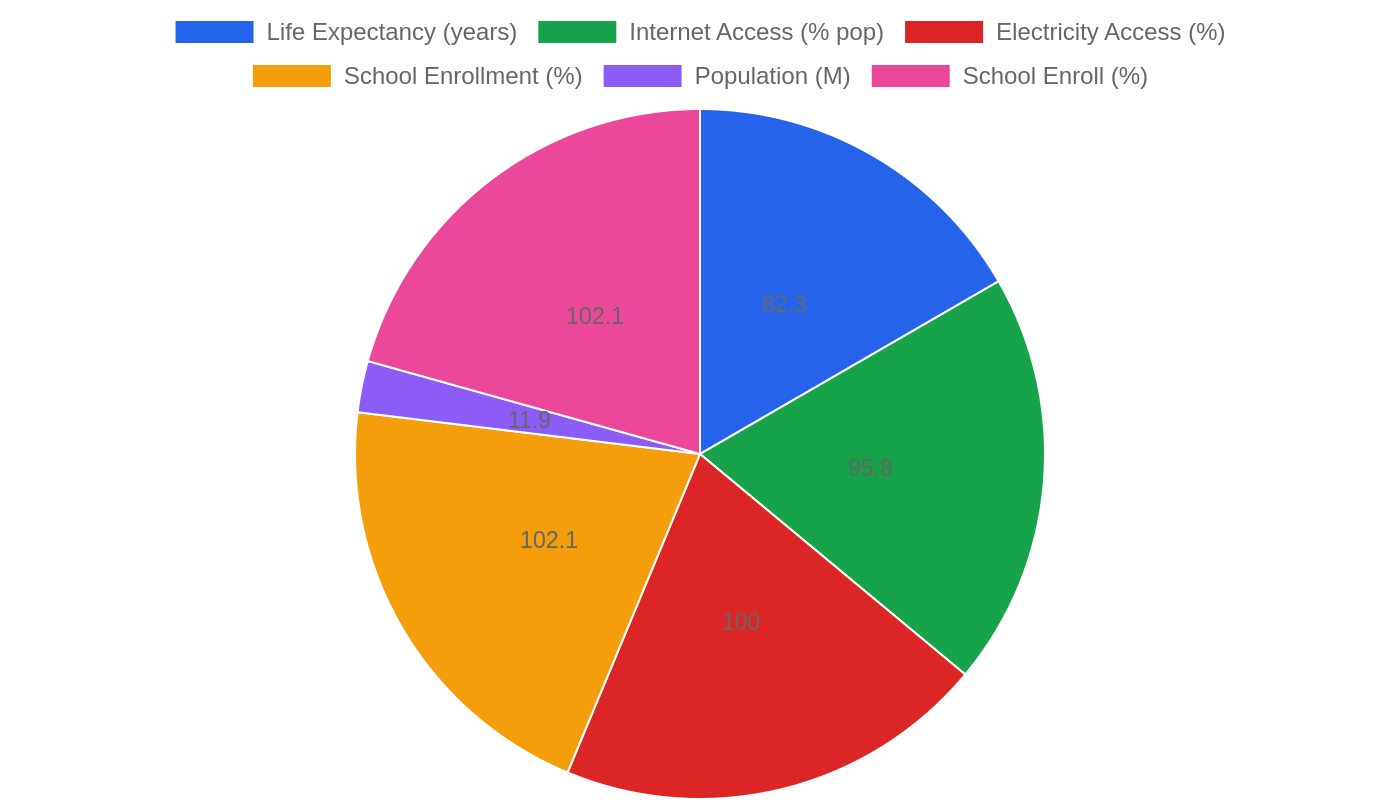
With a GDP of roughly $725 billion and a per-capita GDP (PPP) of about $74,700, Belgium’s citizens enjoy a level of economic output that places the country in the top tier globally.
This is not a frontier market story; it is a story of stewardship and maintenance — and in a volatile world, there is quiet value in that.
The Cost of Living: Comfort Comes at a Price
Belgium is not a cheap place to live, and the World Bank’s income data makes clear why.
With a GNI per capita of $59,500, Belgians earn enough to afford a relatively high cost of living — but that cost is substantial.
Housing in Brussels, Antwerp, and Ghent has become increasingly expensive, driven by limited supply, stringent zoning regulations, and the steady demand from EU institutions and international companies.
Renting in Brussels, in particular, commands a premium, especially in neighborhoods popular with expatriates and EU officials.
Buying a home in Belgium involves significant transaction costs, including notary fees and registration taxes, which can add up to 15 percent or more on top of the purchase price — a substantial barrier for first-time buyers.
Daily expenses — food, transport, utilities — are broadly in line with neighboring countries like the Netherlands and France, though energy costs have been a lingering source of household pain since the European energy crisis.
Belgian households spend a notable share of their income on heating, and the country’s aging housing stock often lacks modern insulation, making energy bills a live issue.
On the other hand, Belgium’s public services — health care, education, and social security — are comprehensive and heavily subsidized, which offsets some of the cash costs of daily life.
The trade-off is high taxes; Belgium has one of the highest tax burdens in the OECD, particularly on labor income.
For the average Belgian, the system works: you pay a lot, but you get a lot back in services and security.
For newcomers and investors, however, the tax regime is often a shock.
Business and Investment: Where Global Giants Meet Mid-Sized Innovation
If you want to understand Belgium’s economic ambition, look at its corporate roster.
Anheuser-Busch InBev — the world’s largest brewer — calls Belgium home, and its presence anchors a consumer goods sector that is far more sophisticated than the country’s size would suggest.
Alpro, the plant-based food pioneer, is also Belgian, reflecting the country’s strength in food technology and health-oriented consumer products.
In health care, Ablynx (now part of Sanofi) demonstrated Belgium’s capacity for biotech innovation, while Agfa-Gevaert remains a stalwart in industrial imaging and printing technology.
The financial sector is anchored by Ageas and Ackermans & van Haaren, both of which have deep roots in the Belgian economy and significant international operations.
For investors, Belgium offers a gateway into the European market — literally and figuratively.
Brussels is home to the EU’s key institutions, making it a strategic location for lobbying, regulatory affairs, and pan-European business development.
The country’s infrastructure is excellent, its workforce is multilingual and highly educated, and its location is central to Europe’s richest consumer markets.
However, the business environment is not without friction.
Belgium’s labor market is heavily regulated, wage costs are high, and the country’s political complexity can slow decision-making.
The recent formation of a new federal government after the 2024 elections brought a degree of political stability, but coalition dynamics remain fragile.
For companies willing to navigate these complexities, the rewards are real — but so are the administrative burdens.
Safety, Politics, and Quality of Life: The European Ideal, With Caveats
Belgium’s political system is one of the most complex in the world — a federal structure with overlapping competencies between the federal state, three regions (Flanders, Wallonia, Brussels-Capital), and three language communities (Dutch, French, and German).
This arrangement exists to manage the deep linguistic and cultural divisions between Flanders in the north and Wallonia in the south, but it also produces a governance style characterized by compromise, coalition-building, and, at times, paralysis.
Belgium holds the world record for the longest period without a government — 541 days in 2010-2011 — and while the country functioned through a caretaker administration, the episode highlighted the fragility of its political model.
Compulsory voting, which Belgium maintains, ensures high turnout and a degree of political engagement that many democracies envy, but it also reinforces the dominance of established parties and makes radical reform difficult.
The country is a constitutional monarchy and a federal parliamentary democracy, with a Senate composed of 50 senators appointed by regional and community parliaments plus 10 co-opted senators — a system reformed in 2014 to reduce the Senate’s direct electoral legitimacy.
For all its complexity, the system delivers stability in the sense that governments are always coalitions and policy changes are incremental.
On the safety front, Belgium is a generally secure country, with crime levels typical of Western European nations — urban petty crime is a concern in Brussels, but violent crime is rare.
Quality of life, meanwhile, is high: Belgians enjoy excellent health care, strong social protections, and a cultural scene that punches well above its weight in art, food, and architecture.
The Current Moment: Inflation’s Grip and a Government Finding Its Feet
Right now, Belgium is navigating a delicate moment.
Inflation at 2.47 percent is running above the European Central Bank’s target, and while it has cooled from the double-digit peaks of 2022, the persistence of price growth is a political and economic headache.
Households feel the pinch every time they shop, and labor unions — powerful in Belgium — are pressing for wage indexation to protect purchasing power.
That, in turn, feeds back into inflation, creating a cycle that the new federal government is trying to manage without triggering a full-blown wage-price spiral.
On the political front, the government formed in 2025 is still in its early phase, working to implement its coalition agreement while managing the perennial challenge of balancing Flemish and Walloon interests.
The government’s agenda includes measures to boost labor market participation, simplify the tax system, and address the country’s long-term fiscal sustainability — a pressing issue given Belgium’s high public debt, which exceeds 100 percent of GDP.
The economy, meanwhile, is being supported by the resilience of its key sectors: beer and consumer goods, financial services, and a growing health-tech cluster.
The World Bank’s growth figure of 0.98 percent for 2025 reflects an economy that is holding its own but not roaring ahead.
For Belgians, the immediate question is whether inflation will ease enough to restore real income growth — and whether their complex political system can deliver the reforms the economy needs.
The Bottom Line
Belgium is not a country for those seeking explosive growth or dramatic transformation.
It is a country for those who value stability, high living standards, and strategic positioning in the heart of Europe.
Investors should watch Belgium for its corporate champions, its gateway role to the EU, and its high-income consumer market.
Policymakers should study it as a case study in managing linguistic and regional diversity within a functioning (if cumbersome) federal system.
And anyone interested in the future of Europe should keep an eye on Brussels — not just for its politics, but for the quiet, steady economic engine that keeps the EU’s capital running.
Belgium’s story is one of maintenance and resilience, and in a world of turbulence, that may be exactly the kind of story that matters most.
Sources & Methodology
This article is authored by Economic Pulse Net for informational and research purposes.
Economic Pulse Net sources its data from multilateral institutions, national statistics bureaus, and proprietary databases.
All data is believed to be current as of the date of publication. Published: August 29, 2026 |
Category: Research — Belgium
Use these signals in your own platform
Economic Pulse publishes its live signal feed through a documented, read-only API. Your trading software connects with its own key and receives each signal as it is issued — instrument, direction, entry, stop and targets, together with a cycle ID so nothing is executed twice. The feed is independent of this website and cannot change it.
Signals are informational only and are not financial advice.