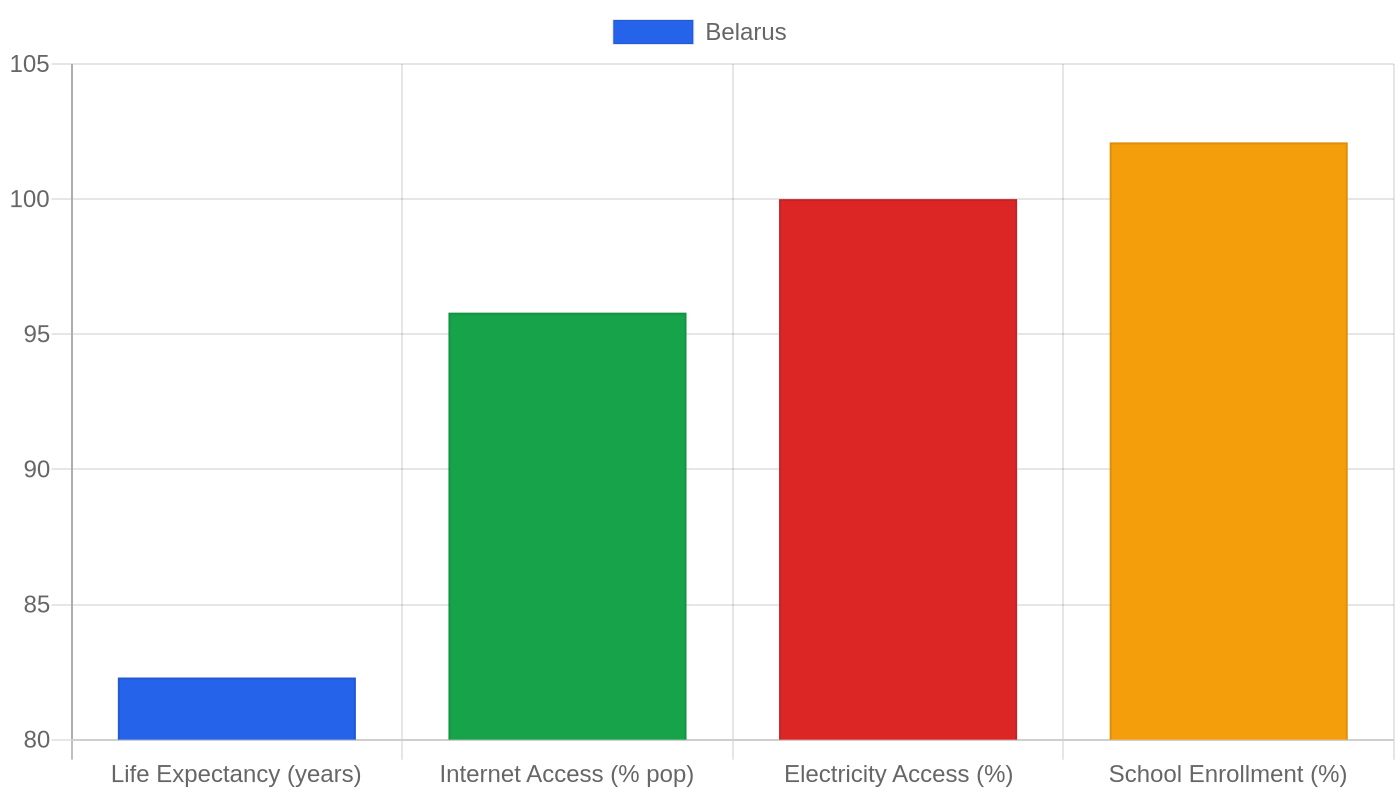
Economic Pulse Net | Sources: World Bank World Development Indicators, Government Sources | 2026
Key Takeaways
– Belarus operates under a highly centralized authoritarian system led by President Alexander Lukashenko, widely described by media outlets as “Europe’s last dictatorship,” which profoundly shapes every aspect of its economic and business environment.
– The country’s industrial backbone is dominated by state-owned giants in heavy machinery, potash mining, transportation, and banking, with companies like BelAZ, Belaruskali, and Belarusbank anchoring the economy.
– Telecommunications and technology sectors show pockets of dynamism, with A1 and the Belarus High Technologies Park representing rare private-sector and innovation-driven growth areas.
– Despite its strategic location between Russia and the European Union, Belarus faces profound isolation from Western markets and investment due to its political landscape, creating a bifurcated economy dependent on Russian support.
– Comprehensive economic data from the World Bank — including GDP growth, inflation, unemployment, and per capita income — remains unavailable, reflecting the opacity and lack of transparency that characterizes the country’s governance.
The Ghost Economy — What We Don’t Know Tells Us Everything
The most striking feature of Belarus’s economic data is not a number — it is the absence of numbers. The World Bank, the premier international institution for tracking global economic health, reports no data whatsoever for Belarus on GDP growth, inflation, unemployment, gross domestic product in US dollars, GDP per capita based on purchasing power parity, or GNI per capita. This statistical black hole is itself a data point of immense significance.
It signals a country that has either chosen not to participate fully in international economic transparency mechanisms or whose institutions are so compromised that reliable data collection has become impossible.
Belarus operates an economy that remains heavily Soviet in structure. Its main industries, while not enumerated in the available data, are clearly reflected in its top companies. The industrial sector is dominated by state-owned behemoths: BelAZ, one of the world’s largest manufacturers of mining dump trucks; Belaruskali, a giant in potash fertilizer production; and Belarusian Railway, the state-run rail network that connects the country to both Russian and European markets.
Belkommunmash produces electric buses and trams, while Belavia serves as the national airline. These enterprises are not just economic actors — they are instruments of state power, employment, and political loyalty.
The financial sector is similarly state-dominated, with Belarusbank standing as the country’s largest lender. The presence of BelaPAN, a consumer services company, and Aliasworlds Entertainment, a technology firm, suggests some diversity, but the overwhelming weight of the economy rests on industrial state-owned enterprises.
Without GDP figures, it is impossible to calculate the size of the economy or its growth trajectory, but the composition of its corporate landscape points to an economy vulnerable to commodity price shocks, Russian political pressure, and Western sanctions.
The Price of Living in a Pariah State
Cost of living data for Belarus is not available through the provided sources, but the economic structure suggests a stark reality for ordinary citizens. In a country where the state controls major industries, banking, and much of the retail and service sector, prices are not purely market-driven.
The government has historically used price controls and subsidies to maintain social stability — a tactic that keeps basic goods affordable but distorts economic incentives and creates chronic shortages or quality problems.
Housing, rent, and daily expenses in Belarus exist in a peculiar equilibrium. The state remains heavily involved in housing construction and allocation, a legacy of the Soviet system. For Belarusians, the choice between renting and buying is often less a matter of market preference and more a question of access to state programs or connections.
Compared to regional averages in Eastern Europe, Belarus likely offers lower nominal costs for basics like utilities and public transport, but those low prices come with trade-offs: limited choice, aging infrastructure, and an economy that cannot generate the kind of wage growth seen in neighboring Poland or the Baltic states.
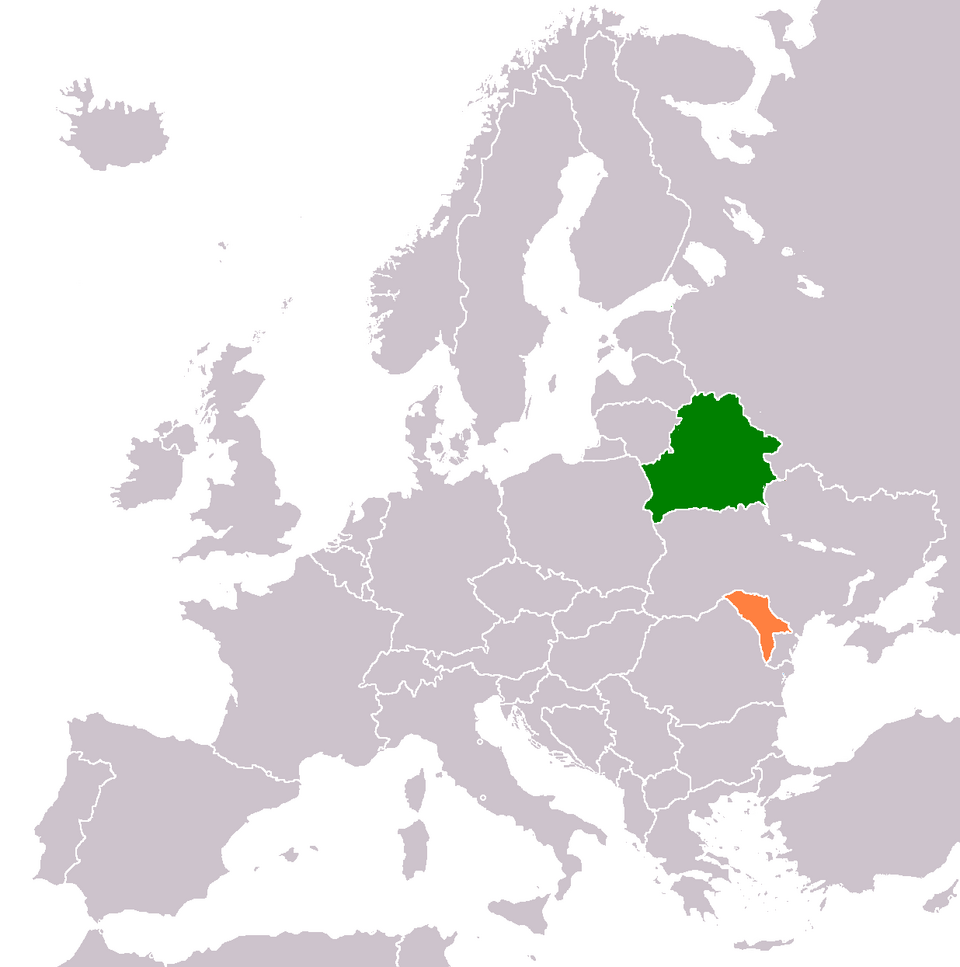
Investment and Business — A Landscape of Risk and Exception
The list of top companies in Belarus reads like a map of where the state allows — and does not allow — private enterprise. On one hand, heavy industry is almost entirely state-owned: BelAZ, Belaruskali, Belarusian Railway, Belavia, and Belkommunmash are all either fully state-owned or under tight state control. On the other hand, there are notable exceptions. A1, a telecommunications company, represents a sector where private investment and foreign capital have been permitted, albeit under strict regulation.
Aliasworlds Entertainment, a technology firm, shows that Belarus has produced some innovative tech talent, particularly in gaming and software development.
The Belarus High Technologies Park deserves special attention. Listed among the top companies as a “Financials” entity, it is actually a special economic zone designed to attract IT and technology firms with tax breaks and regulatory exemptions. This park has been one of the few bright spots in the Belarusian economy, producing software exports and attracting international clients. However, its success has been increasingly threatened by the political climate.
Western sanctions and the exodus of skilled workers following political crackdowns have put pressure on this sector.
For any foreign investor considering Belarus, the political landscape is the overriding factor. The country is described as a semi-presidential republic with separation of powers by its constitution, but the reality, as noted by numerous media outlets, politicians, and authors, is that Belarus is an autocracy where power is ultimately concentrated.
This creates a business environment where contracts can be respected or torn up at political whim, where sanctions can sever access to Western markets overnight, and where the ultimate guarantor of economic stability is not the rule of law but the goodwill of Alexander Lukashenko and, by extension, the Kremlin.
Safety, Politics, and the Quality of Life Under Authoritarianism
Crime and safety indices for Belarus are not available in the provided data, but the nature of public safety in an authoritarian state is fundamentally different from that in a democracy. Street crime in Minsk, the capital, has historically been low compared to Western European cities. Police presence is visible and state security services are pervasive. However, “safety” in the Belarusian context takes on a different meaning.
Political safety — the safety to protest, to speak freely, to organize — does not exist. The political landscape, as described by multiple sources, is one of a highly centralized authoritarian government that has been labeled “Europe’s last dictatorship” and its leader “Europe’s last dictator.”
This political reality permeates every aspect of life. The quality of life for Belarusians is a paradox. Basic material needs — housing, food, education, healthcare — are often met, a legacy of the Soviet social contract. But the absence of political freedom, the suppression of civil society, and the constant presence of state surveillance create a psychological burden that is difficult to quantify.
The country is considered an autocracy, and that classification affects everything from career mobility to personal relationships. For those who are loyal to the regime, life can be stable and comfortable. For those who are not, life can be dangerous.
The Frozen Present — Sanctions, Dependency, and Stagnation
As of 2026, Belarus finds itself in a state of deep economic and political stasis. The country’s integration with Russia has deepened since the 2020 political crisis and the subsequent Western sanctions regime. Belarus has become a staging ground for Russian military operations and a transshipment point for goods circumventing sanctions, but this role comes at a cost. The economy is increasingly dependent on Russian subsidies, cheap energy, and preferential loans.
This dependency gives Moscow enormous leverage over Minsk, reducing Lukashenko’s already limited room for maneuver.
The technology sector, once a rare success story, is hemorrhaging talent. Skilled IT workers, who could earn competitive salaries working remotely for international companies, have been leaving in large numbers since the political crackdowns. The Belarus High Technologies Park still exists, but its future is uncertain. Meanwhile, the industrial giants — BelAZ, Belaruskali, Belarusian Railway — continue to operate, but they face shrinking access to Western markets and technology.
European Union sanctions have targeted key exports, particularly potash, and have restricted the ability of Belarusian companies to raise capital in Western financial markets.
There are no signs of imminent political liberalization. The regime remains firmly in control, opposition figures are imprisoned or in exile, and the next election cycle promises more of the same. The economy is not crashing — Russian support prevents that — but it is not growing in any meaningful or sustainable way. Belarus is a country running in place, consuming its Soviet inheritance and its Russian lifeline, with no clear path to a different future.
The Bottom Line
Belarus is a country for the specialist observer, not the casual investor. Those tracking geopolitics should watch Belarus as a bellwether for Russian influence in Eastern Europe and as a test case for how sanctions and isolation reshape an economy. For businesses, the risks are extreme: political unpredictability, legal opacity, and the constant threat of sanctions.
The human story of Belarus — a nation of 9 million people caught between Europe and Russia, between a Soviet past and an uncertain future — is one of resilience under extraordinary constraints. But from an economic standpoint, Belarus remains a closed book, its data hidden, its trajectory dependent on forces far beyond its borders.
Sources & Methodology
This article is authored by Economic Pulse Net for informational and research purposes. Economic Pulse Net sources its data from multilateral institutions, national statistics bureaus, and proprietary databases. All data is believed to be current as of the date of publication.
Published: July 30, 2026 | Category: Research — Belarus
Use these signals in your own platform
Economic Pulse publishes its live signal feed through a documented, read-only API. Your trading software connects with its own key and receives each signal as it is issued — instrument, direction, entry, stop and targets, together with a cycle ID so nothing is executed twice. The feed is independent of this website and cannot change it.
Signals are informational only and are not financial advice.