Economic Pulse Net | Sources: World Bank World Development Indicators, Government Sources | 2026
Key Takeaways
– Tunisia remains North Africa’s most politically open society, but democratic institutions have eroded significantly since President Kais Saied’s power grab in 2021, according to the country’s constitutional framework.
– The economy is dominated by a heavily financialized private sector, with nine of the top ten listed companies operating in banking and financial services, signaling a lack of industrial diversification.
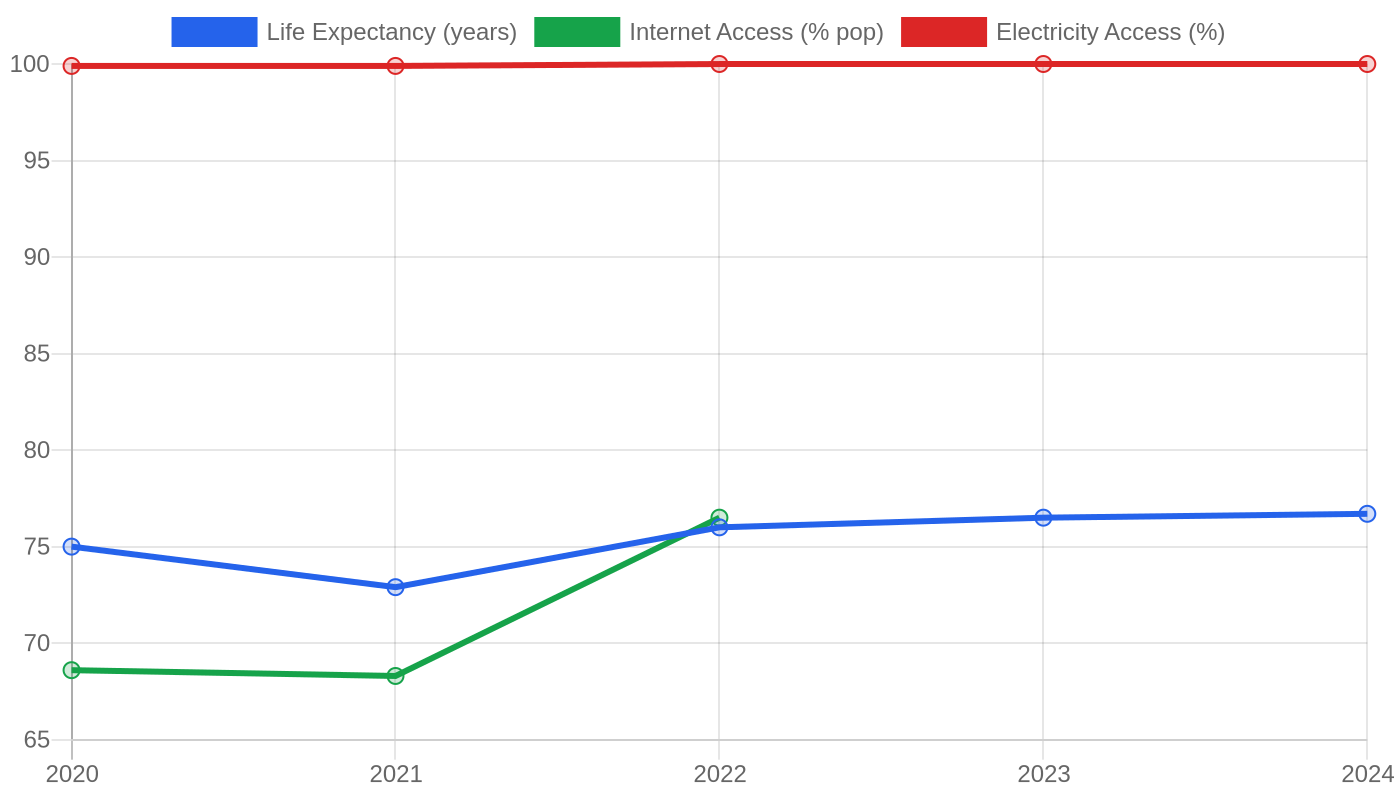
– The World Bank data shows critical gaps in basic economic indicators—GDP growth, inflation, unemployment, and GDP per capita are all unreported—suggesting either statistical opacity or genuine data collection challenges.
– Tunisia’s cost of living and safety indices are also absent from international databases, making it difficult for investors and expatriates to assess daily life conditions with precision.
– The nation’s political trajectory has shifted from being the “sole democracy in North Africa” to a hybrid regime, creating uncertainty for both domestic businesses and foreign capital.
The Missing Numbers — Tunisia’s Economic Black Box
The most striking feature of Tunisia’s current economic profile is what the World Bank data does *not* say. GDP growth, inflation, unemployment, GDP per capita, and GNI per capita are all listed as unavailable. This is not merely a data gap—it is a statement.
For a country that was once held up as the Arab Spring’s success story, the absence of basic macroeconomic indicators suggests either a breakdown in statistical infrastructure or a deliberate opacity that should concern investors and policymakers alike.
Tunisia’s economy has historically relied on a mix of agriculture, phosphate mining, manufacturing (particularly automotive components and textiles), and tourism. But the World Bank data provided offers no breakdown of main industries, leaving analysts to infer that the formal economy is increasingly financialized.
The dominance of banks among the top companies—Amen Bank, Arab Tunisian Bank, Banque de l’Habitat, Banque de Tunisie et des Emirats, Banque de Tunisie, Banque Internationale Arabe de Tunisie, Banque Nationale Agricole, and Banque Zitouna—paints a picture of an economy where credit allocation, rather than productive investment, drives corporate activity.
The sole non-financial firm in the top ten is Adwya, a healthcare company, which hints at a modest pharmaceutical sector but hardly offsets the banking monoculture.
The lack of inflation data from the World Bank is particularly concerning. Tunisia has historically struggled with rising consumer prices, especially for food and energy imports. Without this metric, it is impossible to gauge whether the Tunisian dinar is holding its value or whether households are experiencing a quiet erosion of purchasing power. Unemployment data is equally absent—a critical blind spot for a country with a young, restive population that was central to the 2011 uprising.
The Housing Puzzle — Living Costs in a Data Vacuum
Cost of living data for Tunisia is not available from the sources provided, which creates a significant challenge for anyone trying to assess the real economic pressures facing Tunisian households.
In the absence of hard numbers, what can be said is that Tunisia’s housing market has historically been bifurcated: a formal sector in major cities like Tunis, Sfax, and Sousse, where prices have been driven by tourism demand and remittances from the diaspora, and an informal sector where property rights are murky and transactions occur outside official channels.
Rental costs in Tunis have traditionally been lower than in Casablanca or Algiers but higher than in smaller North African cities. The absence of official data, however, means that even this regional comparison is speculative. For potential expatriates or investors considering relocation, the lack of a reliable cost-of-living index is a red flag.
It suggests that the government is either not collecting this data, not publishing it, or that the informal economy is so large that official statistics would be meaningless. In any case, the data vacuum itself is a cost—one paid in uncertainty.
Banking on a Narrow Base — Tunisia’s Investment Landscape
Tunisia’s corporate landscape is dominated by financial institutions to an extent that is unusual even for an emerging market. The Bourse de Tunis, the country’s stock exchange, is itself listed among the top companies, underscoring the centrality of financial markets to the formal economy.
Amen Bank, Arab Tunisian Bank, Banque de l’Habitat, Banque de Tunisie et des Emirats, Banque de Tunisie, Banque Internationale Arabe de Tunisie, Banque Nationale Agricole, and Banque Zitouna collectively represent a financial sector that appears to have crowded out industrial and technological investment.
This concentration carries risks. When an economy’s most valuable companies are all lenders, it suggests that capital is being intermediated rather than deployed into productive assets. Tunisia needs manufacturing, renewable energy, technology, and agribusiness—not more banks lending to each other or to the government. The sole exception, Adwya, offers a glimpse of what a diversified private sector could look like, but one pharmaceutical company does not make an industrial base.
For foreign investors, the business climate is shaped by political uncertainty. Tunisia’s constitution, adopted in 2014, guarantees rights for women and establishes Islam as the president’s religion, but the democratic backsliding since 2021 has eroded the rule of law and institutional predictability.
Investors who once saw Tunisia as a stable, liberalizing economy must now reckon with a government that has concentrated power and shown little appetite for the kind of structural reforms that international financial institutions demand.
From Beacon to Twilight — Politics and Daily Life
Tunisia was the only democracy in North Africa until 2021, according to the political landscape data provided. That distinction is now qualified. The country operates as a presidential republic with a president serving as head of state, a prime minister as head of government, a bicameral parliament, and a civil law court system. But after a democratic backsliding, the political environment has shifted dramatically.
The crime and safety indices are listed as unavailable, which again forces reliance on qualitative assessment. Historically, Tunisia has been considered safer than many of its neighbors, with lower rates of violent crime and a more professional police force. But political instability often correlates with rising crime, and the absence of data makes it impossible to confirm whether safety has deteriorated alongside democratic institutions.
Quality of life in Tunisia has always been a mixed picture. The country boasts strong social indicators relative to its income level—high literacy rates, good healthcare access in urban areas, and a robust civil society. But unemployment, especially among university graduates, has been a chronic problem. The Arab Spring was sparked in part by a young street vendor’s desperation, and that underlying economic frustration has not been resolved.
Without current unemployment data from the World Bank, it is impossible to say whether conditions have improved or worsened, but the political trajectory suggests that economic grievances remain unresolved.
The Present Tense — Tunisia’s Uncertain Now
The most current data available paints a picture of a country in limbo. The political landscape section notes that Tunisia held its first elections under the 2014 constitution in October of that year, but the democratic backsliding that followed has left the country without a clear direction. President Kais Saied’s consolidation of power, the dissolution of parliament, and the drafting of a new constitution have all taken place without the broad consensus that characterized the post-revolutionary period.
Economically, the absence of live indicators from the World Bank means that analysts must rely on anecdotal evidence and regional trends. Tunisia’s economy is vulnerable to external shocks—European tourism demand, energy prices, and remittances from the diaspora. With inflation data unavailable, it is impossible to know whether the central bank’s monetary policy is keeping pace with price pressures.
The banking sector, which dominates the stock exchange, may be profitable, but profitability in a concentrated financial system does not necessarily translate into broad-based economic growth.
What is clear is that Tunisia’s moment of democratic promise has passed, at least for now. The country that inspired the Arab world with its peaceful transition has become a cautionary tale about the fragility of political reform without economic transformation. The next election, whenever it comes, will be a test of whether Tunisians can reclaim their democratic experiment or whether the country will settle into a new authoritarian normal.
The Bottom Line
Tunisia is a country that investors and policymakers should watch—not for what it is today, but for what it could become. The data gaps are themselves a warning sign: a government that does not publish basic economic statistics is a government that does not want to be held accountable. For risk-tolerant investors with a long time horizon, Tunisia’s educated workforce, strategic location, and untapped potential in renewable energy and manufacturing may eventually offer opportunities.
But for now, the combination of political backsliding, economic opacity, and financial sector dominance makes Tunisia a high-risk bet rather than a safe harbor.
Sources & Methodology
This article is authored by Economic Pulse Net for informational and research purposes. Economic Pulse Net sources its data from multilateral institutions, national statistics bureaus, and proprietary databases. All data is believed to be current as of the date of publication.
Published: July 30, 2026 | Category: Research — Tunisia
Use these signals in your own platform
Economic Pulse publishes its live signal feed through a documented, read-only API. Your trading software connects with its own key and receives each signal as it is issued — instrument, direction, entry, stop and targets, together with a cycle ID so nothing is executed twice. The feed is independent of this website and cannot change it.
Signals are informational only and are not financial advice.