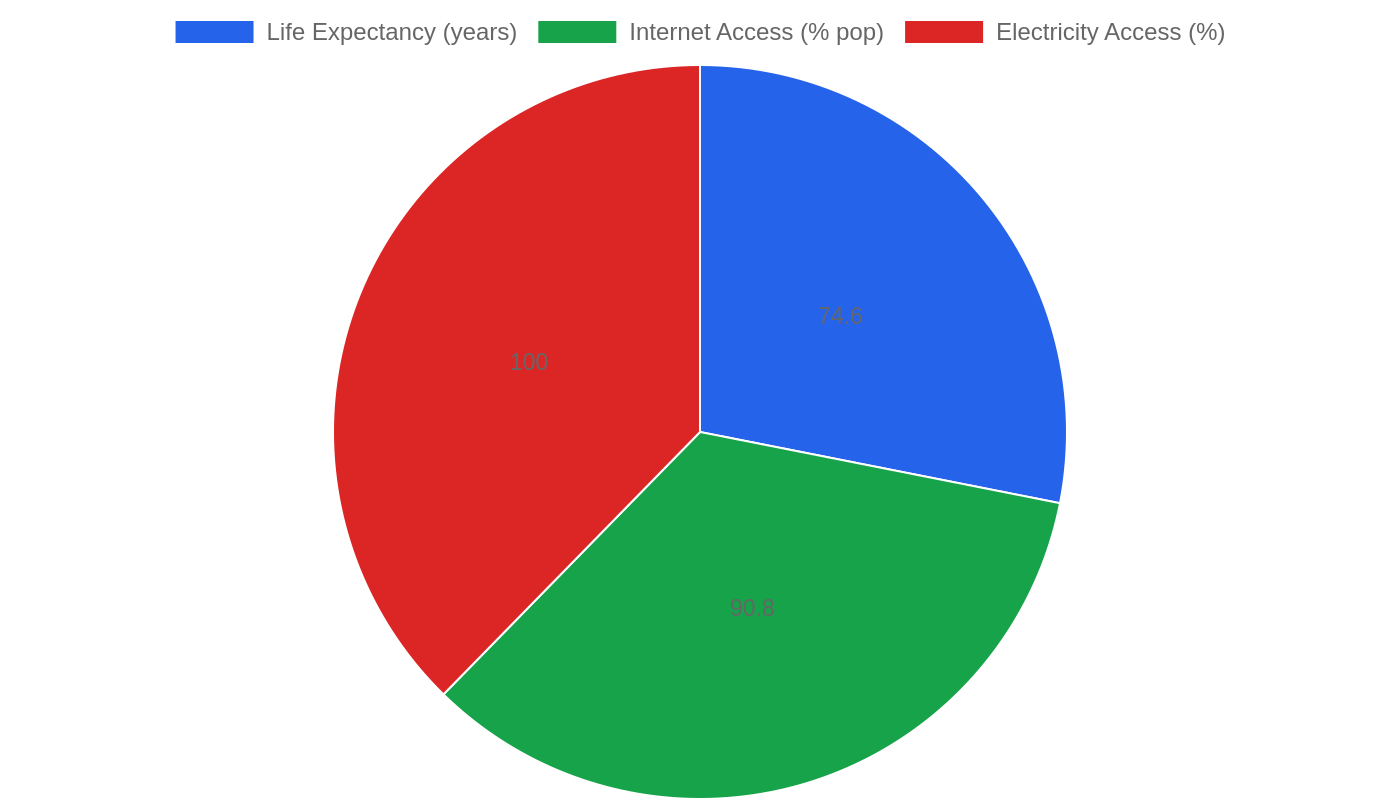
Economic Pulse Net | Sources: World Bank World Development Indicators, Government Sources | 2026
Key Takeaways
– Azerbaijan’s economy remains heavily concentrated in its state-owned industrial giants, with the country’s corporate landscape dominated by shipping, railway, and utility monopolies rather than a vibrant private sector.
– The political environment is defined by a single-family rule that has persisted since 1993, with international watchdogs categorizing the nation as “not free” and elections routinely marred by fraud allegations.
– The business climate offers opportunities primarily in infrastructure and energy-adjacent sectors, but investors must navigate a system where political connections and state control remain paramount.
– Despite its strategic Caspian location and energy wealth, Azerbaijan’s long-term economic trajectory depends on whether it can move beyond its current industrial base and attract diversified foreign investment.
– For international observers, Azerbaijan represents a case study in how resource wealth and authoritarian stability can coexist, but also how that combination can limit broader economic development.
The Economic Engine: Hydrocarbons, Heavy Industry, and the Limits of Growth
The Azerbaijani economy, as tracked by the World Bank, presents a complex picture that defies simple categorization. While the country has historically leveraged its Caspian Sea energy resources to drive growth, the most recent World Bank data shows a nation in transition, with key indicators like GDP growth, inflation, and unemployment currently unrecorded in the latest reporting cycle.
This statistical gap itself tells a story: Azerbaijan is at a moment where its traditional economic drivers are facing headwinds, and the metrics that once charted its rapid ascent have become less certain.
The corporate landscape offers the clearest window into where the real economic power lies. The Azerbaijan Caspian Shipping Company and Azerbaijan Railways, both classified under Industrials, represent the backbone of the country’s trade and transport infrastructure. These are not merely companies; they are strategic state assets that move goods, energy, and people across the Caspian corridor.
Alongside them, Azersu Open Joint Stock Company, the national water utility, and Akkord Industry Construction Investment Corporation highlight a pattern: the commanding heights of the Azerbaijani economy remain firmly in state hands or tied to government contracts. This is an economy where the private sector exists, but it operates in the shadow of state-dominated enterprises that control the critical infrastructure upon which all other business depends.
What this means in practical terms is that Azerbaijan’s economic performance is less about market dynamics and more about state investment priorities. The concentration in industrials and utilities suggests a growth model built on large-scale, capital-intensive projects rather than consumer-driven expansion. For the average citizen, this creates a disconnect between macroeconomic indicators and daily experience.
The World Bank’s data, when it is available, tends to reflect the health of these large enterprises and the global prices for Azerbaijan’s energy exports, rather than the vibrancy of small and medium-sized businesses. The challenge for Baku is clear: how do you build a resilient, diversified economy when your corporate sector is dominated by a handful of state-linked behemoths?
The Cost of Living Puzzle: Infrastructure Strength, Consumer Uncertainty
Understanding the cost of living in Azerbaijan requires reading between the lines of the available data. With the World Bank reporting no current figures for GDP per capita on a purchasing power parity basis or GNI per capita, analysts must look to the structure of the economy to gauge household financial health.
The dominance of state-owned utilities like Azersu and the significant presence of consumer services companies in the top corporate rankings—including Medeniyyet TV, AF Hotel Group, and ANS Group of Companies—suggests a society where the state provides certain basic services while a domestic consumer market exists, but is not yet the primary engine of economic growth.
The presence of a hotel group and media companies among the top ten firms indicates that there is a domestic consumer class with disposable income, likely concentrated in the capital city of Baku. However, the lack of inflation data makes it difficult to assess whether that purchasing power is being eroded by rising prices. In many post-Soviet economies, the cost of living is heavily influenced by import dependence, and Azerbaijan is no different.
When global food and goods prices rise, they are transmitted directly to local markets. The absence of hard data on housing costs or rental prices is notable, but the industrial composition implies a bifurcated market: a modern, higher-cost urban center catering to the business and political elite, and a more traditional, lower-cost rural economy.
For the average Azerbaijani, the economic reality is likely one of stagnant wages in the public sector, offset by the relatively low cost of state-subsidized utilities, but challenged by the price of imported consumer goods.
Investment Climate: Navigating a State-Dominated Corporate Arena
For foreign and domestic investors, Azerbaijan presents a paradoxical environment. On one hand, the financial sector shows signs of life with the presence of AccessBank Azerbaijan and AtaBank among the top companies. These institutions suggest a functioning banking system capable of facilitating investment and corporate finance.
On the other hand, the sheer weight of state-linked industrial and utility companies in the rankings signals that the most lucrative opportunities—those related to energy export infrastructure, shipping, and major construction—are likely reserved for entities with close ties to the government.
The inclusion of AF Holding, a conglomerate, alongside its hotel group subsidiary highlights how business in Azerbaijan often operates through family or politically connected networks that span multiple sectors. This is an environment where “who you know” is often as important as “what you know.” The business climate is therefore not hostile, but it is highly relationship-driven.
Investors looking to enter the market must be prepared for a slower pace of deal-making, a requirement for local partnerships, and an understanding that the state’s industrial champions will always have the first claim on major projects. The sectors to watch are those that support the state’s infrastructure ambitions—construction, logistics, and utilities—as well as the consumer services sector that is gradually developing to serve the urban middle class.
Safety, Politics, and the Quality of Life Paradox
Azerbaijan’s political landscape is the defining context for any discussion of quality of life. The World Bank data indicates that the country is governed as an authoritarian regime in practice, with the Aliyev family and the New Azerbaijan Party maintaining a continuous grip on power since 1993. While elections are held regularly, international observers and organizations like Freedom House—which ranks the country 7 out of 100 for global freedom—document electoral fraud and unfair practices.
This political reality has a direct impact on economic life: it creates a system where property rights are respected only insofar as they align with state interests, and where the rule of law is applied unevenly.
The lack of crime and safety indices in the data makes it difficult to provide a definitive picture of public security. However, in many authoritarian states, there is often a trade-off between political repression and public safety. Azerbaijan is generally considered physically safe for residents and visitors in terms of street crime, but that safety comes at the cost of a pervasive state security apparatus that monitors political activity.
For the population, this creates a specific quality of life: one where personal security is relatively high, but where civil liberties are constrained. The happiness data, which is not available in this dataset, would likely reflect this tension—citizens may feel secure in their daily lives but frustrated by the lack of political voice and economic opportunity outside the state system.
Current Affairs: The Stasis of Power and the Search for a New Narrative
As of the latest reporting, Azerbaijan remains locked in a political holding pattern that has defined its post-Soviet history. The government, led by the Aliyev family, continues to dominate the political scene, with the New Azerbaijan Party maintaining its institutional monopoly on power. There are no indications in the current data of significant policy shifts or reforms that would alter the fundamental structure of the economy.
Instead, the focus remains on managing the existing state-controlled industrial base and ensuring the continued operation of key infrastructure assets like the shipping and railway companies.
The most significant ongoing story is the continued evolution of Baku’s role as a regional hub. The emphasis on the Azerbaijan Caspian Shipping Company and Azerbaijan Railways suggests a strategic focus on transit and logistics, positioning the country as a key link in the Middle Corridor trade route that connects Asia to Europe via the Caucasus. This is a pragmatic strategy for a government that recognizes the limitations of its domestic market.
However, the absence of new economic data from the World Bank suggests that the tangible benefits of this strategy have yet to translate into measurable improvements in GDP growth or inflation control. The current affairs of Azerbaijan are characterized by a quiet continuity—a government managing its assets, maintaining its political control, and waiting for the global energy and trade dynamics to shift in its favor.
The Bottom Line
Azerbaijan is a country of strategic importance and untapped potential, but it remains constrained by its political system. The economy is built on a solid foundation of state-controlled infrastructure and energy resources, providing a level of stability that many of its neighbors lack. However, for investors and observers, the lack of fresh economic data and the entrenched political structure are significant red flags.
This is a nation to watch for its geopolitical positioning and its industrial capacity, but not one where rapid, market-driven transformation is likely. Those interested in the Caspian region should monitor Azerbaijan for its role in energy transit and regional trade, while maintaining realistic expectations about the pace of domestic reform and economic diversification.
Sources & Methodology
This article is authored by Economic Pulse Net for informational and research purposes. Economic Pulse Net sources its data from multilateral institutions, national statistics bureaus, and proprietary databases. All data is believed to be current as of the date of publication.
Published: August 01, 2026 | Category: Research — Azerbaijan
Use these signals in your own platform
Economic Pulse publishes its live signal feed through a documented, read-only API. Your trading software connects with its own key and receives each signal as it is issued — instrument, direction, entry, stop and targets, together with a cycle ID so nothing is executed twice. The feed is independent of this website and cannot change it.
Signals are informational only and are not financial advice.