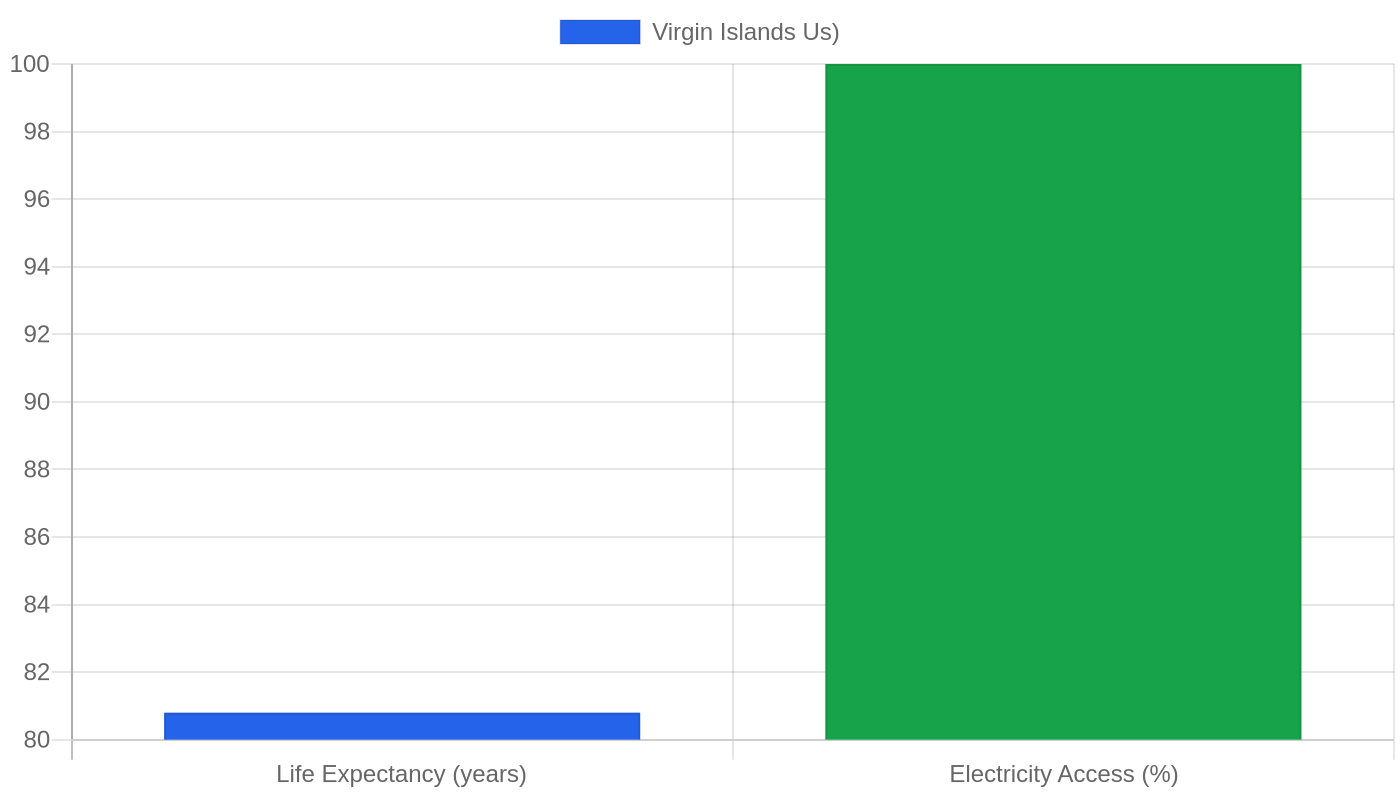
Economic Pulse Net | Sources: World Bank World Development Indicators, Government Sources | 2026
The United States Virgin Islands sits at a curious crossroads in the Caribbean economic landscape. It is a territory with immense natural beauty, a strategic location along major shipping lanes, and a tourism sector that has historically been its lifeblood. Yet, for the observer peering into the World Bank’s data portals, the Virgin Islands presents a frustrating paradox: the headline indicators—GDP growth, inflation, unemployment, and even population—are all listed as unavailable.
This statistical silence is not merely an administrative gap; it is a reflection of a broader challenge facing the territory. In an era where data drives investment and policy, operating in a vacuum makes it difficult to attract capital, benchmark progress, or even tell its own story to the world. This feature delves into what we know about the economic architecture of this territory, the industries that sustain it, and the structural hurdles it must overcome to secure a prosperous future.
Key Takeaways
– Data Transparency Gap: The World Bank currently lists no key economic indicators (GDP, inflation, unemployment) for the US Virgin Islands, creating a significant challenge for investors and policymakers seeking to gauge economic health.
– Tourism as the Linchpin: The territory’s economy is overwhelmingly reliant on its tourism and hospitality sectors, making it highly vulnerable to external shocks such as hurricanes, global pandemics, and shifts in travel patterns.
– Strategic Geographic Asset: Located at the northeastern edge of the Caribbean, the Virgin Islands possess a deep-water port and proximity to major shipping lanes, offering an underutilized opportunity for logistics and trade.
– Infrastructure Vulnerability: The territory remains in a prolonged recovery phase from recent natural disasters, with the rebuilding of energy grids, housing, and tourism facilities being the primary driver of local economic activity.
– An Uncertain Political Horizon: As a U.S. territory, the islands face unique political constraints that limit its ability to control its own monetary policy or negotiate independent trade agreements—a factor that defines its business climate.
The Economic Engine: Tourism Dependency and the Cost of Isolation
When discussing the economy of the US Virgin Islands, one must start with the undeniable reality that it is a tourism-dependent microstate. The absence of hard data from the World Bank—no GDP per capita, no inflation figures—does not diminish the fact that the service sector dominates the local landscape. The economy functions on a cyclical basis, driven by the ebb and flow of cruise ship arrivals and hotel occupancy rates.
This reliance creates a “boom or bust” dynamic; when global travel is strong, the local economy thrives, but when crises hit—whether health-related or meteorological—the islands face immediate economic contraction. Without official data, we cannot quantify the inflation rate, but the lived experience of residents suggests that the cost of imported goods remains a persistent pressure point.
Because the islands import the vast majority of their consumer goods, food, and fuel, they are price takers in the global market. This structural import dependency means that global supply chain disruptions or spikes in oil prices hit the local economy harder than more diversified markets. The lack of World Bank data also masks the informal economy, which is likely substantial, as many residents engage in small-scale vending, taxi services, and informal construction work that goes unrecorded in official statistics.
Housing and the Cost of Living: The Price of Paradise
The cost of living in the US Virgin Islands is notoriously high, a fact that shapes the quality of life for its residents. While specific rental indices are unavailable, the economic reality is dictated by the islands’ insularity. Nearly everything—from building materials to food staples—must be shipped in, and those shipping costs are passed directly to the consumer. Housing is a particularly acute challenge.
The territory faces a limited supply of affordable housing, a situation exacerbated by the damage wrought by recent hurricanes which destroyed a significant portion of the housing stock. This scarcity drives up prices for the available units, creating a market where rent consumes a disproportionate share of household income. For the average worker in the hospitality industry, the dream of homeownership remains largely out of reach, leading to a “rent burdened” population.
Compared to mainland standards, utility costs—specifically electricity—are exceptionally high, as the territory relies heavily on imported fossil fuels for power generation. This high cost of utilities adds another layer of financial strain on families and makes the operation of small businesses more expensive, further entrenching the cycle of high prices.
Investment and Business Climate: A Tale of Reconstruction
The primary business climate narrative in the US Virgin Islands is currently defined by reconstruction and resilience. With the World Bank data silent on formal investment figures, we must look at the physical landscape to understand the economic priorities. The largest “industry” at present is the rebuilding effort itself—construction, engineering, and infrastructure rehabilitation. This creates a unique opportunity for businesses in the construction supply chain, project management, and logistics.
However, the business environment is not without its friction points. The territory suffers from a lack of economic diversification; there are no major manufacturing hubs or tech sectors to speak of. The top companies operating here are predominantly in the tourism, retail, and banking sectors, catering to the visitor economy or providing essential local services. For investors, the primary deterrent is the uncertainty surrounding the political status and the fragility of the infrastructure.
While there is potential in the “Blue Economy”—sustainable marine resources, renewable energy, and eco-tourism—these sectors remain nascent. The business climate is therefore one of high risk and high potential reward, heavily reliant on government contracts and federal disaster recovery funds.
Safety, Politics, and Quality of Life
The political landscape of the US Virgin Islands is defined by its territorial status, which brings both benefits and limitations. While the territory enjoys a degree of local autonomy, it lacks voting representation in the U.S. Congress and has no control over its foreign policy or currency. This political limbo creates an environment of uncertainty, as the islands are subject to federal laws but have limited say in their formulation.
Regarding safety, the data provided is silent, but like many Caribbean territories, the islands grapple with social issues that are exacerbated by economic inequality. The high cost of living and limited economic opportunity can strain the social fabric. However, the quality of life is often measured by the strength of the community and the natural environment.
The recovery from natural disasters has been a test of the territory’s resilience, and the slow pace of rebuilding has led to frustration among the population. The political discourse is heavily focused on securing more federal assistance and pushing for greater economic self-sufficiency, though progress is often slow-moving.
What’s Happening Now: The Long Road to Resilience
Right now, the pulse of the Virgin Islands economy is beating to the rhythm of reconstruction. The most pressing current affair is the ongoing effort to harden the territory’s infrastructure against future climate shocks. There is a visible push towards renewable energy, with solar projects being developed to reduce the crippling dependence on imported fuel.
The tourism sector is attempting to reinvent itself, moving away from high-volume, low-yield cruise tourism towards high-end, eco-conscious travel that promises greater economic returns per visitor. However, this transition is hampered by labor shortages, as many skilled workers left the territory after the storms and have not returned.
The government is currently navigating the complex process of utilizing recovery funds, trying to balance the immediate need for housing with the long-term goal of building a more modern, resilient grid. The business community is watching these developments closely, aware that the success of these projects will determine whether the Virgin Islands can finally break free from its cycle of vulnerability and establish a stable, diversified economic base for the next decade.
The Bottom Line
The US Virgin Islands is a nation in waiting. The lack of concrete data from the World Bank is a red flag for traditional investors, but it also signals an untapped frontier for those willing to navigate the complexity. This is a country for the patient investor, specifically those involved in infrastructure development, renewable energy, and sustainable tourism. The government is the primary driver of economic activity, and anyone looking to enter this market must be prepared to work closely with public agencies.
For the casual observer, the Virgin Islands serves as a case study in the fragility of tourism-dependent economies in the era of climate change. It is a place where the beauty of the landscape contrasts sharply with the harsh realities of economic isolation. The next five years will be decisive in determining whether the territory can rebuild smarter and stronger, or whether it will remain a beautiful but economically vulnerable outpost in the Caribbean.
Sources & Methodology
This article is authored by Economic Pulse Net for informational and research purposes. Economic Pulse Net sources its data from multilateral institutions, national statistics bureaus, and proprietary databases. All data is believed to be current as of the date of publication.
Published: August 01, 2026 | Category: Research — Virgin Islands Us)
Use these signals in your own platform
Economic Pulse publishes its live signal feed through a documented, read-only API. Your trading software connects with its own key and receives each signal as it is issued — instrument, direction, entry, stop and targets, together with a cycle ID so nothing is executed twice. The feed is independent of this website and cannot change it.
Signals are informational only and are not financial advice.