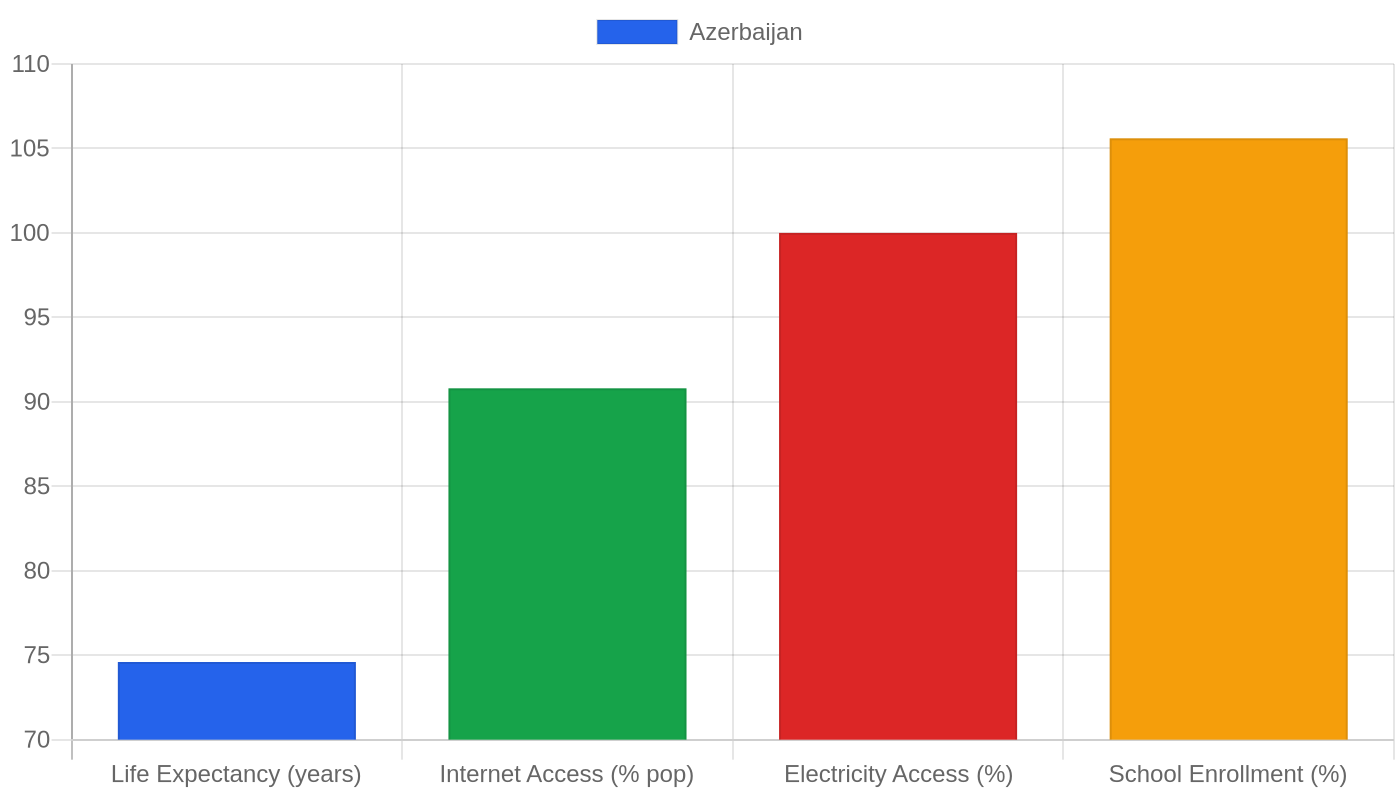
Economic Pulse Net | Sources: World Bank World Development Indicators, Government Sources | 2026
Key Takeaways
– Azerbaijan remains firmly under the grip of the Aliyev political dynasty, with the New Azerbaijan Party (YAP) dominating a political landscape that Freedom House rates as “not free” with a score of 7 out of 100 on its Global Freedom index.
– The economy is dominated by state-linked industrial giants, including Azerbaijan Caspian Shipping Company, Azerbaijan Railways, and Azersu Open Joint Stock Company, reflecting a model where infrastructure and utilities remain under tight state control.
– Financial sector activity is concentrated among institutions like AccessBank Azerbaijan and AtaBank, suggesting a banking system that serves both commercial interests and state-directed economic priorities.
– Despite regular electoral processes, international observers and human rights organizations consistently document electoral fraud and unfair election practices, creating a governance environment where political risk is structural rather than cyclical.
The Baku Paradox — Growth Without Transparency in a Resource-Rich Economy
Azerbaijan’s economic narrative is one of considerable potential wrapped in layers of opacity. The World Bank’s latest data does not provide specific figures for GDP growth, inflation, or unemployment, which itself tells a story. For a country that sits on substantial Caspian Sea hydrocarbon reserves and has invested heavily in infrastructure, the absence of timely, transparent macroeconomic indicators raises questions about data governance and economic management.
The backbone of Azerbaijan’s economy remains its industrial sector, dominated by state-owned or state-affiliated enterprises. The Azerbaijan Caspian Shipping Company is not merely a transport firm; it is a strategic asset that moves the oil and gas products upon which the national budget depends. Azerbaijan Railways similarly functions as both a commercial entity and an instrument of state policy, connecting the energy-rich Caspian littoral to markets in Georgia, Turkey, and beyond.
The Azersu Open Joint Stock Company, which manages water utilities, underscores how even basic public services are organized through large, state-controlled corporate structures rather than through decentralized municipal governance.
This industrial concentration creates a peculiar economic dynamic. On one hand, these enterprises provide employment and anchor the formal economy. On the other, they limit the space for private sector dynamism and entrepreneurial competition. When the largest employers are effectively extensions of the state, the economy becomes vulnerable to political decision-making rather than market forces.
The lack of transparent GDP and inflation data from the World Bank suggests that even international institutions struggle to get a clear picture of Azerbaijan’s true economic performance, which is concerning for investors and analysts who rely on comparable cross-country data.
Housing and Daily Life — The Cost of Living in a Dual Economy
Azerbaijan’s cost of living story is shaped by the sharp divide between Baku and the rest of the country. The capital city has undergone a dramatic transformation over the past two decades, with gleaming towers, luxury shopping centers, and high-end restaurants catering to a wealthy elite connected to the energy sector and state procurement.
This creates a bifurcated housing market where prime real estate in central Baku commands prices that rival those in Eastern European capitals, while regional cities and rural areas remain far more affordable but offer fewer economic opportunities.
For the average Azerbaijani family, daily expenses are heavily influenced by imported goods and energy subsidies. The government has historically maintained low domestic prices for natural gas and electricity, which keeps utility bills manageable for most households. However, food prices, particularly for imported staples and processed goods, have risen steadily as the manat has faced periodic pressure.
Rent in Baku’s desirable districts can consume a significant portion of a middle-class salary, pushing many young professionals to live with extended families or in older Soviet-era housing stock further from the city center.
The absence of reliable inflation data from the World Bank makes it difficult to track how purchasing power has evolved in recent years. What is clear is that Azerbaijan operates a dual economy: one connected to state contracts and energy revenues, which enjoys relative prosperity, and another comprising small traders, farmers, and public sector workers, whose real incomes have stagnated. This divide is visible in Baku’s streets, where luxury SUVs navigate potholed roads in working-class neighborhoods.
The Business Landscape — State-Linked Giants and a Constrained Private Sector
Azerbaijan’s corporate landscape is dominated by a relatively small number of large entities that span multiple sectors. The AF Holding conglomerate and its subsidiary AF Hotel Group illustrate how business groups in Azerbaijan often diversify across industries to manage risk and maintain political connections.
Similarly, the Akkord Industry Construction Investment Corporation has become a major player in infrastructure development, benefiting from state-funded building projects that have reshaped Baku’s skyline.
The financial sector is anchored by AccessBank Azerbaijan and AtaBank, both of which operate in a regulatory environment shaped by the central bank and political considerations. These institutions provide essential banking services to businesses and individuals, but the sector remains relatively shallow compared to regional peers. Credit is often directed toward favored sectors or companies with state connections, while small and medium enterprises struggle to access affordable financing.
The presence of Medeniyyet TV and ANS Group of Companies in the consumer services sector indicates that media and entertainment remain areas of commercial activity, though content is subject to political oversight in a country classified as “not free” by Freedom House.
For foreign investors, the business climate presents a paradox. The energy sector offers clear opportunities, particularly in oil and gas production and related logistics. The Azerbaijan Caspian Shipping Company’s fleet is a critical asset for anyone looking to move goods across the Caspian Sea. However, the rule of law is uneven, contracts can be subject to political interference, and the dominance of state-linked entities means that competing on a level playing field is difficult.
The lack of transparent GDP and economic data from the World Bank further complicates due diligence and risk assessment.
Security, Surveillance, and the Price of Stability
Azerbaijan’s crime and safety indices are not available from the data provided, which makes it difficult to offer precise comparisons with regional peers. What is known from the political landscape data is that the country operates under what analysts describe as an authoritarian regime. The Aliyev family has held power since 1993, and the New Azerbaijan Party (YAP) controls political life.
Freedom House’s assessment of 7 out of 100 on the Global Freedom index places Azerbaijan among the world’s most restricted political environments.
This political reality has direct implications for quality of life. On one hand, street crime in Baku is relatively low compared to many large cities, and the security apparatus maintains tight control over public spaces. On the other hand, this stability comes at the cost of political freedom, civil liberties, and the ability to challenge government decisions through independent courts or media.
Elections are held regularly, but they are marred by electoral fraud and unfair practices, according to multiple international observers cited in the data. For ordinary citizens, this means that political expression is constrained, and the avenues for holding officials accountable are limited.
The quality of life in Azerbaijan is therefore a mixed picture. Public infrastructure in Baku has improved significantly, with new parks, roads, and cultural venues. Healthcare and education systems, however, remain underfunded and uneven in quality. The concentration of opportunity in the capital means that many young Azerbaijanis either move to Baku or seek work abroad, particularly in Turkey and Russia.
The political stability that the Aliyev regime provides is real, but it is a stability built on limited political participation and the suppression of dissent.
Current Affairs — The Post-Conflict Era and the Search for Economic Diversification
Azerbaijan is currently navigating a complex period following its military victory in the Nagorno-Karabakh conflict, which fundamentally changed the regional security landscape. The government has announced ambitious plans to rebuild and develop the territories that came under its control, presenting this as both a national priority and an economic opportunity.
Construction companies like Akkord Industry Construction Investment Corporation are likely to be major beneficiaries of reconstruction contracts, which will channel significant state spending into infrastructure projects.
The political landscape remains dominated by the Aliyev family and YAP, with no meaningful opposition able to challenge their grip on power. The regular elections that the data mentions continue to be held, but they are characterized by the same unfair practices that international observers have documented for years. This political continuity provides predictability for the business elite but stifles the kind of political competition that might drive reforms in governance, transparency, and economic liberalization.
On the economic front, Azerbaijan faces the perennial challenge of diversifying away from hydrocarbon revenues. The state-linked industrial giants that dominate the economy — from shipping to railways to utilities — are efficient at executing state priorities but less adept at fostering innovation or competing in global markets. The financial sector, anchored by AccessBank and AtaBank, remains cautious and relationship-driven.
Without more transparent economic data from institutions like the World Bank, it is difficult for outside analysts to assess whether the non-energy economy is genuinely growing or merely treading water.
The Bottom Line
Azerbaijan is a country that demands attention from anyone with interests in Caspian energy, regional infrastructure, or post-conflict reconstruction. The dominance of state-linked industrial giants like Azerbaijan Caspian Shipping Company and Azersu creates opportunities for partners and suppliers who can navigate the political landscape, but the authoritarian governance structure documented by Freedom House means that political risk is ever-present.
Investors and analysts should watch Azerbaijan for its strategic position and resource wealth, but they must do so with eyes wide open to a system where economic opportunity is inseparable from political connection.
Sources & Methodology
This article is authored by Economic Pulse Net for informational and research purposes. Economic Pulse Net sources its data from multilateral institutions, national statistics bureaus, and proprietary databases. All data is believed to be current as of the date of publication.
Published: July 18, 2026 | Category: Research — Azerbaijan
Use these signals in your own platform
Economic Pulse publishes its live signal feed through a documented, read-only API. Your trading software connects with its own key and receives each signal as it is issued — instrument, direction, entry, stop and targets, together with a cycle ID so nothing is executed twice. The feed is independent of this website and cannot change it.
Signals are informational only and are not financial advice.