Economic Pulse Net | Sources: World Bank World Development Indicators, Government Sources | 2026
Key Takeaways
* Political Stability via Autocracy: The Aliyev family and the New Azerbaijan Party have maintained continuous control since 1993, operating an authoritarian regime that is classified as “not free” by Freedom House.
Industrial Dominance: The economy is heavily anchored by state-linked industrial giants, including Azerbaijan Caspian Shipping Company, Azerbaijan Railways, and major utility providers like Azersu.
Financial Sector Consolidation: Key banking institutions such as AccessBank Azerbaijan and AtaBank operate within a tightly controlled financial landscape, alongside conglomerates like AF Holding.
Media Landscape Control: Consumer services sectors are dominated by media entities like Medeniyyet TV and ANS Group, reflecting a centralized information environment.
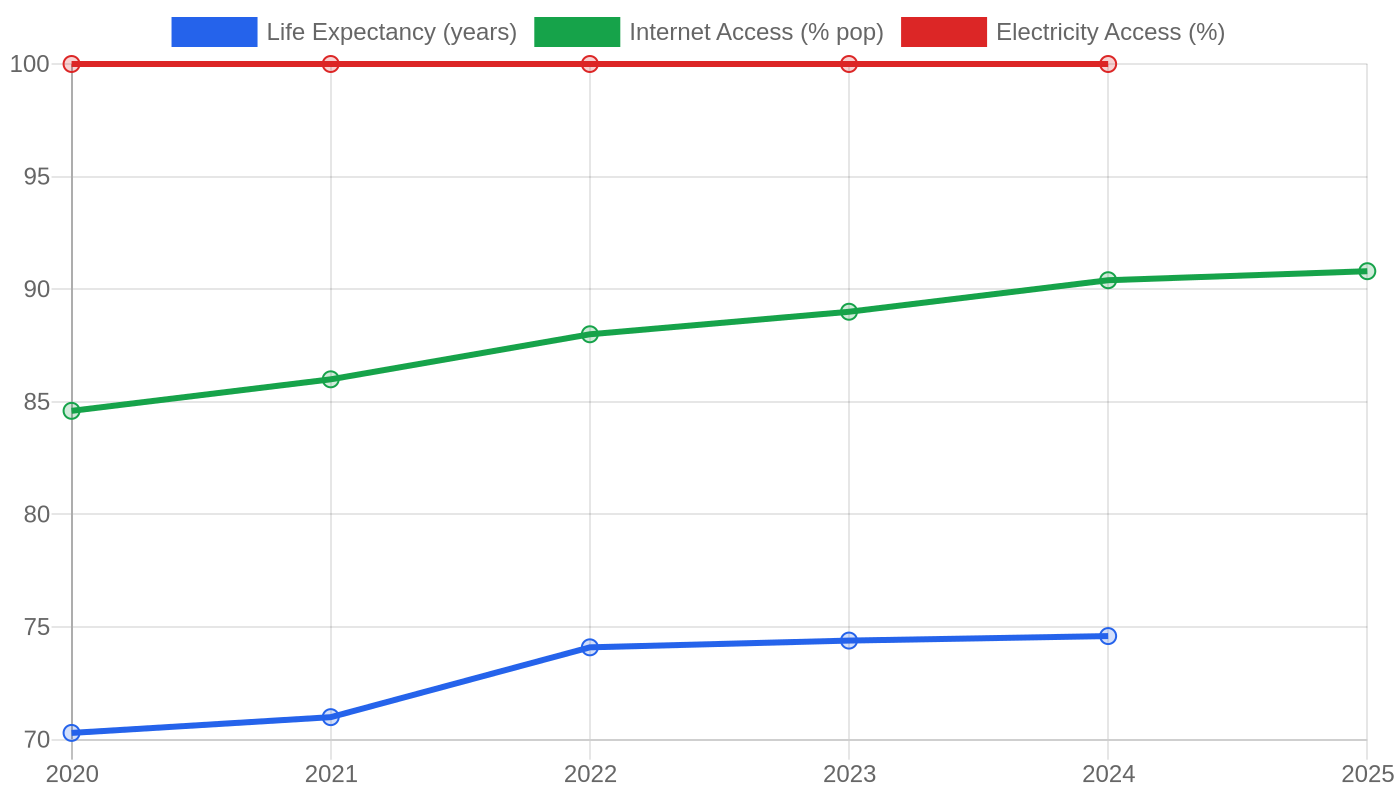
Data Transparency Gaps: Official macroeconomic indicators such as GDP growth, inflation rates, and unemployment figures are currently listed as N/A, complicating traditional economic forecasting models.
Economic Foundations and Industrial Structure
The economic architecture of Azerbaijan is defined less by transparent market metrics and more by the sheer weight of its state-affiliated industrial base. While specific World Bank data points for GDP growth, inflation, and unemployment remain unavailable or marked as N/A, the structural composition of the economy reveals a nation where large-scale infrastructure and logistics drive national output.
The presence of heavyweights like Azerbaijan Caspian Shipping Company and Azerbaijan Railways indicates that transportation and trade corridors through the Caspian Sea are central to the country’s value proposition. These entities do not just facilitate movement; they represent significant capital accumulation and employment hubs within the industrials sector.
Furthermore, the utility sector, represented by Azersu Open Joint Stock Company, ensures that essential services remain under strict corporate oversight, likely tied to state interests. This industrial concentration suggests an economy that prioritizes stability and control over rapid, volatile expansion. For investors and analysts, the absence of standard macroeconomic data forces a reliance on observing these corporate behemoths rather than broad economic indices to gauge health.
The dominance of conglomerates like AF Holding further illustrates a business environment where diversified holdings play a crucial role in maintaining economic continuity amidst political rigidity.
Cost of Living and Housing Dynamics
Assessing the cost of living in Azerbaijan requires navigating a landscape where detailed consumer price indices and housing metrics are not explicitly provided in current datasets. However, the structure of the top companies offers indirect clues about the commercial real estate and service sectors.
With prominent players like AF Hotel Group and Medeniyyet TV operating in the consumer services space, there is a clear infrastructure catering to both domestic consumption and potentially international tourism or business travel. The existence of established hospitality groups suggests a tiered market for accommodation, ranging from budget to luxury, which typically influences local rental and property prices.
Without specific CPI data, one must infer that daily expenses are likely shaped by the availability of imported goods versus locally produced utilities managed by entities like Azersu. In regions with similar political structures, housing costs often correlate closely with the proximity to government centers and major industrial hubs.
Therefore, while exact rent-to-buy ratios are unavailable, the presence of robust corporate service providers implies a functional, albeit possibly expensive, urban economy for those engaged in high-level business or diplomatic activities. The lack of transparent cost-of-living data means expatriates and businesses must rely on localized, anecdotal evidence rather than standardized national averages.
Investment and Business Climate
The investment landscape in Azerbaijan is characterized by the overwhelming presence of large, established corporations that dominate key sectors. For foreign direct investment or local partnership opportunities, the primary gatekeepers are firms like AccessBank Azerbaijan and AtaBank, which control the flow of credit and financial services in a market described as politically constrained.
The financials sector, therefore, does not operate in a vacuum but is deeply intertwined with the political will of the ruling party. Meanwhile, the industrials sector offers tangible assets for investment, with Akkord Industry Construction Investment Corporation and Azerbaijan Railways providing exposure to infrastructure development projects. These companies benefit from their scale and likely state backing, making them stable but potentially less agile partners compared to smaller private enterprises.
The consumer services sector, featuring ANS Group of Companies and AF Holding, presents opportunities in media and hospitality, though these industries operate within the boundaries set by the authoritarian political framework. Investors must navigate a climate where regulatory decisions can be influenced by political loyalty rather than pure market efficiency.
Consequently, due diligence goes beyond financial statements to include an assessment of political risk and alignment with the New Azerbaijan Party’s long-term strategic goals.
Safety, Politics, and Quality of Life
Safety and political freedom in Azerbaijan present a complex dichotomy for residents and visitors alike. The Crime Index and Safety Index are listed as N/A, meaning statistical measures of public safety are not readily available for comparison. However, the political landscape provides critical context for quality of life. The government functions as an authoritarian regime, with elections regularly held but marred by electoral fraud and unfair practices, according to extensive reporting.
This political reality is underscored by Freedom House, which categorizes the country as “not free” and ranks it poorly on global freedom indexes. The continuous rule of the Aliyev political family and the New Azerbaijan Party since 1993 creates a highly centralized power structure. For citizens, this translates to limited political expression and a tightly controlled social environment.
While physical safety may vary by region, the broader quality of life is significantly impacted by the lack of democratic freedoms and civil liberties. Individuals and organizations operating in this space must prioritize security protocols that account for political sensitivities and surveillance risks, given the “not free” classification. The absence of crime statistics does not negate the need for caution, especially in areas involving political discourse or independent journalism.
Current Affairs and Policy Shifts
Currently, the most defining feature of Azerbaijan’s news cycle is the entrenchment of its political system rather than sudden economic reforms. Recent analyses highlight the persistent nature of the Aliyev family’s control, noting that despite regular elections, the process remains fundamentally undemocratic. This political stasis directly influences policy shifts, as reforms are likely designed to consolidate power rather than liberalize the economy.
International observers continue to flag issues related to electoral integrity, which affects Azerbaijan’s standing in global governance forums. There are no recent indicators of significant inflation trends or new fiscal policies being announced, suggesting a period of managed stability. Business developments are likely focused on maintaining existing contracts with state-owned enterprises rather than sparking new market innovations.
The media landscape, dominated by groups like Medeniyyet TV and ANS, serves as a channel for state narratives, limiting the scope of public debate. Consequently, the “current affairs” narrative is one of continuity: the regime is secure, the economy is steady but opaque, and external pressure regarding human rights remains a constant backdrop. Stakeholders should watch for any changes in how the government engages with international bodies, as this could signal subtle shifts in economic openness.
The Bottom Line
Azerbaijan is a country where political stability is guaranteed by authoritarian control, creating a predictable but restrictive environment for business and civil society. Investors interested in infrastructure, logistics, and energy-related services should focus on the dominant state-linked corporations like Azerbaijan Railways and Azersu, while remaining vigilant about political risks.
The lack of transparent economic data and freedom ratings makes this a challenging market for those requiring high levels of regulatory clarity and democratic accountability. Ultimately, this country is best suited for stakeholders who prioritize long-term resource access over short-term market dynamism and who possess the expertise to navigate complex geopolitical landscapes.
Sources & Methodology
This article is authored by Economic Pulse Net for informational and research purposes. Economic Pulse Net sources its data from multilateral institutions, national statistics bureaus, and proprietary databases. All data is believed to be current as of the date of publication.
Published: September 27, 2026 | Category: Research — Azerbaijan
Use these signals in your own platform
Economic Pulse publishes its live signal feed through a documented, read-only API. Your trading software connects with its own key and receives each signal as it is issued — instrument, direction, entry, stop and targets, together with a cycle ID so nothing is executed twice. The feed is independent of this website and cannot change it.
Signals are informational only and are not financial advice.