Economic Pulse Net | Sources: World Bank World Development Indicators, Government Sources | 2026
Key Takeaways
– Uzbekistan is undergoing a quiet but determined post-Soviet transformation, with state-owned industrial giants still dominating the economy while consumer goods companies like Artel Electronics signal a shift toward private-sector growth.
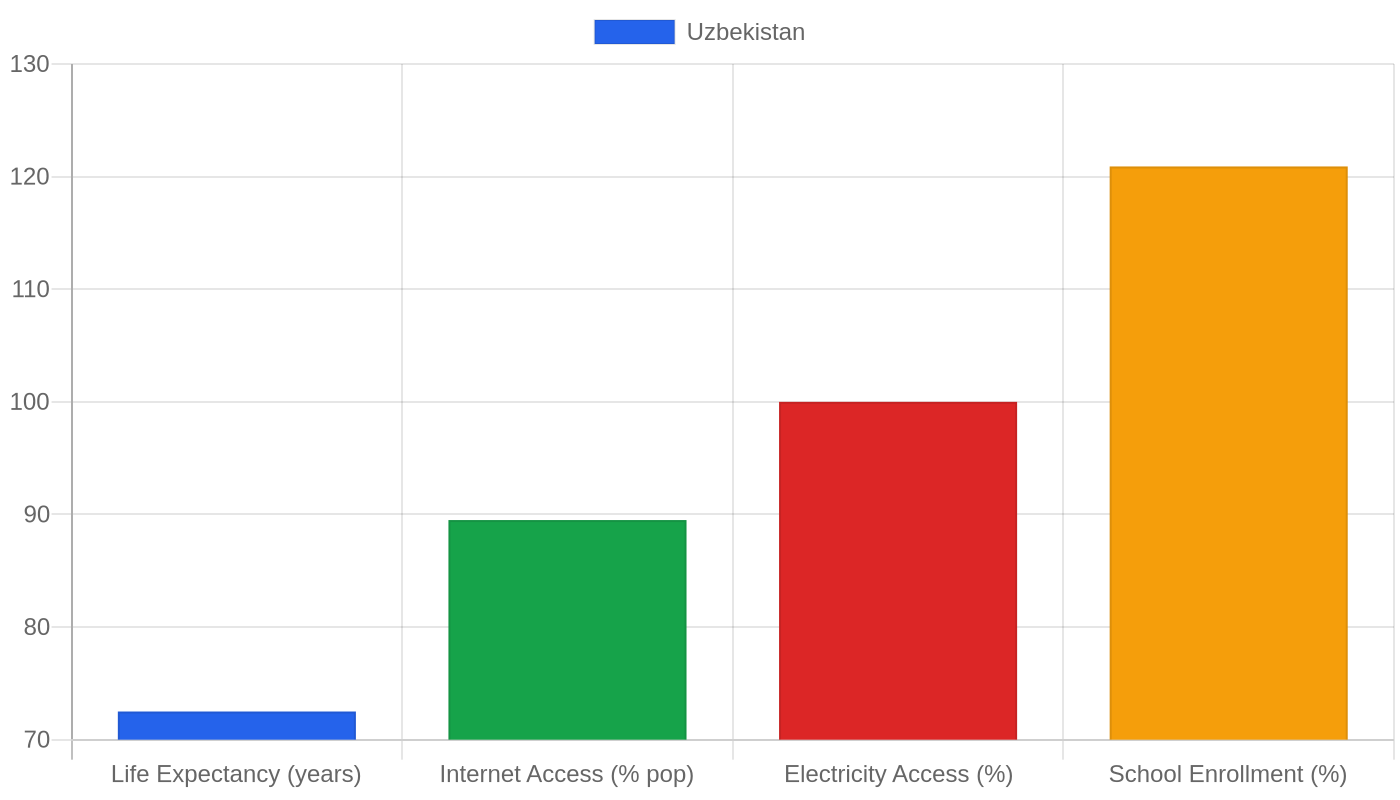
– The country’s economic data remains opaque — the World Bank provides no current figures for GDP growth, inflation, unemployment, or GDP per capita — making it one of the most statistically invisible major economies in Central Asia.
– Political power has been consolidated since independence in 1991, with a bicameral parliament of 150 members in the Legislative Chamber and 100 senators, but the system remains heavily centralized under presidential authority.
– Key industries are anchored by massive state-linked players: Navoi Mining and Metallurgical Company in basic materials, GM Uzbekistan in automotive, and the Tashkent Aviation Production Association in industrials.
– For investors and analysts, Uzbekistan represents a high-risk, high-reward frontier where reform momentum exists but measurable economic progress is difficult to verify through publicly available data.
The Tashkent Paradox — Growth Without a Paper Trail
The World Bank’s latest data on Uzbekistan is a study in silence. GDP growth: not available. Inflation: not available. Unemployment: not available. GDP per capita: not available. For a country of roughly 35 million people — Central Asia’s most populous nation — this statistical vacuum is itself a story. It is not that Uzbekistan is not growing; it is that the official machinery for measuring that growth has not kept pace with the country’s ambitions.
What the World Bank *does* confirm is the shape of Uzbekistan’s industrial skeleton. The country’s top companies read like a directory of the post-Soviet command economy, slowly being retrofitted for market competition. Navoi Mining and Metallurgical Company dominates basic materials — uranium, gold, and other minerals that have long been Uzbekistan’s quiet export backbone.
GM Uzbekistan, a joint venture with the American automaker, churns out cars for a domestic market where personal vehicle ownership is still a status symbol. And then there is Artel Electronics, the consumer goods giant that has become the face of Uzbekistan’s emerging private sector, producing everything from refrigerators to televisions for households across the region.
The absence of headline economic numbers does not mean stagnation. It means opacity. For the World Bank, for the International Monetary Fund, and for foreign investors, Uzbekistan remains a country where the data trail is thin, and where the real economy moves faster than the statistics bureau can track it.
The Cost of Living in a Statistical Shadow
Without cost-of-living indices from the World Bank or other major sources, painting a precise picture of daily life in Tashkent or Samarkand requires inference from the industrial landscape. What is clear is that Uzbekistan’s economy is still heavily shaped by state-linked enterprises that influence everything from employment to housing prices.
The presence of companies like O’zelectroapparat-Electroshield and SamKochAvto — both industrials — suggests a manufacturing base that employs large numbers of workers in and around Tashkent. Housing costs in the capital have risen in recent years as the city modernizes, but without regional comparison data, it is impossible to say whether Tashkent is cheap or expensive by Central Asian standards.
What can be said is that the dominance of state-linked firms like O’zbekiston Pochtasi, the national postal service, and Avialeasing, the aviation leasing company, means that many workers’ livelihoods are tied to the health of these enterprises — and that health is not publicly reported in any detail.
For the average Uzbek household, daily expenses are likely shaped by the same forces that drive the broader economy: a mix of Soviet-era industrial wages, emerging consumer goods markets, and a currency that has historically been volatile. The lack of official CPI data from the World Bank means that even basic questions about inflation — is bread getting more expensive? Is rent rising? — cannot be answered with authority.
The Artel Effect — Where Business and Politics Meet
Uzbekistan’s business climate is a study in concentration. The list of top companies provided by the World Bank is dominated by industrials: seven of the ten largest firms operate in sectors like manufacturing, aviation, automotive assembly, and postal services. Only two — Artel Electronics and GM Uzbekistan — are consumer-facing. One, the Central Bank of Uzbekistan, is the monetary authority itself.
This concentration matters. It means that the private sector, where it exists, is still dwarfed by state-connected enterprises. Artel Electronics is the exception that proves the rule: a homegrown consumer goods company that has managed to build a brand across Central Asia without being a direct arm of the state. Its presence on the list suggests that there is room for private capital in Uzbekistan — but the path is narrow.
For foreign investors, the sectors to watch are basic materials and industrials. Navoi Mining and Metallurgical Company is a global player in uranium and gold, commodities that will only grow in importance as the world transitions to nuclear energy and seeks stable supply chains outside of Russia. The Tashkent Aviation Production Association, meanwhile, represents a legacy of Soviet aerospace engineering that could be revived for modern markets. But the business environment remains opaque.
Without reliable data on taxation, property rights, or contract enforcement from the World Bank or other sources, investors are flying blind.
The Politics of Stability — And Its Price
Uzbekistan’s political landscape, as described by the World Bank data, is one of continuity. After independence from the Soviet Union in 1991, Islam Karimov was elected the first president on 29 December of that year. The Supreme Soviet was replaced by the Oliy Majlis in 1994, and the current system is bicameral: a 150-member Legislative Chamber and a 100-member Senate, both elected for five-year terms.
This structure has provided political stability — but at a cost. The absence of any crime or safety indices from the World Bank makes it impossible to compare Uzbekistan’s security situation to its neighbors. What is known is that the country has avoided the kind of violent instability that has plagued parts of Afghanistan and Tajikistan. Tashkent is widely considered safe by regional standards, though the lack of data means that claim rests on anecdote rather than evidence.
Quality of life in Uzbekistan is shaped by these political realities. The state provides basic services, but the economy’s reliance on state-linked enterprises means that opportunity — and mobility — are limited for those outside the system. The country’s young population, educated and increasingly connected to the internet, may be the force that pushes for more transparency in the years ahead.
The Reform Window — What’s Happening Now
The most important thing happening in Uzbekistan right now is not captured in any of the World Bank’s data fields. It is the slow, grinding process of economic liberalization that began under President Shavkat Mirziyoyev, who took office after Karimov’s death in 2016. Mirziyoyev has opened the country to foreign investment, relaxed currency controls, and sought to modernize the agricultural and industrial sectors.
But the data gap remains. Without current GDP growth figures from the World Bank, it is impossible to say whether these reforms are working. Without inflation data, it is impossible to say whether the cost of living is stabilizing or spiraling. Without unemployment numbers, it is impossible to say whether the young population is finding work.
What can be said is that the companies on the World Bank’s list are not standing still. Artel Electronics continues to expand its product lines. Navoi Mining is positioning itself as a key supplier for global energy markets. GM Uzbekistan is updating its vehicle lineup. These are not the actions of a stagnant economy — but they are also not the actions of one that is transparent about its progress.
The Bottom Line
Uzbekistan is a country to watch for anyone interested in Central Asia’s economic future — but it is not a country for those who demand clear data. The absence of basic economic statistics from the World Bank is itself a warning sign: the government in Tashkent has not yet committed to the kind of transparency that attracts serious foreign capital.
For now, Uzbekistan remains a frontier market in the truest sense — full of potential, rich in resources, but shrouded in the statistical fog of its Soviet inheritance. Investors and analysts should monitor the reform trajectory, but they should not expect clarity anytime soon.
Sources & Methodology
This article is authored by Economic Pulse Net for informational and research purposes. Economic Pulse Net sources its data from multilateral institutions, national statistics bureaus, and proprietary databases. All data is believed to be current as of the date of publication.
Published: July 28, 2026 | Category: Research — Uzbekistan
Use these signals in your own platform
Economic Pulse publishes its live signal feed through a documented, read-only API. Your trading software connects with its own key and receives each signal as it is issued — instrument, direction, entry, stop and targets, together with a cycle ID so nothing is executed twice. The feed is independent of this website and cannot change it.
Signals are informational only and are not financial advice.