Economic Pulse Net | Sources: World Bank World Development Indicators, Government Sources | 2026
Thailand enters 2026 as a study in contradictions. The kingdom’s economy is expanding at a modest clip, its labour market is exceptionally tight, and yet prices are falling — a combination that tells a deeper story about an export-driven nation navigating a delicate global moment. From Bangkok’s gleaming skyline to the industrial estates of the Eastern Economic Corridor, the country is positioning itself as a hub for connectivity, tourism, and technology.
But beneath the surface, political evolution and structural shifts are reshaping what “Thailand Inc.” means for investors, workers, and the region at large.
Key Takeaways
– Growth with a chill: The World Bank reports GDP growth of 2.44% in 2025 — steady, but unspectacular, signalling a mature economy searching for its next engine.
– Deflation is here: Inflation stands at -0.13%, meaning consumer prices are actually falling. That’s a double-edged sword — good for buyers, worrying for producers and debtors.
– Full employment, almost: Unemployment is a microscopic 0.78%, one of the lowest rates in the world. Labour is scarce; talent is gold.
– A $577 billion economy: Thailand’s GDP is substantial, with per-capita purchasing power near $26,250 — a middle-income nation with upper-middle-income ambitions.
– Infrastructure is the story: From airports to telecoms, the top companies list reads like a blueprint for a connected, mobile-first society.
The Growth Paradox — Modest Expansion, Falling Prices
Thailand’s economy grew by 2.44% in 2025, according to World Bank data. In most emerging markets, that number would be cause for celebration. For Thailand, it feels like a plateau. The country has long punched above its weight as a regional manufacturing and tourism powerhouse, but the post-pandemic rebound has cooled into something more measured.
The headline numbers, however, mask a fascinating anomaly: deflation. Consumer prices contracted by 0.13% over the year. In plain English, goods and services are getting slightly cheaper. That might sound delightful, but economists view persistent deflation with caution. When prices fall, consumers may delay purchases, businesses see profit margins squeezed, and the real burden of debt rises. For a nation with a large domestic consumption base, this is a signal that demand is soft even as employment is full.
And employment is remarkably full. Unemployment sits at just 0.78% — essentially everyone who wants a job has one. This is a structural feature of Thailand’s labour market, which has historically been tight due to demographic shifts and a large informal sector. The flip side is that businesses struggle to find skilled workers, which can cap expansion and innovation.
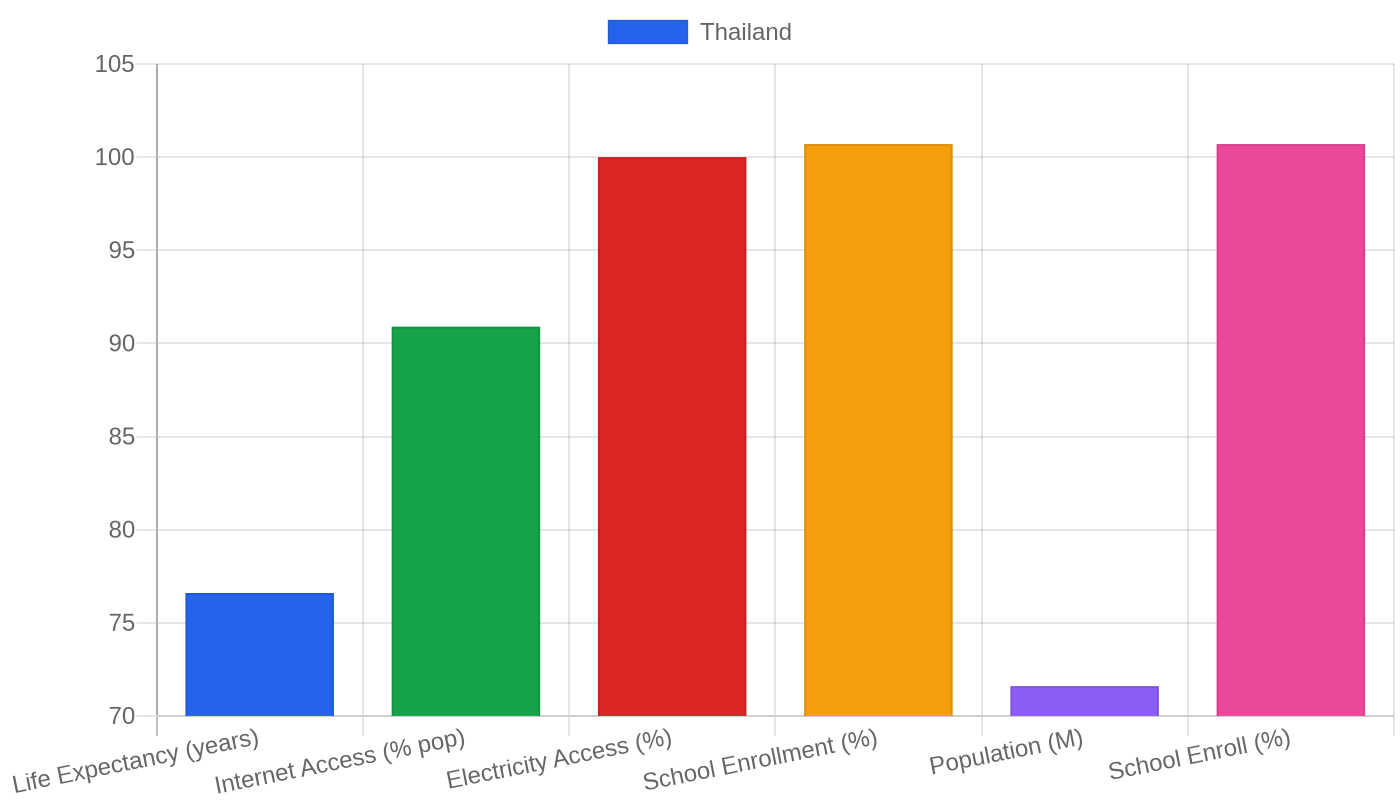
The GDP per capita on a purchasing-power basis is $26,250, according to the World Bank, while GNI per capita is $7,690. That gap between PPP and nominal income reflects the relative cost of living — goods and services in Thailand are cheaper than in the West, so the same dollar buys more locally. With a population of roughly 71.6 million, Thailand is a mid-sized nation with outsized regional influence.
The Cost of Living Tightrope — Cheap Noodles, Pricey Phones
Thailand has long been a magnet for expatriates and digital nomads, and the cost of living remains a key draw. With deflation currently in play, day-to-day expenses for food, transport, and utilities are easing slightly. Street food, local markets, and public transit remain affordable by global standards, particularly outside the central Bangkok districts.
Housing, however, tells a more complex story. In prime Bangkok locations, condominium prices have climbed steadily over the past decade, driven by foreign demand and limited supply. Renting in the capital offers flexibility, but yields are modest compared to regional peers. Outside the capital, in cities like Chiang Mai or Khon Kaen, the cost of buying a home is dramatically lower, and the rent-versus-buy calculation tilts heavily toward ownership.
The broader picture is one of a two-speed economy. Urban professionals in tech, finance, and tourism enjoy comfortable lifestyles on incomes that stretch far further than in Singapore or Hong Kong. Rural and semi-urban workers, while employed, face thinner margins. The deflationary environment provides some relief, but it also hints at weak pricing power among small businesses — a concern for the backbone of the Thai economy.
Investment & Business Climate — Giants of Connectivity
The corporate landscape in Thailand is dominated by infrastructure and consumer services. Airports of Thailand PCL, a top-10 company by data provided, is the gateway for the kingdom’s vital tourism sector. Advanced Info Service, a telecoms giant, powers the nation’s mobile-first digital economy. These are not just companies; they are critical national assets.
The presence of aviation and logistics firms — including Air Andaman, Angel Air, and Air People International — underscores Thailand’s ambition to be the region’s aviation hub. Meanwhile, 3K Battery (Industrials) and Areeya Property (Financials) point to a diversified economy with strength in manufacturing and real estate.
For investors, the key sectors to watch are tourism-related services, digital infrastructure, and logistics. The government has prioritised the Eastern Economic Corridor as a high-tech industrial zone, and the data suggests that momentum is building. The low unemployment rate means any major new investment will need to bring its own talent or invest in training — a challenge and an opportunity.
The business environment is generally open, though foreign ownership rules in certain sectors remain restrictive. Still, the sheer scale of consumer demand — 71 million people with rising digital adoption — makes Thailand a compelling market for consumer-facing businesses and B2B service providers alike.
Safety, Politics & the Long Shadow of 1932
Thailand’s political system is unique — a constitutional monarchy that evolved from absolute rule. The World Bank data provided notes that prior to 1932, Thai kings were feudal or absolute monarchs, with the Sukhothai Kingdom viewing the sovereign as a *dharmaraja*, or “king who rules in accordance with dharma.” The modern unitary state was consolidated under Chulalongkorn, and the bloodless revolution of 24 June 1932 by the Khana Ratsadon (People’s Party) marked the transition to constitutional governance.
This history matters today. The political landscape remains shaped by the tension between traditional institutions and populist movements. Coups and constitutions have come and gone, but the underlying structure — a powerful monarchy, a restless military, and an increasingly vocal urban electorate — persists.
Crime and safety indices are not available in the provided data, but Thailand’s reputation as a relatively safe country for tourists and residents is well established. Violent crime against foreigners is rare, though petty theft and scams are common in high-traffic tourist zones. The broader quality of life is high: excellent food, warm climate, and a culture that prizes social harmony.
What’s Happening Now — Deflation’s Quiet Campaign
Right now, the most pressing issue in Thailand is the deflationary trend. The World Bank’s CPI reading of -0.13% is not a crisis, but it is a signal. It suggests that domestic demand is not yet strong enough to generate pricing power. For policymakers, the challenge is to stimulate spending without reigniting inflation — a delicate balance.
The tourism recovery is well underway, with Airports of Thailand PCL and the aviation companies in the top-10 list indicating robust travel volumes. The digital economy is expanding, driven by Advanced Info Service and a young, mobile-savvy population. Meanwhile, the property sector, represented by Areeya Property, is navigating a soft market — deflation in asset prices can be just as challenging as in consumer goods.
The political calendar is always a factor in Thailand. While the provided data does not detail current election cycles, the historical trajectory from absolute monarchy to constitutional rule suggests a nation still refining its democratic institutions. For businesses, the key is stability — and so far, the economic data suggests a steady, if unspectacular, hand on the tiller.
The Bottom Line
Thailand is not a frontier market, nor is it a developed economy — it is something in between, a mature middle-income nation with world-class infrastructure and a deeply entrenched service culture. Investors should watch Thailand for its connectivity: aviation, telecoms, and logistics. Consumers should watch it for value: deflation and low unemployment make it an attractive place to live and work.
And policymakers should watch it as a bellwether for the challenges facing export-oriented economies in a fragmented global market. The kingdom is not booming, but it is building — quietly, steadily, and with an eye on the long game.
Sources & Methodology
This article is authored by Economic Pulse Net for informational and research purposes. Economic Pulse Net sources its data from multilateral institutions, national statistics bureaus, and proprietary databases. All data is believed to be current as of the date of publication.
Published: August 21, 2026 | Category: Research — Thailand
Use these signals in your own platform
Economic Pulse publishes its live signal feed through a documented, read-only API. Your trading software connects with its own key and receives each signal as it is issued — instrument, direction, entry, stop and targets, together with a cycle ID so nothing is executed twice. The feed is independent of this website and cannot change it.
Signals are informational only and are not financial advice.