Economic Pulse Net | Sources: World Bank World Development Indicators, Government Sources | 2026
Key Takeaways
* Global Tech Hub: Taiwan hosts some of the world’s most critical semiconductor and electronics manufacturers, including TSMC and Foxconn, making it indispensable to global supply chains.
Political Framework: The nation operates under the 1947 Constitution of the Republic of China (ROC), structured around the Three Principles of the People with a unique five-branch government system.
Service Sector Growth: Beyond hardware, there is a visible expansion in consumer services, ranging from technology peripherals to retail and food service brands like 85°C Bakery Cafe.
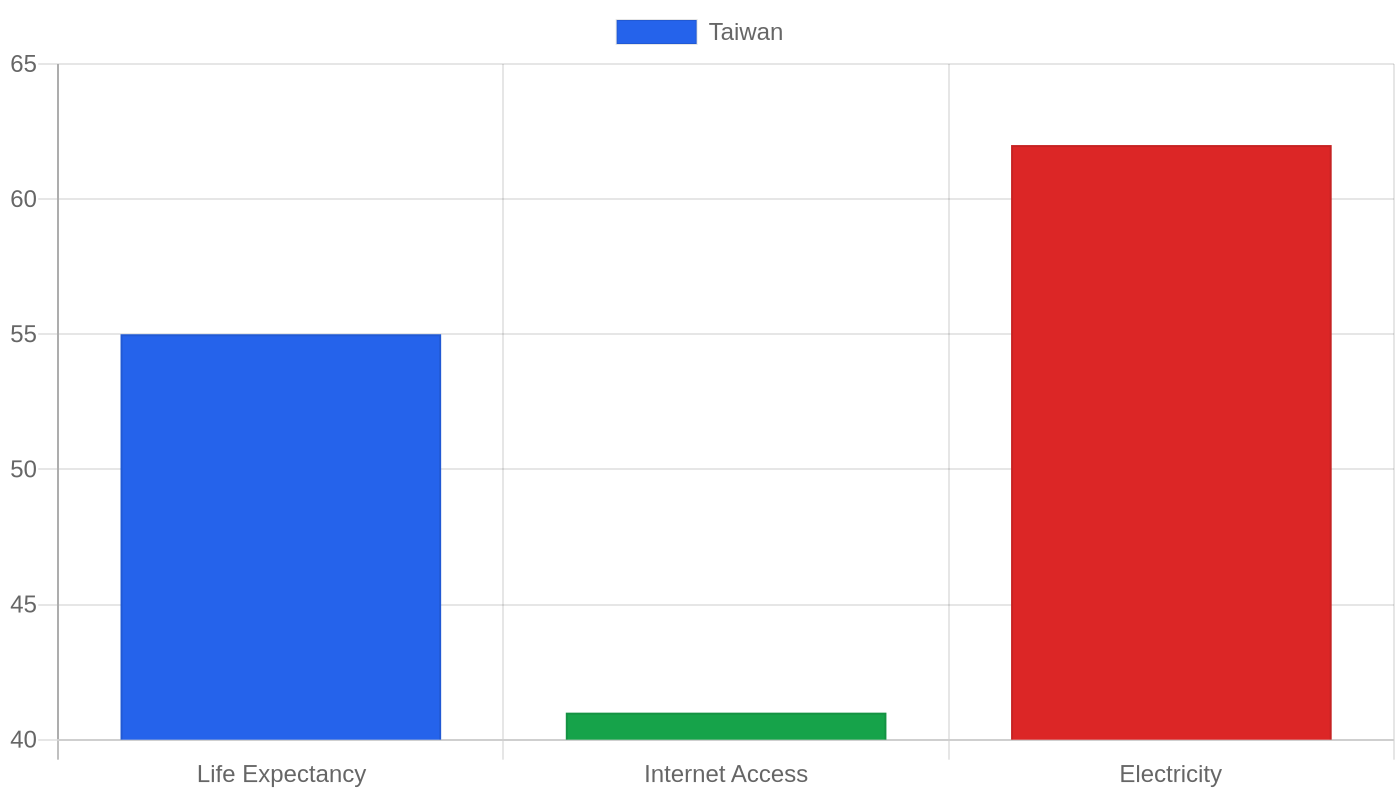
Data Transparency Gaps: Current economic metrics such as GDP growth, inflation rates, and unemployment figures are not currently available in standard World Bank datasets for this region.
The Invisible Engine of Global Electronics
Taiwan’s economic identity is inextricably linked to its dominance in high-tech manufacturing, serving as the backbone for the global electronics industry. While specific macroeconomic indicators like GDP growth, inflation CPI, and unemployment rates are currently listed as unavailable by the World Bank, the structural importance of the island cannot be overstated.
The presence of heavyweights such as Taiwan Semiconductor Manufacturing Company (TSMC) and Hon Hai Precision Industry (Foxconn) indicates a robust industrial base focused on semiconductors and contract manufacturing. These entities are not merely large corporations; they are critical nodes in the worldwide supply chain for everything from smartphones to supercomputers.
The inclusion of Quanta Computer and Pegatron further solidifies the country’s role in computer hardware production, suggesting a diversified tech ecosystem rather than a reliance on a single product line. Additionally, the emergence of A4Tech in the technology sector highlights innovation in peripheral devices and consumer electronics components. This concentration of talent and infrastructure creates an economic moat that protects the region from typical cyclical downturns seen in other manufacturing hubs.
Understanding Taiwan requires looking past standard GDP figures and recognizing its strategic value as a producer of essential technological infrastructure.
Living Costs and Consumer Dynamics
The cost of living in Taiwan is shaped by a vibrant mix of traditional markets and modern consumer services. Data regarding specific housing costs or rent-to-buy ratios is not explicitly detailed in the provided datasets, but the landscape of consumer engagement offers clues to daily expenses. The proliferation of brands such as 85°C Bakery Cafe and 50 Lan suggests a competitive retail environment where affordability and convenience drive consumer behavior.
Similarly, the presence of A.mart points to a strong supermarket and grocery sector that likely caters to both local residents and expatriates seeking familiar goods. These consumer service companies indicate a middle class with disposable income directed toward dining out and packaged goods. While precise inflation metrics are missing, the variety of offerings implies a stable demand for mid-range consumer products.
For residents, navigating daily life involves balancing these branded experiences with local market options, creating a diverse economic microcosm. The availability of technology-focused retailers like A4Tech also suggests that consumers have access to a wide range of electronic accessories, potentially influencing household spending patterns on gadgets and peripherals.
Investment Climate and Corporate Power
For international investors, Taiwan presents a landscape defined by corporate giants and specialized industrial clusters. The business environment is heavily influenced by the performance of top-tier firms such as CPC, which plays a significant role in energy and petrochemical sectors, providing essential inputs for other industries. TSMC remains the crown jewel of this investment climate, setting global standards for semiconductor fabrication and attracting continuous foreign interest.
However, the investment story is not limited to chips; Quanta Computer and Wistron represent the broader IT hardware assembly market, offering opportunities in server manufacturing and cloud infrastructure components. Foxconn (Hon Hai Precision Industry) continues to diversify beyond simple assembly into new areas like electric vehicles and digital health, expanding the scope for potential partnerships.
The entry of newer players like A4Tech into the technology space shows that innovation is still flowing into the region, particularly in niche hardware markets. Investors must navigate a complex political backdrop, but the sheer scale and efficiency of these companies make Taiwan a low-risk option for supply chain stability. The concentration of power in these few major firms means that economic policy decisions often ripple through the entire global tech sector.
Safety, Politics, and Quality of Life
Taiwan’s political structure is distinct, rooted in the 1947 Constitution of the ROC and guided by the Three Principles of the People, which envisions a democratic republic governed by and for the people. The government is organized into five branches: the Executive Yuan (cabinet), the Legislative Yuan (Congress), the Judicial Yuan, and others, reflecting a system designed to balance power and ensure checks and balances.
Significant revisions known as the Additional Articles were implemented in the 1990s, modernizing the framework and enhancing democratic processes. Regarding safety, specific crime indices and safety scores are currently unavailable, leaving the exact quantification of public security data incomplete. However, the general perception of quality of life is often supported by the robust consumer services and technological infrastructure present in urban centers.
The political landscape remains dynamic, with ongoing discussions surrounding the interpretation of the constitution and the evolving relationship with neighboring regions. Citizens operate within a system that emphasizes democratic ideals, even as geopolitical tensions persist externally. The stability of this political framework is crucial for maintaining the social cohesion necessary for economic productivity.
Current Affairs and Strategic Positioning
The current narrative surrounding Taiwan is dominated by its strategic position in global technology and the intricate diplomatic maneuvers required to maintain stability. While live economic indicators like real-time inflation trends are not accessible, the focus of recent discourse has shifted toward how major corporations adapt to shifting global supply chain demands.
Companies like TSMC and Foxconn are increasingly involved in discussions about sustainability and next-generation manufacturing technologies, reflecting a proactive approach to future challenges. The political landscape continues to evolve, with the five-branch government system working to address domestic priorities while managing external pressures.
There is a growing emphasis on strengthening the consumer services sector, as evidenced by the expansion of brands like 85°C Bakery Cafe and A.mart, which cater to changing lifestyle preferences. Meanwhile, the technology sector sees constant innovation, with firms like A4Tech pushing boundaries in peripheral design and connectivity solutions. Analysts note that the resilience of these industries depends heavily on political stability and clear regulatory frameworks.
As global trade dynamics shift, Taiwan’s ability to leverage its technical expertise becomes even more critical for long-term economic security.
The Bottom Line
Taiwan should be watched closely by investors and policymakers interested in the intersection of technology and geopolitics. Despite gaps in standard economic reporting, the strength of its corporate leaders provides a reliable indicator of economic health. The country serves as a vital stabilizer in the global tech supply chain, making its internal developments relevant worldwide.
Stakeholders must monitor political developments in Taipei, as they directly impact the operational environment for key industries like semiconductors and electronics.
Sources & Methodology
This article is authored by Economic Pulse Net for informational and research purposes. Economic Pulse Net sources its data from multilateral institutions, national statistics bureaus, and proprietary databases. All data is believed to be current as of the date of publication.
Published: October 20, 2026 | Category: Research — Taiwan
Use these signals in your own platform
Economic Pulse publishes its live signal feed through a documented, read-only API. Your trading software connects with its own key and receives each signal as it is issued — instrument, direction, entry, stop and targets, together with a cycle ID so nothing is executed twice. The feed is independent of this website and cannot change it.
Signals are informational only and are not financial advice.