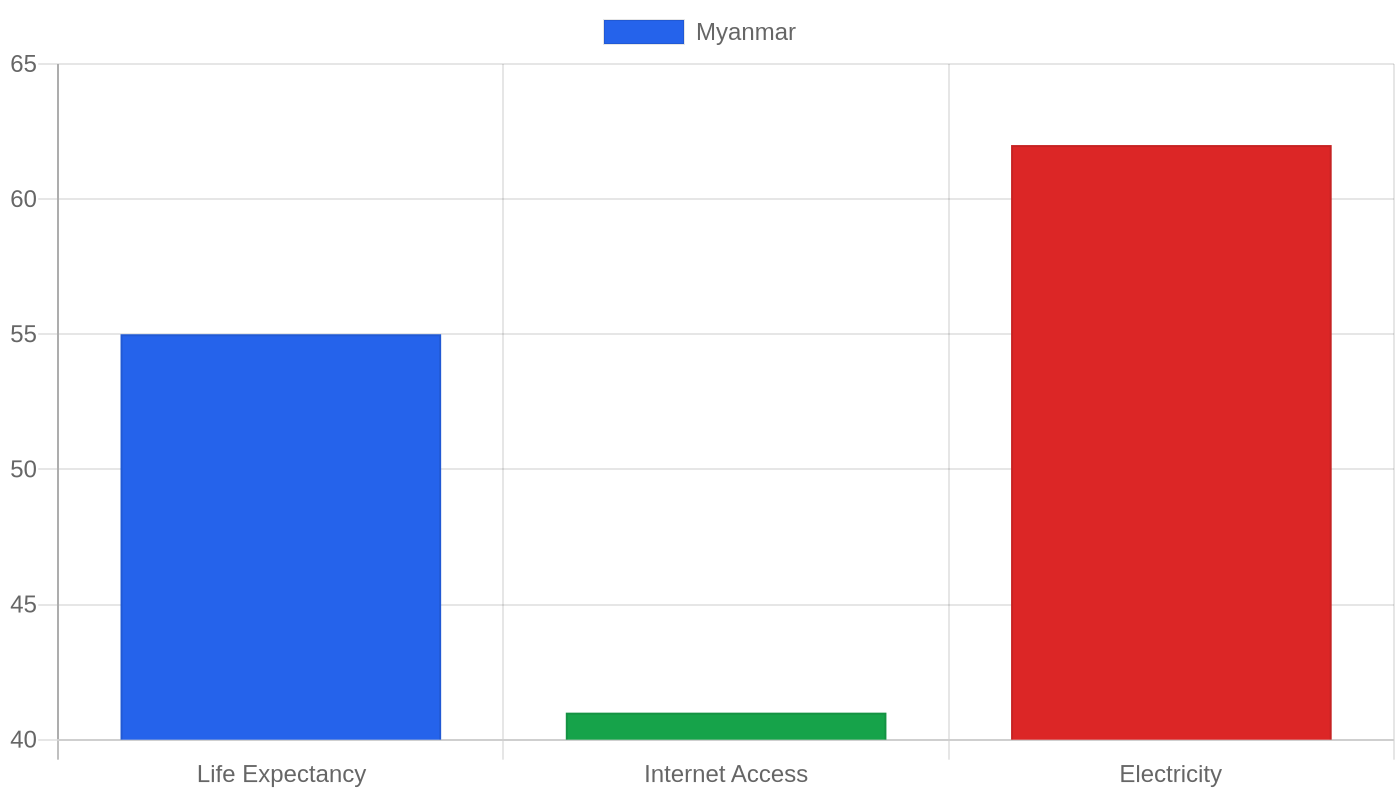
Economic Pulse Net | Sources: World Bank World Development Indicators, Government Sources | 2026
Key Takeaways
* Structural Governance: Myanmar operates under a unique parliamentary system with a bicameral legislature, where 25% of seats are constitutionally reserved for military-appointed legislators, creating a distinct political-economic dynamic.
State and Conglomerate Dominance: The corporate landscape is heavily influenced by large conglomerates and state-owned enterprises, including Myanma Economic Holdings Limited and Myanma Oil and Gas Enterprise, which control critical sectors like oil, gas, and basic materials.
Data Transparency Gap: Current macroeconomic indicators such as GDP growth, inflation rates, and unemployment figures are not currently available from the World Bank, highlighting significant challenges in economic transparency and data collection.
Consumer Services Growth: Despite broader uncertainties, specific consumer-facing industries remain active, with major players like Asia World, Htoo Group, and Eleven Media Group driving activity in services and conglomerate operations.
The Architecture of Uncertainty
Understanding Myanmar’s economy requires looking beyond standard metrics, as the latest data from the World Bank leaves key indicators such as GDP growth, inflation CPI, and unemployment at N/A%. This absence of hard data does not mean the economy has ceased to function; rather, it signals a period of profound structural opacity where traditional forecasting models struggle to gain traction.
Without concrete figures on GDP per capita or GNI, analysts must rely on sectoral observations to gauge health, noting that the country’s output is likely driven by resource extraction and domestic consumption rather than export-led manufacturing growth. The lack of population-specific economic data further complicates the assessment of living standards, forcing observers to look at industrial outputs as proxy indicators for national performance.
Consequently, any evaluation of Myanmar’s economic trajectory is inherently speculative, requiring a deep dive into the activities of its dominant entities rather than reliance on aggregate national statistics. This environment demands a cautious approach, where the stability of individual companies often tells a more reliable story than national headlines.
The High Cost of Operating in the Dark
For businesses and expatriates, the cost of living in Myanmar presents a complex puzzle, as specific indices for housing costs, rent-to-buy ratios, and daily expenses are not currently quantified in the provided datasets. In markets where official price tracking is absent, informal pricing mechanisms often dictate the real cost of doing business, leading to potential volatility in everyday expenditures.
While regional comparisons are difficult to make without precise local data, the presence of established consumer goods and services firms suggests that a formal market exists, albeit one that may operate with higher risk premiums due to regulatory uncertainty. Investors should anticipate that operational costs could be inflated by logistical challenges and security considerations, which are rarely captured in standard cost-of-living indexes.
Therefore, budgeting for Myanmar requires a buffer for unpredictability, as the true financial burden is often found in the gaps between reported prices and actual transaction costs.
Corporate Giants and Strategic Sectors
The investment landscape in Myanmar is defined by the outsized influence of large conglomerates and state-linked enterprises, which dominate the flow of capital and resources. At the forefront is Myanma Economic Holdings Limited, a massive conglomerate that serves as a central pillar of the state’s economic interests, alongside Myanma Oil and Gas Enterprise, which controls the vital energy sector.
Other significant players include Asia World and Htoo Group of Companies, both operating as diversified conglomerates that span multiple industries, thereby concentrating economic power within a few key hands. In the consumer services space, companies like Air Bagan, Air Mandalay, and Eleven Media Group provide essential infrastructure and media connectivity, reflecting a demand for modernization in transport and information dissemination.
Meanwhile, Myanma Gems Enterprise and Myanma Pharmaceutical Industry Enterprise highlight the importance of natural resource extraction and domestic healthcare production. For investors, these entities represent both the primary channels for engagement and the significant risks associated with concentrated ownership and state involvement.
Stability, Safety, and Political Realities
Navigating Myanmar requires a clear understanding of its intricate political framework and safety environment, as crime and safety indices are currently listed as N/A, offering little quantitative guidance for risk assessment. Politically, the country functions as a unitary assembly-independent republic under its 2008 constitution, featuring a parliamentary system with a bicameral legislature.
A defining feature of this structure is that 25% of legislators are appointed by the military, while the remainder are elected in general elections, ensuring that the armed forces retain substantial veto power over legislative processes. The executive president is accountable to this legislature, creating a complex web of checks and balances that are heavily skewed toward military oversight.
This political arrangement introduces a layer of institutional rigidity that can impact policy consistency and long-term planning. For residents and businesses, the interplay between elected representatives and appointed military officials creates an unpredictable environment where legal and regulatory frameworks may shift rapidly based on internal political negotiations.
Current Affairs: Power Dynamics and Sectoral Shifts
The current affairs landscape in Myanmar is dominated by the ongoing interplay between civil governance and military authority, as outlined in the constitutional provisions of the 2008 framework. With 25% of the legislature appointed by the military, recent political developments likely center on how this bloc influences economic legislation and resource allocation.
The activities of state-owned enterprises like Myanma Oil and Gas Enterprise suggest that energy policy remains a top priority for the ruling structures, potentially affecting foreign investment agreements and domestic supply chains. Simultaneously, the continued operation of private conglomerates such as Asia World and Htoo Group indicates that commercial activities persist despite political tensions, adapting to whatever regulatory environment is imposed.
Media outlets like Eleven Media Group play a crucial role in shaping public discourse, reflecting the delicate balance between information control and market demand. As the government navigates its parliamentary duties, observers should watch for shifts in how the appointed legislators interact with elected members, as this dynamic will likely determine the pace of any economic reforms or austerity measures.
The Bottom Line
Myanmar remains a high-risk, high-complexity market where economic decisions are driven more by political maneuvering than by transparent macroeconomic trends. Investors and analysts must focus on the resilience of major conglomerates and state enterprises, as these entities form the backbone of the country’s functional economy. The absence of reliable data on growth, inflation, and safety necessitates extreme caution and localized intelligence gathering.
Ultimately, those who engage with Myanmar must prioritize understanding the military’s role in governance, as it is the single most significant factor influencing all economic outcomes.
Sources & Methodology
This article is authored by Economic Pulse Net for informational and research purposes. Economic Pulse Net sources its data from multilateral institutions, national statistics bureaus, and proprietary databases. All data is believed to be current as of the date of publication.
Published: October 20, 2026 | Category: Research — Myanmar
Use these signals in your own platform
Economic Pulse publishes its live signal feed through a documented, read-only API. Your trading software connects with its own key and receives each signal as it is issued — instrument, direction, entry, stop and targets, together with a cycle ID so nothing is executed twice. The feed is independent of this website and cannot change it.
Signals are informational only and are not financial advice.