Economic Pulse Net | Sources: World Bank World Development Indicators, Government Sources | 2026
Key Takeaways
* Moderate Growth Trajectory: The economy is projected to grow by approximately 1.0% in 2025, reflecting a stabilization phase rather than rapid expansion.
High Living Standards: With a GDP per capita (PPP) exceeding $63,000 and low unemployment, the nation maintains robust individual economic power despite slower aggregate growth.
Corporate Diversity: Major players range from global consumer giants like Amorepacific to specialized firms such as 5Rocks and AKOM, indicating a diverse industrial base.
Democratic Stability: The political landscape remains firmly anchored in a constitutional democracy with separated executive, legislative, and judicial branches.
Economic Pulse: Navigating Slow but Steady Growth
South Korea’s economic engine is currently operating at a measured pace, with World Bank data projecting a GDP growth rate of 1.007% for 2025. While this figure may appear modest compared to emerging market peaks, it signals a mature economy adjusting to internal structural changes and external pressures. The total Gross Domestic Product stands at roughly $1.87 trillion USD, underscoring the nation’s status as a significant global player.
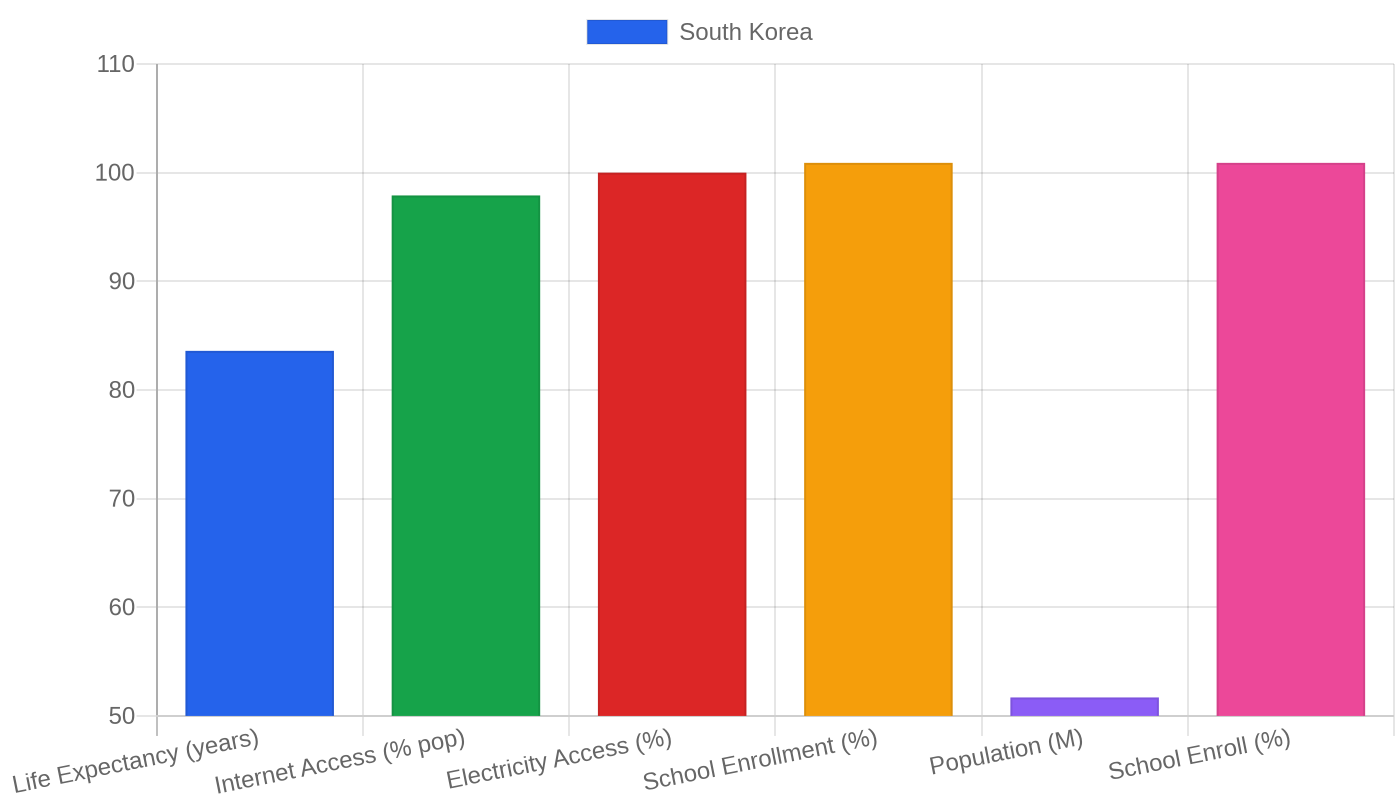
Crucially, the distribution of this wealth suggests high prosperity among citizens; the GDP per capita based on purchasing power parity (PPP) is an impressive $63,124.92. This high per-capita metric indicates that while national growth is slow, the average citizen retains substantial economic capacity. Furthermore, the labor market remains exceptionally tight, with unemployment hovering at a low 2.683%.
This near-full employment scenario suggests that labor shortages or skill mismatches might be constraining faster growth, as nearly everyone who wants a job has one. Inflation, meanwhile, is being managed effectively, with the Consumer Price Index (CPI) sitting at 2.123%, which is generally considered healthy and stable for advanced economies. These figures collectively paint a picture of a resilient, high-income economy that prioritizes stability over volatile expansion.
Cost of Living and Daily Expenses
For residents and expatriates alike, understanding the cost of living in South Korea requires looking beyond simple averages. While specific housing indices are not detailed in the current dataset, the high GDP per capita implies that disposable income levels are sufficient to absorb typical urban costs in major hubs like Seoul and Busan. The low inflation rate of 2.123% provides a buffer against sudden spikes in daily expenses, allowing households to plan budgets with greater predictability.
However, the presence of major financial institutions like BC Card and regional banks such as Busan Bank suggests a sophisticated consumer credit environment, which can influence spending habits and debt levels. Consumers must navigate a market where essential goods and services are priced within a stable framework, yet luxury or imported items may carry premium tags due to logistical and tariff structures.
The interplay between high wages and controlled inflation creates a unique economic bubble where quality of life remains high, even if absolute savings rates fluctuate based on personal lifestyle choices.
Investment and Business Climate
The corporate landscape in South Korea is characterized by a mix of household names and niche industry leaders. Amorepacific Corporation continues to dominate the beauty and cosmetics sector globally, leveraging strong brand equity. In the transportation and logistics space, Asiana Airlines plays a critical role in connecting the nation to international markets.
The manufacturing and construction sectors are represented by entities like Asia Cement, highlighting the ongoing need for infrastructure maintenance and development. Meanwhile, technology and media production are supported by companies such as AKOM (Aicom Production) and 5Rocks, indicating a vibrant creative and digital economy. For investors, these firms offer exposure to both traditional heavy industry and modern service-based sectors.
The business environment is further supported by a robust financial infrastructure, evidenced by the presence of payment processors like BC Card and various banking groups including Aju Group and Bexel. This diversity reduces systemic risk, as downturns in one sector, such as manufacturing, can be offset by stability in others, like consumer goods or digital media.
Safety, Politics, and Quality of Life
South Korea operates under a well-defined constitutional framework that ensures a balance of power among the executive, legislative, and judicial branches. This democratic structure provides political stability, which is a crucial factor for long-term economic planning and social cohesion. Local governments retain semi-autonomous powers, allowing for tailored policy implementations that address regional needs while maintaining national unity.
Regarding personal safety, current data sources do not provide specific Crime or Safety Indices, leaving a gap in quantifiable metrics for public security assessments. However, the general consensus on quality of life is bolstered by the high standard of living indicated by the GNI per capita of $37,880. This income level typically correlates with access to high-quality healthcare, education, and public services.
The absence of reported violent crime spikes in available summaries suggests a society that is generally secure, though travelers should always exercise standard precautions. The political system’s transparency and adherence to constitutional norms contribute to a predictable environment for both domestic citizens and foreign observers.
What’s Happening Now: Current Affairs
The immediate economic narrative in South Korea is defined by cautious optimism amidst global uncertainties. As we move through 2025, policymakers are focused on sustaining the low unemployment rate of 2.683% while managing the slight but steady GDP growth of 1.007%. This dual focus suggests that the government is prioritizing job creation and social stability over aggressive stimulus measures that could reignite inflation.
With CPI inflation held at 2.123%, monetary authorities likely maintain a neutral stance, avoiding drastic interest rate changes that could disrupt the delicate balance of consumer spending and business investment. Recent developments in the corporate sector show companies like Binggrae and Asia Cement adapting to supply chain realities, ensuring consistent product availability. The political branch continues to operate smoothly, with ministries executing local functions efficiently to support national goals.
This period is less about dramatic reforms and more about fine-tuning existing systems to withstand potential external shocks. Stakeholders are watching closely to see if the 1% growth threshold can be breached in subsequent quarters without compromising price stability.
The Bottom Line
South Korea presents a compelling case for investors and economists seeking stability in a volatile world. The combination of high per-capita wealth, low unemployment, and controlled inflation offers a safe harbor for capital preservation. While rapid growth may no longer be the headline story, the depth and diversity of its industries—from Amorepacific to Asia Cement—provide enduring value. For those interested in developed Asian markets, South Korea remains a critical, reliable partner worth monitoring closely.
Sources & Methodology
This article is authored by Economic Pulse Net for informational and research purposes. Economic Pulse Net sources its data from multilateral institutions, national statistics bureaus, and proprietary databases. All data is believed to be current as of the date of publication.
Published: October 17, 2026 | Category: Research — South Korea
Use these signals in your own platform
Economic Pulse publishes its live signal feed through a documented, read-only API. Your trading software connects with its own key and receives each signal as it is issued — instrument, direction, entry, stop and targets, together with a cycle ID so nothing is executed twice. The feed is independent of this website and cannot change it.
Signals are informational only and are not financial advice.