Economic Pulse Net | Sources: World Bank World Development Indicators, Government Sources | 2026
Key Takeaways
* Exceptional Prosperity: Singapore boasts one of the highest GDP per capita figures globally, with a PPP-adjusted value exceeding $163,000, signaling immense individual wealth generation.
Labor Market Tightness: With an unemployment rate hovering near 2.8%, the nation faces a constrained labor supply despite robust economic output.
Price Stability: Inflation remains remarkably low at approximately 0.9%, offering a stable environment for consumers and businesses alike.
Corporate Diversity: From financial services giants like 2C2P to consumer brands such as Agoda and Awfully Chocolate, the corporate landscape is varied and dynamic.
Governance Structure: As a parliamentary republic based on the Westminster system, political stability is underpinned by a constitutional framework that separates governance into three distinct branches.
Economic Engines and Labor Dynamics
Singapore’s economic profile presents a fascinating study in high-value efficiency. According to World Bank data, the country’s GDP per capita adjusted for Purchasing Power Parity (PPP) stands at an impressive $163,353.99, placing it among the wealthiest nations in terms of individual economic output. This figure suggests that while total GDP metrics may be N/A or less emphasized in current reporting, the productive capacity per resident is exceptionally high.
Supporting this wealth is a highly efficient labor market; the unemployment rate is recorded at just 2.818%. Such a low figure indicates that nearly everyone who wants to work can find employment, reflecting a tight labor market where skills shortages might drive wage growth rather than job scarcity. Furthermore, price stability has been maintained with a Consumer Price Index (CPI) inflation rate of only 0.902998495002676%.
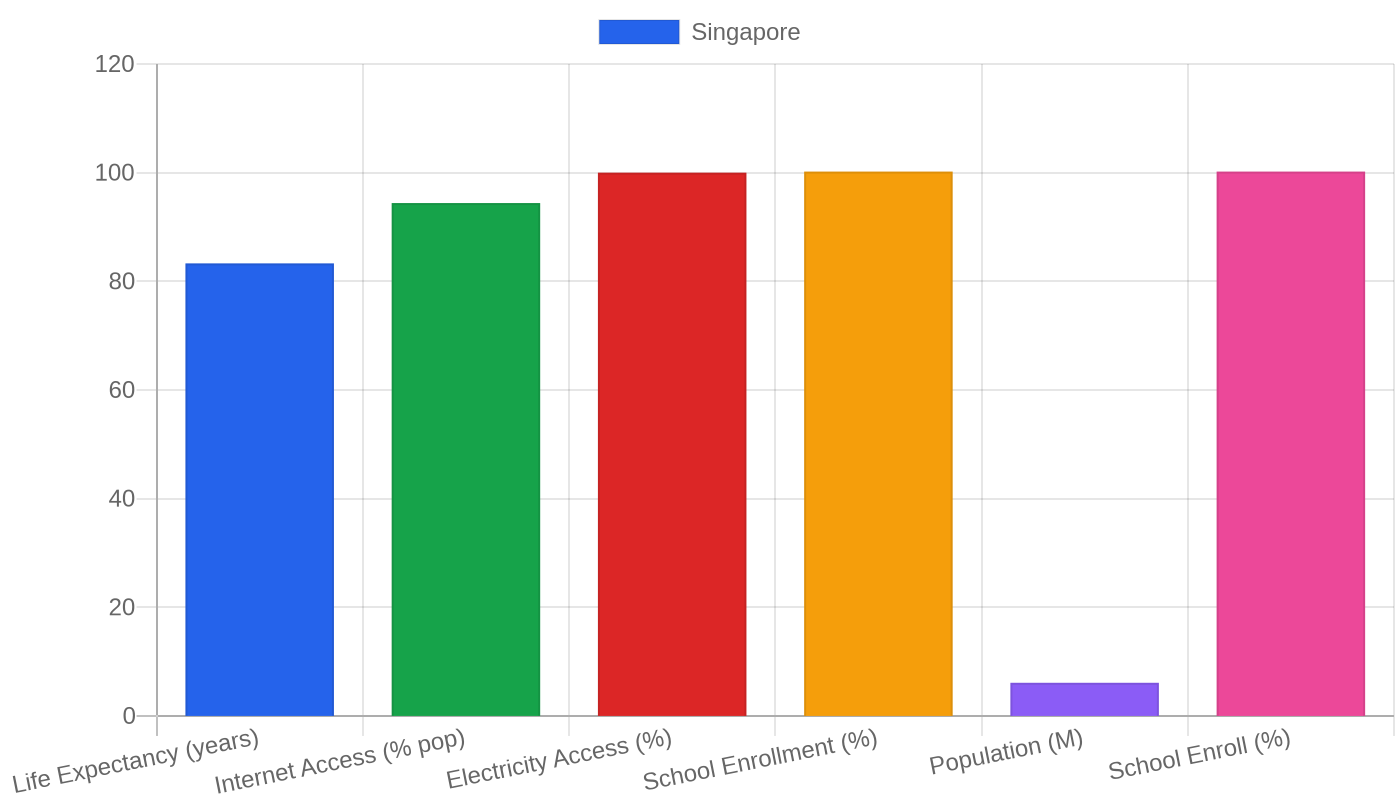
For an open economy reliant on trade, keeping inflation this low is critical for maintaining purchasing power and attracting foreign investment. The Gross National Income (GNI) per capita sits at $81,760, further validating the high standard of living supported by these economic fundamentals. The population of 6,111,175 manages to generate this level of economic intensity through advanced sectors rather than sheer volume, creating a dense but highly productive urban economy.
The Premium on Daily Life
Living in Singapore comes with a significant premium, driven by its status as a global hub. While specific housing cost percentages are not detailed in the provided dataset, the high GNI and GDP per capita suggest that residents have substantial disposable income relative to regional averages. However, the low inflation rate of roughly 0.9% implies that daily expenses are currently stable, allowing households to plan their budgets without the shock of rapid price increases.
The cost of living is likely structured around high-quality infrastructure and services, which are funded by the nation’s strong fiscal position. For expatriates and locals alike, the trade-off involves higher baseline costs for goods and services, balanced against the safety and efficiency of the urban environment. Rent versus buy decisions are influenced by the scarcity of land and the high value placed on property, though exact ratios remain unspecified.
Ultimately, the economic data points to a society where high earnings offset the elevated costs of urban living, creating a sustainable, albeit expensive, lifestyle model.
Corporate Landscape and Investment Opportunities
The business environment in Singapore is characterized by a diverse mix of established players and innovative firms across multiple sectors. In the financial technology space, companies like 2C2P and ABR Holdings demonstrate the country’s strength in digital payments and banking services. The consumer goods sector is equally vibrant, featuring recognizable brands such as Agoda, Awfully Chocolate, Ayam Brand, and Bee Cheng Hiang, which serve both local tastes and international markets.
Other notable entities include 77th Street and Akira in consumer goods, highlighting a strong domestic retail presence. Beyond consumer-facing brands, the industrial and technology sectors are represented by Aetos Security Management and Aftershock PC, indicating a broad base of operational expertise. This diversity reduces reliance on any single industry, making the economy resilient to sector-specific shocks.
Investors looking at Singapore should note that the presence of these top companies reflects a mature market with strong brand equity and logistical advantages. The concentration of financial and service-oriented firms underscores the city-state’s role as a connector of global trade and capital.
Governance, Safety, and Social Fabric
Political stability is a cornerstone of Singapore’s appeal, rooted in its identity as a parliamentary republic based on the Westminster system. The Constitution serves as the supreme law, establishing a clear structure for governance that separates powers into three branches, ensuring checks and balances within the state apparatus. The President acts as the head of state, providing a ceremonial yet constitutionally defined leadership role alongside the executive government.
Regarding public safety, specific Crime and Safety Indices are listed as N/A in the current data set, which often correlates with well-regarded security records in similar jurisdictions, though precise statistical rankings are unavailable here. The combination of a stable political framework and low inflation contributes to a predictable social environment. Citizens benefit from a system where legal structures are transparent and consistently applied.
This governance model supports long-term planning for both businesses and residents, minimizing uncertainty in daily life. The focus on constitutional order and separated branches of government helps maintain the rule of law, which is essential for a high-income economy.
Current Affairs and Policy Direction
Recent indicators point to a nation focused on maintaining its competitive edge through structural resilience. With inflation held at a minimal 0.9%, policymakers appear successful in managing external price pressures, a critical achievement for an import-dependent economy. The low unemployment rate of 2.818% suggests that current labor policies are effectively matching workforce capabilities with industry needs, particularly in high-value sectors.
Companies like Agoda and 2C2P continue to operate in a favorable regulatory climate, benefiting from the government’s emphasis on digitalization and financial innovation. The stability of the parliamentary republic ensures that policy shifts are gradual and deliberate, avoiding the volatility seen in more turbulent political systems. As the world navigates economic uncertainties, Singapore’s ability to keep prices stable while sustaining high per-capita income is a key narrative.
Future developments will likely focus on leveraging the existing corporate strengths in finance and consumer services to expand regional influence. The absence of major political upheaval allows for consistent execution of long-term economic strategies.
The Bottom Line
Singapore remains a compelling case study in high-efficiency economics, where exceptional per-capita wealth coexists with strict price stability. Investors and economists should watch this country as a benchmark for how small, open economies can thrive through institutional strength and diverse corporate ecosystems. It is particularly relevant for those interested in financial technology, consumer brands, and stable emerging-market-adjacent opportunities.
The data confirms that despite gaps in some aggregate metrics, the underlying health of the economy is robust and resilient.
Sources & Methodology
This article is authored by Economic Pulse Net for informational and research purposes. Economic Pulse Net sources its data from multilateral institutions, national statistics bureaus, and proprietary databases. All data is believed to be current as of the date of publication.
Published: October 23, 2026 | Category: Research — Singapore
Use these signals in your own platform
Economic Pulse publishes its live signal feed through a documented, read-only API. Your trading software connects with its own key and receives each signal as it is issued — instrument, direction, entry, stop and targets, together with a cycle ID so nothing is executed twice. The feed is independent of this website and cannot change it.
Signals are informational only and are not financial advice.