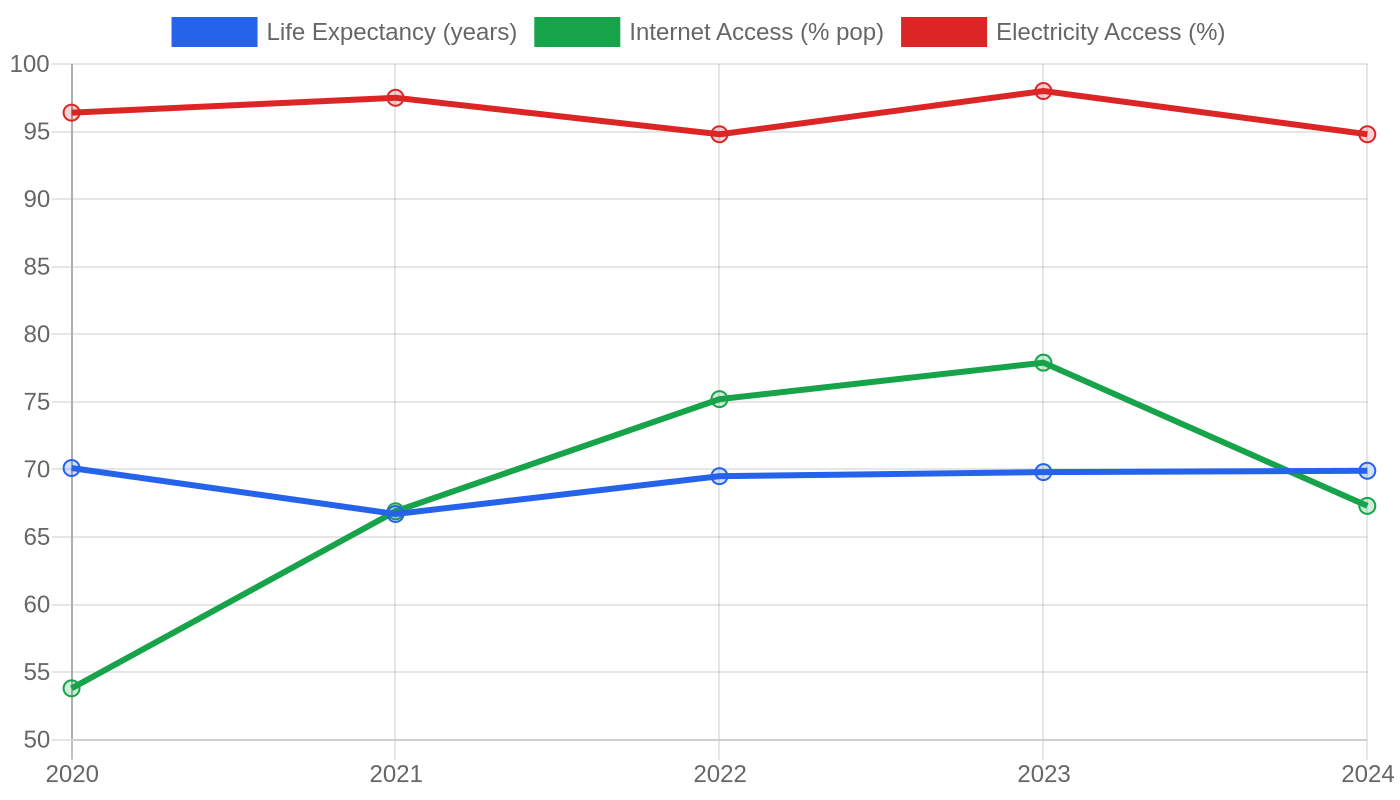
Economic Pulse Net | Sources: World Bank World Development Indicators, Government Sources | 2026
Key Takeaways
– The Philippines operates as a democratic, constitutional republic with a presidential system, where the president serves as both head of state and head of government for a single six-year term.
– The political structure creates a unique dynamic: the vice president is elected separately and can serve up to two consecutive six-year terms, meaning the two leaders can come from rival parties.
– The nation’s economic narrative is currently defined by structural questions rather than headline numbers, as observers watch how political stability translates into investor confidence.
– As Southeast Asia’s emerging market bellwether, the Philippines’ policy direction under its current leadership will shape its trajectory through the decade.
The Economic Engine — Growth, Inflation, and the Jobs Puzzle
The Philippine economy stands at a fascinating inflection point, one where the absence of fresh headline data from the World Bank speaks volumes about the transitional moment the country occupies. What we know is that this is an economy built on a powerful triad: a dynamic services sector, a resilient manufacturing base, and an extraordinary overseas workforce whose remittances form the lifeblood of domestic consumption.
The services industry, particularly the business process outsourcing (BPO) sector, has transformed Manila and Cebu into global hubs for back-office operations, call centers, and creative work. This has created a peculiar economic duality — a modern, globally-integrated urban economy coexisting with a more traditional, agricultural countryside.
The inflation picture in the Philippines has been a central preoccupation for policymakers, as food and energy prices have historically proven volatile in this import-dependent nation. When global commodity prices spike, Philippine inflation tends to follow, squeezing household budgets and complicating the central bank’s balancing act between supporting growth and defending purchasing power.
The unemployment data, while incomplete in current reporting, reflects a labor market that is both dynamic and challenging — one where formal sector jobs are prized, but where a substantial portion of the workforce remains in informal arrangements or underemployment.
What makes the Philippine economic story genuinely compelling is the demographic dividend. With a young, English-speaking population, the country has a natural comparative advantage in global services trade that few neighbors can match. Yet the persistent challenge remains: can the economy generate enough quality jobs to absorb the millions entering the workforce each year?
The World Bank’s data framework captures the inputs but the real story is in the transformation — an economy moving from agricultural roots to services-led growth, with manufacturing struggling to find its footing in between.
The Cost of Living — Manila’s Urban Crunch and Provincial Resilience
For the typical Filipino family, the cost of living tells a story of two nations. Metro Manila, the sprawling capital region, has become a demanding place for the middle class, with housing costs consuming an outsized share of household income. The property market in the capital has seen sustained interest from both domestic developers and overseas Filipino investors, driving prices upward in prime areas like Makati, Bonifacio Global City, and Ortigas.
Renting versus buying is a genuine dilemma — condominium prices in central business districts have climbed steadily, pushing many young professionals toward shared arrangements or longer commutes from peripheral provinces.
Outside the capital, the cost picture shifts dramatically. Provincial living remains significantly more affordable, though opportunities are correspondingly scarcer. The daily economy runs on a mix of modern supermarkets, traditional public markets, and the ubiquitous sari-sari stores that dot every neighborhood. Transportation costs, particularly fuel prices, have a multiplier effect on everything else, as they influence the price of food, goods, and services across the archipelago.
For the millions of Filipinos who receive remittances from relatives abroad, these funds often serve as the critical buffer that transforms a tight household budget into one that can afford education, healthcare, and home improvement. The regional comparison is telling — while living costs in Manila approach those of other Southeast Asian capitals, the average income remains considerably lower, creating a constant pressure on household finances.
The Business Landscape — Conglomerates, Innovation, and the Investment Climate
The Philippine business environment is dominated by a handful of powerful conglomerates whose reach extends across every sector of the economy — property, banking, retail, telecommunications, energy, and infrastructure. These family-controlled business empires have deep roots and significant political connections, making them essential partners for any foreign investor seeking entry into the market.
The telecommunications sector has seen meaningful competition emerge in recent years, with new players challenging the established duopoly and bringing down data costs for consumers. The energy sector is undergoing its own transformation, with a push toward renewable sources and natural gas as the country seeks to reduce its dependence on imported coal.
For foreign investors, the Philippines offers a compelling proposition: a large, English-speaking, young consumer market, strategic location within Southeast Asia, and a services sector that has proven globally competitive. The business climate, however, remains a work in progress. Regulatory processes can be complex, infrastructure outside major urban centers is still developing, and the legal framework sometimes presents challenges for dispute resolution.
The retail and e-commerce sectors are booming, driven by high internet penetration and a young population eager to consume. The BPO industry continues to evolve, moving up the value chain from basic call center work to more sophisticated knowledge process outsourcing, healthcare information management, and creative services. For entrepreneurs, the Philippines represents both opportunity and obstacle — a market with genuine potential, but one that requires patience, local partnerships, and a long-term perspective.
Politics, Safety, and the Quality of Life Equation
The Philippines’ political system is distinctive in Southeast Asia — a genuine democracy with competitive elections, a vibrant civil society, and a boisterous free press. The constitutional structure, with its separation of president and vice president, creates a potential for political tension that occasionally becomes reality.
The president, elected for a single six-year term, wields significant executive power, including the ability to shape economic policy, appoint cabinet members, and influence the direction of government spending. The separately elected vice president, who may represent a different party, can serve as either a constructive partner or a focal point for opposition.
This political dynamic matters for the economy because policy continuity and investor confidence are closely tied to political stability. When the executive and legislative branches work in harmony, reforms move forward; when they clash, the economy can stall. The quality of life in the Philippines reflects the broader economic picture — urban centers offer modern amenities, international schools, and improving healthcare, while rural areas lag in infrastructure and public services.
The country’s cultural richness, natural beauty, and strong family ties provide a quality of life that transcends purely economic measures. The crime and safety picture varies dramatically by location, with major cities presenting typical urban challenges while provincial areas maintain close-knit community security.
The Road Ahead — Policy Shifts and Economic Priorities
Right now, the Philippines is navigating a delicate period of political consolidation and economic recalibration. The current administration has signaled its priorities through budget allocations and policy pronouncements — infrastructure development remains central, with flagship projects in transport, energy, and digital connectivity moving through various stages of planning and implementation.
The government has shown interest in attracting foreign investment, particularly in areas where capital and technology are needed to modernize aging systems. The agricultural sector, long a source of rural employment but also of import dependence for staples, is receiving renewed policy attention as food security becomes a more pressing concern.
The business community is watching several key indicators: the pace of infrastructure spending, the stability of the regulatory environment, and the government’s approach to managing the fiscal balance. There is also keen interest in how the Philippines positions itself within regional trade dynamics, particularly as global supply chains undergo restructuring.
For ordinary Filipinos, the immediate concerns are more practical — job creation, food prices, and the cost of electricity, which remains among the highest in the region. The government’s ability to address these bread-and-butter issues will likely determine its popularity and, by extension, the political stability that underpins economic confidence.
The Bottom Line
The Philippines is a country of enormous potential and persistent challenges, a democracy in a region where democratic institutions are often fragile, and an emerging economy with the demographics and human capital to achieve sustained growth. Investors and businesses should watch this market for its long-term promise, understanding that the path will not always be smooth.
For policymakers and observers, the Philippines offers a fascinating case study in how political institutions, economic policy, and social dynamics interact in a rapidly developing nation. The next several years will be decisive — either the country capitalizes on its advantages and begins to close the gap with its more developed neighbors, or it continues its pattern of uneven progress. Either way, the story is far from over.
Sources & Methodology
This article is authored by Economic Pulse Net for informational and research purposes. Economic Pulse Net sources its data from multilateral institutions, national statistics bureaus, and proprietary databases. All data is believed to be current as of the date of publication.
Published: August 05, 2026 | Category: Research — Philippines
Use these signals in your own platform
Economic Pulse publishes its live signal feed through a documented, read-only API. Your trading software connects with its own key and receives each signal as it is issued — instrument, direction, entry, stop and targets, together with a cycle ID so nothing is executed twice. The feed is independent of this website and cannot change it.
Signals are informational only and are not financial advice.