Economic Pulse Net | Sources: World Bank World Development Indicators, Government Sources | 2026
Key Takeaways
* Macroeconomic Stabilization: Inflation has cooled significantly to approximately 3.5%, while unemployment sits at a manageable 5.4%, suggesting recent policy interventions are yielding short-term relief for consumers.
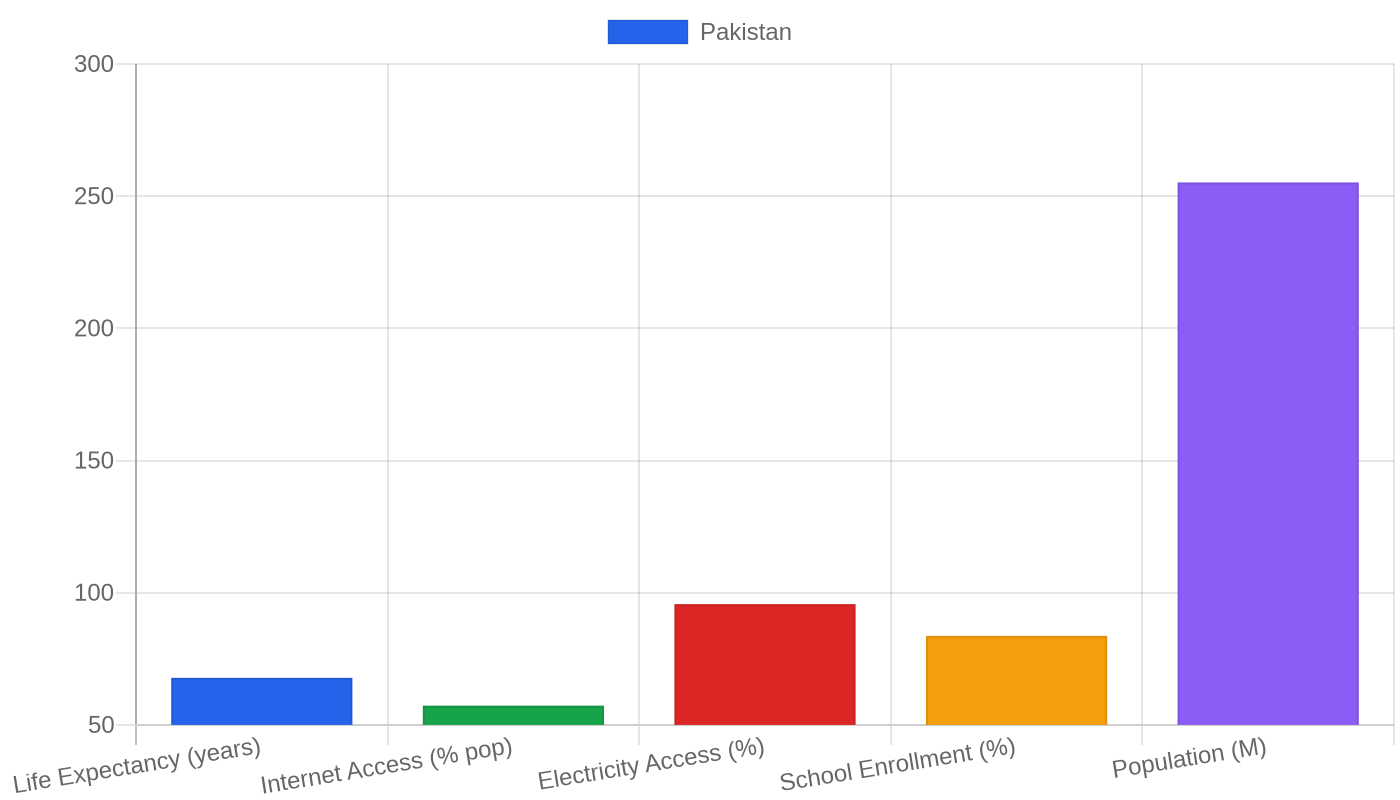
Human Capital Scale: With a population exceeding 255 million, Pakistan represents one of the largest demographic markets globally, though individual purchasing power remains constrained with a GNI per capita of just $1,500.
Corporate Dominance: The business landscape is characterized by established conglomerates and state-linked entities, particularly in aviation, steel, and automotive sectors, indicating a market where large players hold significant sway.
Political Volatility: The interplay between democratic institutions and military influence creates a unique, often unpredictable governance environment that investors must navigate with caution.
Economic Resilience Amidst Structural Constraints
Pakistan’s economic narrative is currently defined by a delicate balance between stabilizing macro indicators and enduring deep structural challenges. According to World Bank data, inflation measured by the Consumer Price Index (CPI) has dropped to 3.54555214890893%, a figure that signals a potential cooling of price pressures that have historically plagued the region. This deceleration in inflation is critical for household stability, allowing consumers to regain some purchasing power after years of volatility.
Simultaneously, the unemployment rate stands at 5.42%, suggesting that the labor market is absorbing workers at a moderate pace, though this masks underlying issues in job quality and sectoral distribution. However, the sheer scale of the economy presents a different picture; with a total population of 255,219,554.0, the pressure on resources and infrastructure is immense.
The Gross National Income (GNI) per capita is recorded at 1,500.0 USD, highlighting that while aggregate numbers may look stable, the average citizen remains in a low-income bracket. This disparity means that while headline growth metrics might appear positive, the lived economic reality for the majority involves tight budgets and limited access to capital-intensive opportunities.
Understanding this duality is essential: Pakistan is not just an emerging market but a complex web of demographic weight and economic fragility.
Cost of Living and Housing Dynamics
For residents and expatriates alike, the cost of living in Pakistan is heavily influenced by its status as a developing economy with significant income disparities. While specific housing indices are not provided in the current dataset, the low GNI per capita of $1,500 suggests that housing costs, relative to income, likely consume a substantial portion of household earnings.
Daily expenses, from food to transportation, are directly tied to the broader inflationary trends; with CPI now near 3.5%, basic goods may be becoming more affordable compared to previous peaks, yet they remain expensive relative to local wages. For those earning international salaries or working with multinational corporations, the cost differential can be advantageous, but for the local workforce, the margin for error is slim.
The lack of detailed regional cost comparisons in the available data makes it difficult to benchmark against neighbors like India or Bangladesh, but the general consensus in such economies is that urban centers command premium prices for rent and utilities. Consequently, financial planning in Pakistan requires a keen awareness of local purchasing power parity rather than relying solely on nominal currency values.
Investment & Business Climate
The corporate landscape in Pakistan is dominated by a mix of family-owned conglomerates and specialized industrial firms, creating a business environment where relationships and legacy play significant roles. Major players such as A. F. Ferguson & Co. dominate the financials sector, providing crucial banking and investment services to a growing middle class.
In the consumer services space, aviation giants like Aero Asia, Air Indus, Airblue, and AirSial illustrate a competitive market for domestic travel, reflecting both the mobility of the population and the logistical challenges of connecting a large country. The industrial base is robust, with companies like Aisha Steel Mills contributing to the basic materials sector, which is vital for construction and manufacturing.
Meanwhile, the automotive and agricultural machinery sectors are represented by Al-Ghazi Tractors and Al Haj FAW Motors, highlighting the importance of transport and agriculture to the national economy. Conglomerates like Adamjee Group and AKD Group span multiple industries, offering diversified exposure for investors but also concentrating risk within fewer corporate structures.
For foreign direct investment, these entities represent either formidable partners or competitors, requiring a nuanced understanding of local market dynamics and regulatory frameworks.
Safety, Politics & Quality of Life
Navigating Pakistan requires an acute awareness of its complex political architecture and security context. The country operates as a democratic parliamentary federal republic, with Islam designated as the state religion, shaping both legal frameworks and social norms. However, the political landscape is uniquely influenced by the military, whose role in mainstream politics has been significant throughout the nation’s history.
Since the initial constitution of 1956, Pakistan has seen constitutional suspensions under leaders like Ayub Khan and Zia-ul-Haq, with the current 1973 framework established under Zulfikar Ali Bhutto serving as a fragile anchor in a turbulent political sea. This historical context implies that policy continuity can be disrupted by shifts in civil-military relations, adding a layer of political risk to long-term planning.
Regarding safety, specific crime and safety indices are not currently available in the provided data, necessitating a cautious approach to personal security assessments. Quality of life is further complicated by the economic constraints mentioned earlier, where high population density and limited public services can impact daily well-being. Investors and travelers must therefore view Pakistan through a lens that prioritizes political intelligence alongside traditional economic metrics.
What’s Happening Now / Current Affairs
The most pressing development in Pakistan right now is the apparent stabilization of key macroeconomic indicators, which suggests that recent government policies are having a tangible effect. The drop in inflation to roughly 3.5% indicates that monetary tightening measures may be working, potentially paving the way for renewed consumer confidence.
However, this progress must be viewed against the backdrop of persistent political uncertainty, where the military’s continued influence ensures that no single party can operate without considering defense establishment priorities. Businesses are currently navigating a period of cautious optimism, with major conglomerates like Adamjee Group and AKD Group likely adjusting strategies to capitalize on stabilized prices while managing supply chain risks.
The aviation sector’s activity, with multiple carriers operating domestically, reflects a rebound in connectivity and possibly tourism or business travel, though this is still recovering from previous disruptions. As the population continues to grow toward 255 million, the government faces increasing pressure to deliver jobs and services, making the maintenance of low unemployment a political imperative.
Any shift in this delicate equilibrium could quickly reverse the gains made in controlling inflation, making ongoing monitoring of fiscal policy and political developments essential.
The Bottom Line
Pakistan offers a compelling but high-risk opportunity for those willing to engage with its complexities. It is a country where macroeconomic stabilization is visible, yet structural challenges related to population size and political history remain unresolved. Investors should focus on established conglomerates and sectors with strong domestic demand, such as aviation and basic materials, while remaining vigilant about political shifts.
For observers, Pakistan serves as a critical case study in how a large, developing democracy manages the tension between economic necessity and institutional tradition.
Sources & Methodology
This article is authored by Economic Pulse Net for informational and research purposes. Economic Pulse Net sources its data from multilateral institutions, national statistics bureaus, and proprietary databases. All data is believed to be current as of the date of publication.
Published: October 08, 2026 | Category: Research — Pakistan
Use these signals in your own platform
Economic Pulse publishes its live signal feed through a documented, read-only API. Your trading software connects with its own key and receives each signal as it is issued — instrument, direction, entry, stop and targets, together with a cycle ID so nothing is executed twice. The feed is independent of this website and cannot change it.
Signals are informational only and are not financial advice.