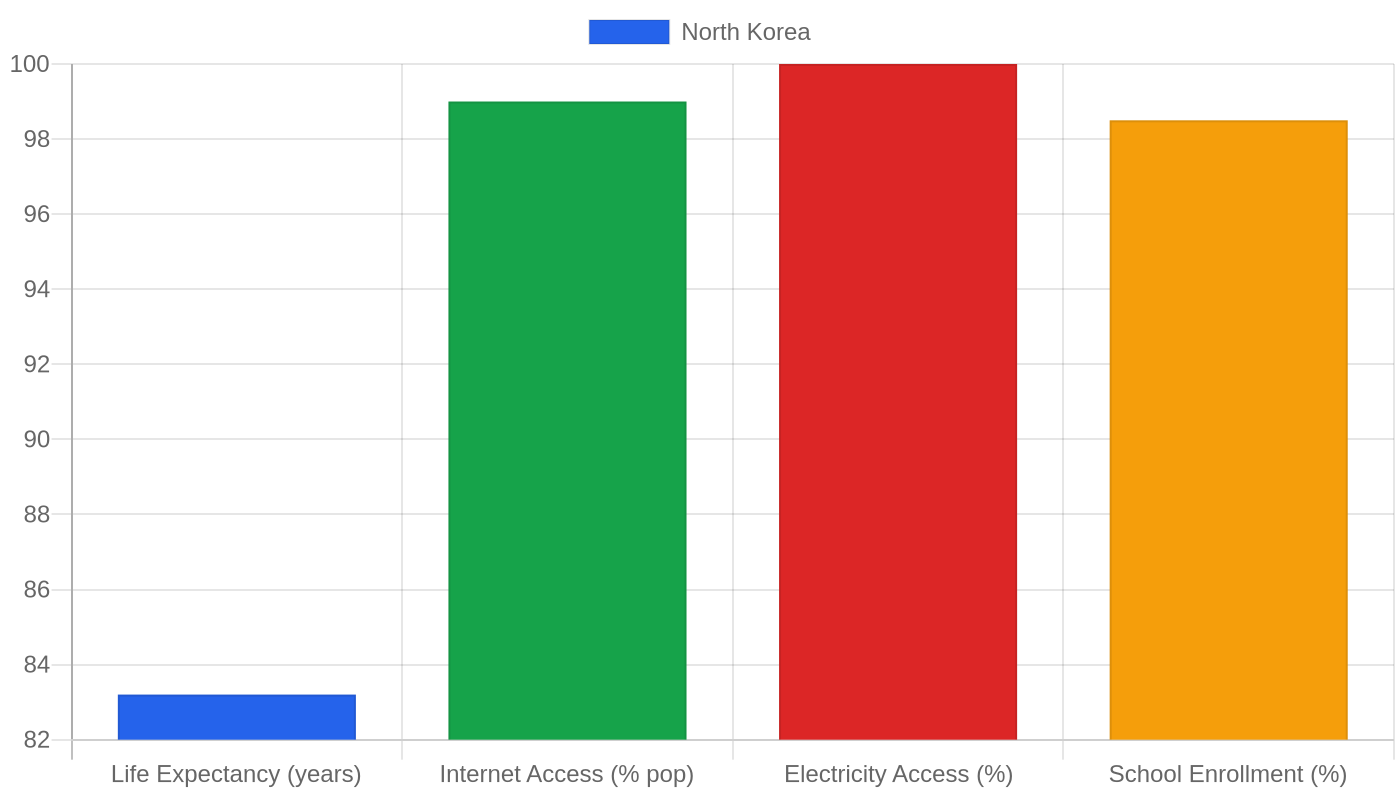
Economic Pulse Net | Sources: World Bank World Development Indicators, Government Sources | 2026
Key Takeaways
- Statistical Blackout: Official macroeconomic indicators for North Korea, including GDP growth, inflation, and unemployment, are unavailable, reflecting the regime’s extreme secrecy and lack of transparent statistical reporting.
- State-Controlled Monopolies: The economic landscape is dominated by state-owned enterprises, with key players like Air Koryo and the Central Bank of the Democratic People’s Republic of Korea serving as the primary pillars of commerce and finance.
- Limited Private Sector Visibility: While entities like Korea Computer Center and Kangsong NET exist, they operate within a tightly controlled framework, offering little insight into private enterprise or consumer market dynamics.
- Unmeasurable Quality of Life: With no available data on crime indices, safety ratings, or political stability metrics, assessing the daily lived experience and business environment remains an exercise in speculation rather than analysis.
The Invisible Ledger: Why Numbers Don’t Exist
In the realm of global economics, North Korea stands as a unique anomaly, a country where the fundamental metrics of economic health are simply not recorded or published.
According to the World Bank, key indicators such as GDP growth, Consumer Price Index (CPI) inflation, and unemployment rates are all marked as “N/A,” or not available.
This is not merely a data gap; it is a structural feature of the North Korean economy, which operates under a strict command system where the state dictates production and distribution, rendering traditional market signals largely moot.
Without reliable data on total GDP or Gross National Income per capita, international economists cannot gauge the true scale of the nation’s output or the purchasing power of its citizens.
The absence of these figures means that standard comparative economic analysis is impossible, forcing observers to rely on indirect estimates and satellite imagery rather than official ledgers.
Consequently, the economic narrative of North Korea is defined less by fluctuating numbers and more by the rigid, unchanging structures of state control that persist regardless of external economic pressures.
This opacity serves a dual purpose: it protects the regime from scrutiny while simultaneously insulating the domestic population from the volatility of global market swings.
A Life Behind the Curtain: The Unquantifiable Cost of Living
When discussing the cost of living in North Korea, the concept becomes abstract because there is no open market where prices are set by supply and demand.
Housing costs, rental rates, and daily expenses are not determined by consumer choice but by state allocation, meaning that the “price” of a home or a loaf of bread is often symbolic rather than transactional.
Without data on regional averages or specific currency exchange rates for daily goods, it is impossible to construct a standard budget or compare living costs to neighboring regions.
The economic reality for most citizens is one of subsistence, where access to goods is determined by one’s social standing and proximity to state resources rather than financial liquidity.
This lack of transparent pricing mechanisms means that the traditional economic concepts of affordability and value are distorted, creating a parallel economy that operates outside the reach of international observation.
For the average resident, the cost of living is measured not in won or dollars, but in the availability of essential goods through the state distribution system, a metric that remains largely invisible to the outside world.
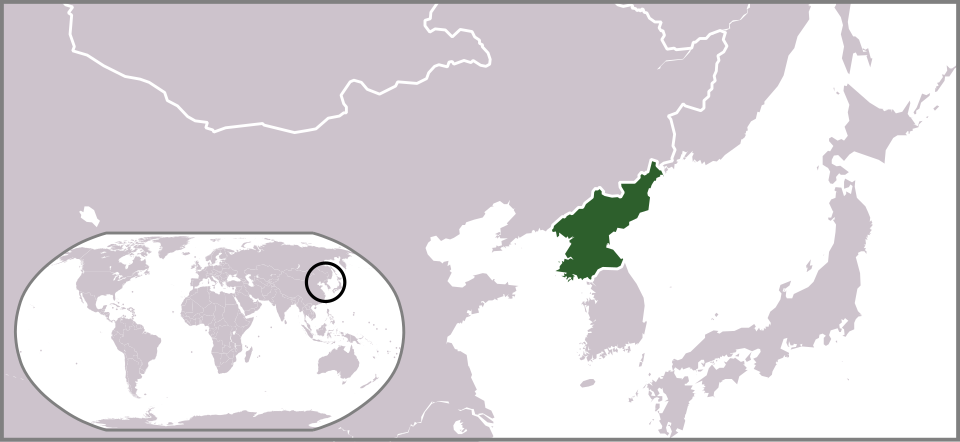
Monopolies of the State: Navigating the Corporate Landscape
The business environment in North Korea is not a marketplace of competition but a landscape of state monopolies, where the top companies are extensions of the government rather than independent entities.
Among the most prominent names is Air Koryo, the national airline, which serves as the primary gateway for international travel and a symbol of the country’s limited engagement with the outside world.
In the financial sector, the Central Bank of the Democratic People’s Republic of Korea and the Foreign Trade Bank hold absolute authority, controlling all monetary policy and cross-border transactions with minimal transparency.
Industrial giants such as Kim Chong-t’ae Electric Locomotive Works and Korea General Machinery Trading Corporation represent the backbone of the country’s heavy industry, focusing on infrastructure and domestic production needs.
The technology sector, represented by entities like Korea Computer Center and Kangsong NET, hints at a state-driven effort to modernize digital infrastructure, yet these services remain tightly restricted and unavailable to the general public.
These organizations do not operate to maximize profit in a capitalist sense but to fulfill state directives, making the concept of “business climate” inapplicable in its traditional Western definition.
Silence on Safety and Stability: The Political Void
Assessing the safety and political landscape of North Korea is complicated by the complete absence of independent data on crime indices, safety ratings, and political freedom metrics.
The World Bank and other international bodies do not provide standard measurements for these areas, leaving analysts without a quantitative framework to evaluate the security environment.
While the regime maintains strict internal control, the lack of published crime statistics makes it impossible to compare safety levels with other nations or to track trends in criminal activity over time.
Similarly, the political landscape is defined by a single-party state structure that does not allow for the kind of political pluralism that generates measurable public opinion data.
Without reliable information on happiness indices or quality of life surveys, the human dimension of living in North Korea remains shrouded in mystery, known only through anecdotal accounts and limited defector testimonies.
This vacuum of data reinforces the isolation of the country, as the world lacks the tools to objectively measure the well-being of its citizens or the stability of its governance.
Current Affairs: The Persistence of Opaqueness
In the current economic climate, the most significant development in North Korea is the continued absence of any shift toward economic transparency or liberalization.
There are no recent reforms, policy shifts, or business developments that have altered the fundamental opacity of the country’s economic reporting, as indicated by the persistent “N/A” status of all key World Bank indicators.
The live indicators remain static, reflecting a system that is resistant to external influence and internal change, with no new data points emerging to challenge the narrative of economic isolation.
This stagnation in data availability suggests that the regime continues to prioritize secrecy over international economic integration, keeping the country firmly outside the global statistical mainstream.
Without new information on inflation trends, electoral processes, or regulatory changes, the current affairs section of North Korea’s economic profile is defined by what is not happening: no reforms, no new markets, and no measurable change.
The Bottom Line
For investors and policymakers, North Korea remains a closed book, offering no actionable data for financial decision-making or strategic planning.
The lack of reliable economic indicators means that any engagement with the country carries an inherent level of uncertainty that cannot be quantified or mitigated through traditional risk analysis.
While the state-controlled entities listed in the corporate landscape provide a glimpse into the sectors of focus, they do not represent investable opportunities in the conventional sense.
Ultimately, North Korea stands as a cautionary tale of economic isolation, where the absence of data is itself the most telling metric of its detachment from the global economy.
Sources & Methodology
This article is authored by Economic Pulse Net for informational and research purposes.
Economic Pulse Net sources its data from multilateral institutions, national statistics bureaus, and proprietary databases.
All data is believed to be current as of the date of publication. Published: September 04, 2026 |
Category: Research — North Korea
Use these signals in your own platform
Economic Pulse publishes its live signal feed through a documented, read-only API. Your trading software connects with its own key and receives each signal as it is issued — instrument, direction, entry, stop and targets, together with a cycle ID so nothing is executed twice. The feed is independent of this website and cannot change it.
Signals are informational only and are not financial advice.