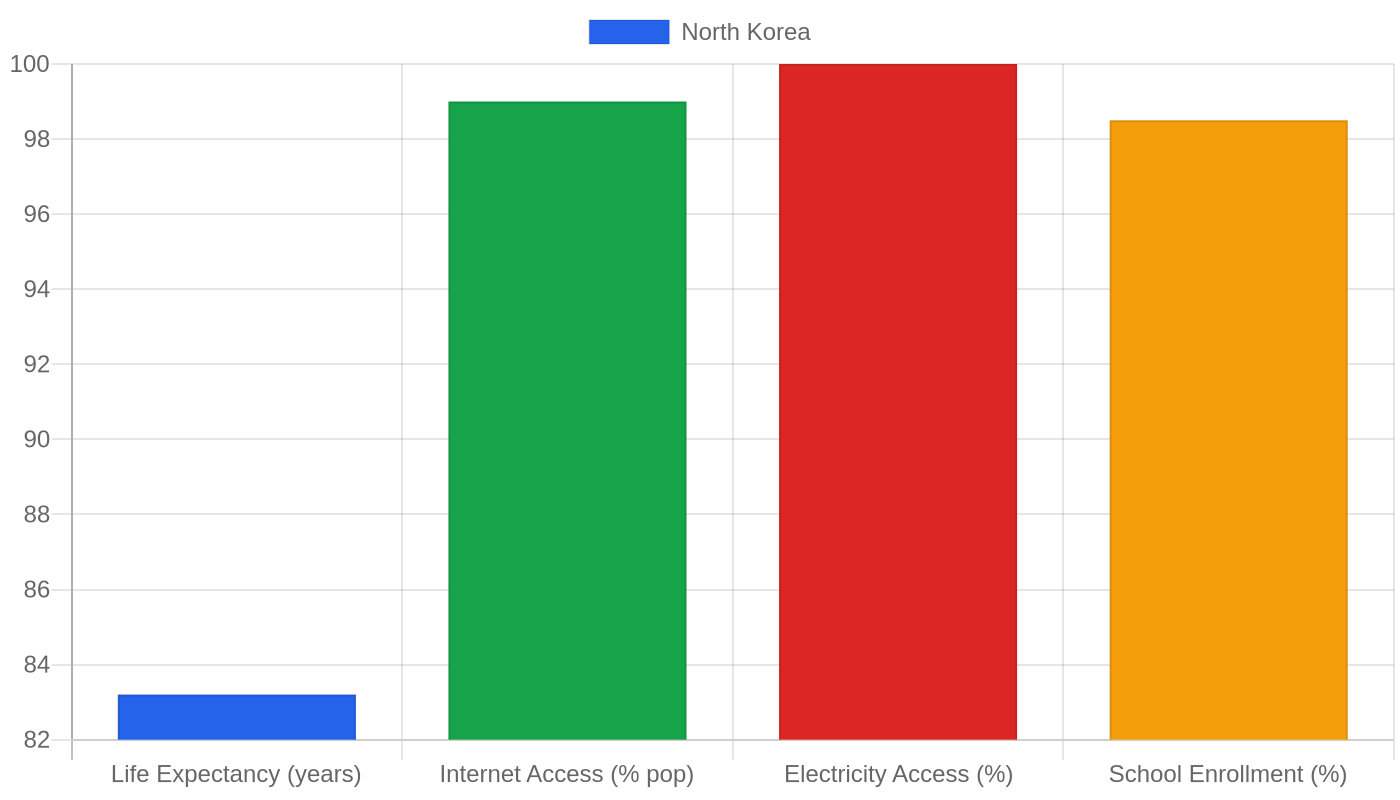
Economic Pulse Net | Sources: World Bank World Development Indicators, Government Sources | 2026
Key Takeaways
* Statistical Opacity: Official macroeconomic indicators such as GDP growth, inflation, and unemployment are officially listed as N/A by the World Bank, reflecting the country’s isolation from global data collection systems.
State-Dominated Economy: The business landscape is defined by state-owned enterprises and specialized trading corporations rather than private market actors, with key players in aviation, finance, and heavy industry.
Isolated Business Environment: Major entities like Air Koryo and the Central Bank operate within a closed loop, limiting foreign investment opportunities and transparency for international observers.
Data Void: With crime indices, safety scores, and political landscape details marked as N/A, external analysts must rely on indirect indicators to assess daily life and stability.
The Architecture of Isolation
North Korea presents one of the most significant challenges in modern economic journalism: a complete lack of verifiable macroeconomic data. According to the latest figures from the World Bank, critical metrics including GDP growth, inflation (CPI), and unemployment rates are all recorded as N/A. This statistical void is not merely a reporting delay but a structural feature of an economy that operates largely outside the formal international financial system.
Without a reported GDP in USD or a PPP-adjusted per capita income, traditional models of economic analysis cannot be applied. The absence of these numbers means that economists cannot measure the velocity of money, the health of consumer spending, or the efficiency of labor markets in standard terms. Consequently, any assessment of the country’s economic pulse must rely on qualitative observations of its industrial output and trade partners rather than quantitative trends.
This opacity suggests an economy that prioritizes self-reliance and security over integration, making it difficult for global investors to gauge risk or opportunity through conventional lenses.
Life Behind Closed Doors
For residents living within the borders, the cost of living remains a tightly guarded secret, with no official data available to compare against regional averages. Housing costs, rent versus buy dynamics, and daily expenses are not tracked in public reports, leaving the general population’s purchasing power invisible to international scrutiny.
In economies where data is scarce, informal markets often fill the void, yet without access to price indices, it is impossible to determine if inflation is eroding wages or if certain goods are becoming more accessible. The lack of housing market data further complicates any understanding of urban development or rural migration patterns. While neighbors in the region may experience rapid urbanization and shifting real estate values, North Korea’s internal economic mechanics remain shrouded in mystery.
This absence of consumer price data implies that price controls or severe shortages may dictate daily survival, though the specific nature of these pressures remains unquantified.
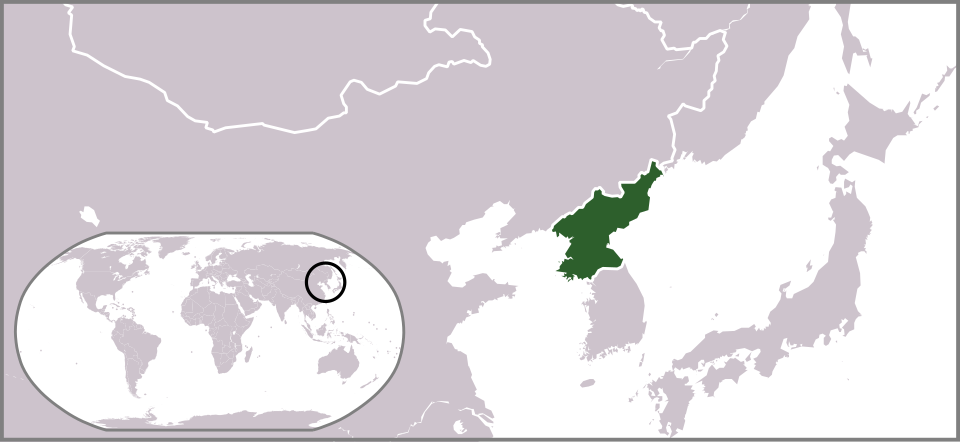
State-Led Industrial Complex
The corporate landscape in North Korea is distinctively characterized by state-controlled entities that dominate essential sectors. A review of top companies reveals a hierarchy centered on national infrastructure and strategic resources. Air Koryo serves as the sole carrier in the consumer services sector, connecting the nation to the outside world in limited capacities.
The financial sector is anchored by the Central Bank of the Democratic People’s Republic of Korea and the Foreign Trade Bank, institutions designed to manage state reserves and facilitate sanctioned or bilateral trade. In the realm of technology and telecommunications, Kangsong NET and the Korea Computer Center represent the digital backbone of the state, likely serving administrative and elite functions rather than broad consumer internet access.
Heavy industry and basic materials are managed by powerful trading corporations, including Korea General Chemicals Trading and Korea General Magnesia Clinker Industry Group, which handle raw material exports. Additionally, the Kim Chong-t’ae Electric Locomotive Works highlights the focus on industrial manufacturing and transportation infrastructure.
These entities do not compete in an open market; instead, they function as extensions of state policy, ensuring that production aligns with national priorities rather than consumer demand.
Stability and Security Metrics
Assessing the quality of life and safety in North Korea is complicated by the total absence of standardized indices. Both the Crime Index and Safety Index are listed as N/A, meaning there is no empirical basis for comparing safety levels to other nations. Similarly, the political landscape is marked as N/A, offering no insight into governance structures, civil liberties, or political stability from a data-driven perspective.
Without happiness data or social satisfaction metrics, any discussion of citizen well-being must remain speculative. The lack of crime statistics does not necessarily imply safety, nor does it indicate chaos; it simply reflects a system where such data is not collected for public or international consumption. This vacuum of information forces observers to infer conditions based on external diplomatic relations and anecdotal evidence rather than hard facts.
For expatriates or potential investors, this lack of safety and political clarity represents the highest possible risk factor, as legal protections and dispute resolution mechanisms are undefined in public records.
Current Affairs and Operational Reality
In the absence of recent news feeds or live indicators, the current operational reality of North Korea’s economy is defined by continuity and isolation. There are no reported reforms, elections, or policy shifts documented in the provided data, suggesting a static environment where change is slow and highly controlled. The business environment appears frozen in time, with major companies continuing their established roles in aviation, banking, and resource trading without visible expansion or contraction.
The lack of new developments in the political sphere or economic indicators implies that the status quo remains firmly entrenched. Any changes that occur are likely internal and not communicated through standard international reporting channels. Therefore, “what is happening now” is effectively nothing that can be verified externally; the economy continues to function according to long-standing directives.
This stagnation, while potentially stable, offers no signals of growth or crisis, leaving the global community watching from the sidelines.
The Bottom Line
North Korea remains a non-entity in standard economic modeling due to its refusal to participate in global data sharing. Investors and analysts should watch this country only as a case study in extreme economic isolation and state control, not as a viable market. The presence of specific state-owned companies provides a window into industrial capabilities, but the lack of macroeconomic data renders financial planning impossible.
Ultimately, this is a nation where the economy exists, but it is invisible to the rest of the world.
Sources & Methodology
This article is authored by Economic Pulse Net for informational and research purposes. Economic Pulse Net sources its data from multilateral institutions, national statistics bureaus, and proprietary databases. All data is believed to be current as of the date of publication.
Published: October 17, 2026 | Category: Research — North Korea
Use these signals in your own platform
Economic Pulse publishes its live signal feed through a documented, read-only API. Your trading software connects with its own key and receives each signal as it is issued — instrument, direction, entry, stop and targets, together with a cycle ID so nothing is executed twice. The feed is independent of this website and cannot change it.
Signals are informational only and are not financial advice.