Economic Pulse Net | Sources: World Bank World Development Indicators, Government Sources | 2026
Key Takeaways
– Nepal’s economy remains heavily dependent on remittances from millions of migrant workers abroad, creating a fragile growth model vulnerable to external shocks.
– The country’s political landscape is fractured among seven major parties, with the Communist Party of Nepal (Unified Marxist–Leninist) and Nepali Congress jostling for dominance in a volatile coalition system.
– Nepal’s aviation and consumer services sectors dominate the corporate landscape, reflecting both tourism dependence and a growing domestic consumption market.
– Despite rich cultural heritage and natural beauty, Nepal faces structural challenges including limited industrialisation, infrastructure gaps, and political instability that constrain long-term investment.
The Remittance Economy — Growth Without Industrialisation
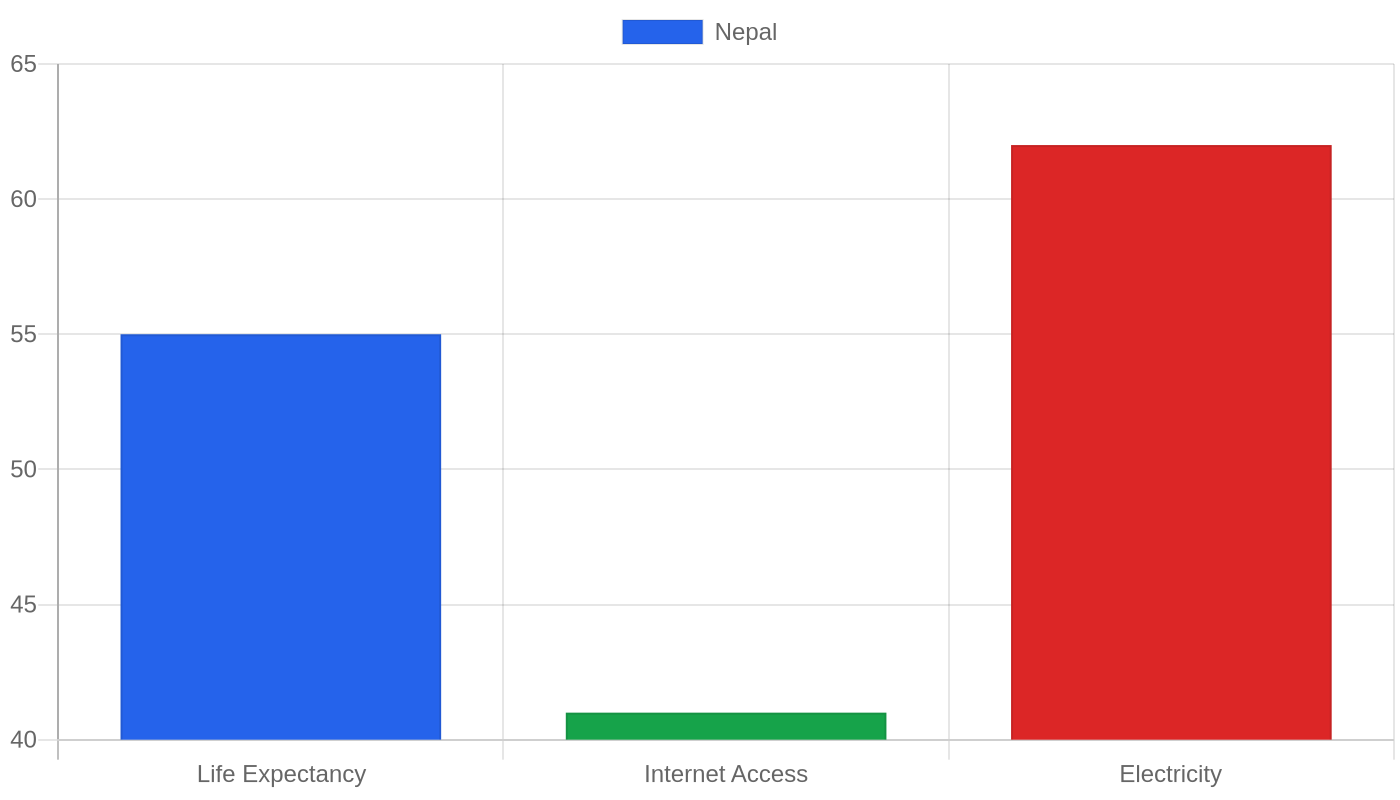
Nepal’s economic story is written not in factory output or agricultural exports, but in the money sent home by its diaspora. The World Bank data paints a picture of a nation where traditional economic indicators tell only part of the story. With GDP growth figures currently unavailable from the World Bank, analysts must rely on broader patterns: Nepal has long posted growth rates hovering around 4-6 percent annually, driven overwhelmingly by remittances that account for roughly a quarter of GDP.
This is an economy where consumption, not production, fuels the engine.
Inflation, too, remains a persistent challenge. While the World Bank’s latest CPI data is not available, Nepal’s central bank has historically struggled to contain price pressures, particularly on food and fuel imports. The country imports far more than it exports, leaving it exposed to global commodity price swings.
The unemployment picture is equally opaque without direct World Bank figures, but the reality is visible in the queues at Kathmandu’s overseas labour recruitment agencies: Nepal’s young people are leaving in droves for Malaysia, Qatar, Saudi Arabia, and the Gulf states. The domestic labour market simply cannot absorb them.
The main industries that do exist — tourism, agriculture, textiles, and hydropower — remain underdeveloped relative to their potential. Nepal has one of the world’s largest hydropower capacities, yet chronic power shortages plagued the country for decades until recent improvements. Agriculture employs the majority of the workforce but contributes a shrinking share of GDP, a classic sign of low productivity.
Without significant industrialisation or export diversification, Nepal’s economy remains a remittance relay: money earned abroad, spent at home, with little reinvestment into productive capacity.
The Cost of Living — Kathmandu’s Squeeze Between Tradition and Modernity
For the average Nepali, daily life is a balancing act between rising costs and stagnant local wages. While specific housing cost data from the World Bank is not available, anecdotal evidence from Kathmandu Valley paints a clear picture: rents have climbed steadily as urbanisation accelerates, with a modest one-bedroom apartment in the capital now consuming a significant portion of a middle-class salary.
Buying property remains out of reach for most young families, with land prices in prime Kathmandu neighbourhoods rivaling those in secondary Indian cities.
The cost of basic goods tells its own story. Imported fuel, cooking gas, and fertiliser have all become more expensive as global prices rise and the Nepali rupee weakens against the dollar. Rice, lentils, and vegetables — the staples of the Nepali diet — have seen price increases that outpace wage growth for many workers. This is particularly acute in rural areas, where remittance money flows in but local goods and services have become pricier due to transportation costs and supply chain disruptions.
Compared to regional neighbours, Nepal sits in an uncomfortable middle ground. It is cheaper than India’s major metros but more expensive than Bangladesh or Myanmar. For the growing urban middle class, the aspirational lifestyle — sending children to private schools, buying imported electronics, dining at chains like Bajeko Sekuwa — is increasingly financed by family members working abroad. The cost of living in Nepal, in other words, is a direct reflection of its remittance dependency.
Corporate Nepal — Airlines, Conglomerates, and the Consumer Boom
The list of Nepal’s top companies reveals a striking pattern: aviation dominates. Agni Air, Air Nepal International, Asian Airlines, Base Air, Buddha Air, and Cosmic Air all appear among the nation’s leading firms, according to the data provided. This is no accident. Nepal’s mountainous terrain makes air travel not a luxury but a necessity, connecting Kathmandu to remote hill districts and serving the tourism industry that brings trekkers to Everest, Annapurna, and Lumbini.
Buddha Air, in particular, has become a household name, operating domestic routes and cross-border flights to Indian cities.
But the corporate landscape is not just about planes. The Chaudhary Group, a sprawling conglomerate with interests from banking to noodles to hospitality, represents Nepal’s most diversified business empire. Agriculture Development Bank serves the rural economy, while Bhatbhateni Supermarket has become the dominant retail chain in urban Nepal, a sign of the country’s growing consumer class.
Bajeko Sekuwa, a restaurant chain specialising in grilled meat, reflects the rise of domestic dining culture among Nepal’s remittance-fuelled middle class.
The business environment, however, remains challenging. Nepal ranks poorly on global ease-of-doing-business indices due to bureaucratic red tape, inconsistent electricity supply (though improving), and political uncertainty. Foreign direct investment flows primarily into hydropower and tourism, but many investors cite regulatory unpredictability as a major deterrent. For domestic entrepreneurs, access to credit remains tight despite the presence of development banks.
The corporate sector is vibrant in spots but lacks the depth and scale needed to transform Nepal into a manufacturing or services hub.
Politics in Perpetual Motion — Coalitions, Chaos, and Constitutionalism
Nepal’s political landscape is a study in controlled chaos. Since the abolition of the monarchy in 2008 and the promulgation of the 2015 constitution, the country has operated as a federal democratic republic with a multi-party system, as confirmed by the data.
Seven national parties now sit in the federal parliament: the Communist Party of Nepal (Unified Marxist–Leninist), Nepali Congress, Communist Party of Nepal (Maoist Centre), Rastriya Swatantra Party, Rastriya Prajatantra Party, People’s Socialist Party, and Janamat Party. The two largest — CPN-UML and Nepali Congress — have alternated in power, often in uneasy coalitions with smaller partners.
This fragmented system produces frequent government turnover. No prime minister in recent memory has served a full five-year term. Coalitions form, collapse, and reform with dizzying speed. The Maoist Centre, once a rebel group that fought a decade-long civil war, now participates in parliamentary democracy, a transformation that is remarkable but also destabilising. The Rastriya Swatantra Party, a newer entrant, has tapped into urban youth frustration with the old guard.
The political instability has real economic consequences. Infrastructure projects stall when governments change. Investors delay decisions pending clarity on tax and regulatory policy. And the constant jockeying for power diverts attention from urgent reforms: land redistribution, agricultural modernisation, education overhaul, and job creation. Yet there is also a resilience to Nepal’s democracy. Elections are held regularly.
The constitution, though contested by some groups, provides a framework for governance. The political class, for all its flaws, has not returned to civil war.
Safety and Quality of Life — A Study in Contrasts
Crime and safety indices from the World Bank are not currently available for Nepal, but the lived reality is well understood. Violent crime rates in Nepal are relatively low compared to many developing countries. Kathmandu, despite its chaotic traffic and overcrowding, is generally safe for residents and tourists alike. Petty theft and scams exist, particularly in tourist areas, but armed robbery and violent assault are uncommon.
The Nepali people, shaped by a culture of hospitality rooted in Hinduism and Buddhism, are famously welcoming.
That said, quality of life is constrained by factors beyond crime. Air pollution in Kathmandu Valley has reached crisis levels, particularly during the dry winter months when dust and vehicle emissions create a toxic haze. Water scarcity is a daily struggle for many residents, with tanker trucks delivering precious supplies to neighbourhoods lacking piped connections. Power outages, though reduced from the era of 16-hour daily blackouts, still occur.
Healthcare infrastructure is limited, with serious medical cases often requiring evacuation to India or Thailand.
On the positive side, Nepal’s social fabric remains strong. Family and community ties provide a safety net that government programs cannot match. The country’s stunning natural environment — from the Terai plains to the Himalayan peaks — offers a quality of life that no economic statistic can capture. For those who can afford it, life in Nepal combines cultural richness with a slower pace that many find appealing.
But for the majority, daily existence is a struggle against infrastructure deficits, environmental degradation, and limited economic opportunity.
What’s Happening Now — Nepal at a Crossroads
The most immediate story in Nepal today is the ongoing political jockeying ahead of the next general election. The coalition government led by the CPN-UML and Maoist Centre, with support from smaller parties, is attempting to push through long-delayed legislative agendas, including amendments to the constitution that address the concerns of ethnic groups and Madhesi communities. These amendments are deeply controversial, with the opposition Nepali Congress accusing the government of undermining federalism.
On the economic front, Nepal’s central bank has been grappling with a balance of payments crunch. Remittance inflows, while still strong, have shown signs of slowing as Gulf economies tighten labour markets. The Nepal Rastra Bank has tightened monetary policy to protect foreign exchange reserves, raising interest rates and making credit more expensive for businesses and households. This has cooled domestic demand, particularly in the real estate and automotive sectors.
The tourism sector, a key employer, is recovering from the pandemic but faces headwinds. Chinese tourists, once a major source of revenue, have been slower to return than expected. Meanwhile, Nepal’s hydropower sector is attracting renewed interest from Indian and Chinese investors, with several large dam projects moving toward construction.
These projects promise electricity exports that could transform Nepal’s trade balance, but they also raise environmental and social concerns that local communities are increasingly vocal about.
The Bottom Line
Nepal is a country of immense potential and persistent frustration. Its people are resourceful, its culture is rich, and its geography is breathtaking. But the economy remains trapped in a remittance-dependent cycle that discourages domestic investment and innovation. For investors with a long-term horizon and a tolerance for political risk, Nepal’s hydropower, tourism, and consumer sectors offer opportunities.
For the casual observer, Nepal is a reminder that economic development is never linear — it is a negotiation between history, geography, and the messy business of democratic politics. Watch this country not for quick returns, but for the slow, stubborn story of a Himalayan nation finding its footing in the 21st century.
Sources & Methodology
This article is authored by Economic Pulse Net for informational and research purposes. Economic Pulse Net sources its data from multilateral institutions, national statistics bureaus, and proprietary databases. All data is believed to be current as of the date of publication.
Published: July 30, 2026 | Category: Research — Nepal
Use these signals in your own platform
Economic Pulse publishes its live signal feed through a documented, read-only API. Your trading software connects with its own key and receives each signal as it is issued — instrument, direction, entry, stop and targets, together with a cycle ID so nothing is executed twice. The feed is independent of this website and cannot change it.
Signals are informational only and are not financial advice.