Economic Pulse Net | Sources: World Bank World Development Indicators, Government Sources | 2026
Key Takeaways
- Mongolia’s economy remains fundamentally anchored to its vast mineral wealth, with state-owned giants like Erdenes Tavantolgoi and Erdenet Mining Corporation dominating the industrial landscape.
- The political system operates as a semi-presidential republic, where a directly-elected president appoints the prime minister, creating a complex balance of power between the executive and legislative branches.
- The country’s economic narrative is defined by its position as a resource frontier, with development finance institutions like the Development Bank of Mongolia playing a pivotal role in infrastructure projects.
- Transportation infrastructure, spearheaded by Ulaanbaatar Railway, is critical to unlocking the country’s export potential and connecting landlocked Mongolia to global markets.
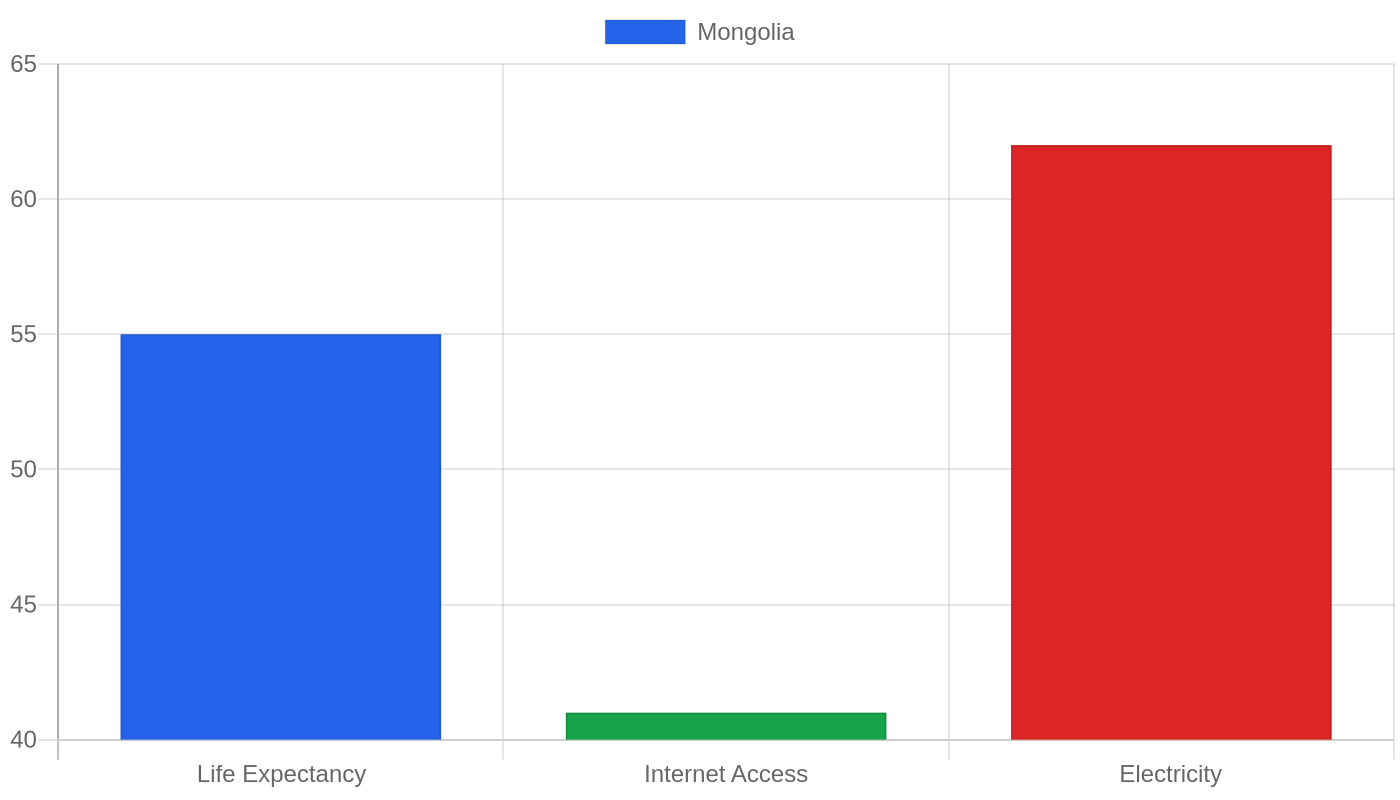
- While comprehensive economic indicators are currently unavailable, the structural composition of Mongolia’s economy points to a nation in transition, balancing its mining heritage with ambitions for diversification.
The Great Mining Engine: Anatomy of a Resource-Dependent Economy
Mongolia’s economic story is written in the rocks beneath its vast, windswept steppes.
According to the World Bank, the country’s economic fundamentals—GDP growth, inflation, and unemployment—remain unquantified in the latest reporting cycle, yet the structure of its industrial base tells a compelling narrative of resource-driven development.
The nation’s economic backbone is unapologetically extractive, with mining conglomerates such as Erdenes Tavantolgoi and Erdenet Mining Corporation serving as the primary engines of national wealth generation.
These entities are not merely private enterprises; they are state-linked behemoths that channel mineral revenues directly into the national treasury, creating a direct pipeline between underground deposits and government coffers.
The significance of this mining-centric model cannot be overstated.
For a nation of Mongolia’s size and geographic position, the extraction and export of coal, copper, and other minerals represents the primary source of foreign exchange earnings and fiscal revenue.
The presence of Baganuur JSC and Shivee-Ovoo in the corporate landscape underscores the strategic importance of coal as a cornerstone commodity.
This concentration of economic activity creates both opportunity and vulnerability—when global commodity prices surge, Mongolia prospers; when they falter, the national budget faces immediate strain.
The World Bank’s data framework suggests an economy in a state of flux, where the absence of updated metrics may itself reflect the challenges of data collection in a vast, sparsely populated territory where economic activity is geographically concentrated around mining sites and the capital city of Ulaanbaatar.
The Cost of the Frontier: Housing and Daily Life in a Land of Extremes
Life in Mongolia presents a unique economic paradox, where the costs of modern urban living intersect with a traditional nomadic heritage.
In Ulaanbaatar, the capital, housing pressures reflect a nation undergoing rapid urbanisation, with residents facing the dual challenge of harsh continental winters and the need for reliable, affordable shelter.
The cost of living in Mongolia’s urban centres is influenced heavily by the country’s reliance on imports for many consumer goods, a consequence of its landlocked geography and relatively small domestic manufacturing base.
While specific price indices are not available in the current data set, the structural realities of the economy suggest that housing and daily expenses consume a significant portion of household incomes.
The rental market in Ulaanbaatar operates in a context of high demand driven by rural-to-urban migration, as younger generations move from herding communities to seek education and employment opportunities in the capital.
Homeownership remains an aspiration for many, but the financing landscape, dominated by institutions like State Bank, plays a crucial role in determining accessibility.
The juxtaposition of modern apartment blocks against traditional *ger* districts—where families live in felt tents on the city’s outskirts—illustrates the economic stratification that defines Mongolian urban life.
For the average citizen, daily expenses are shaped by the need to heat homes through brutal winters, with energy costs forming a substantial portion of monthly budgets.
The economic reality is one of resilience, where families navigate the intersection of a resource-driven economy and the enduring traditions of a nomadic culture.
The Corporate Steppe: Investment Opportunities and the Business Landscape
For investors eyeing Mongolia, the corporate landscape is defined by a distinctive blend of state capitalism and emerging market potential.
The commanding heights of the economy are occupied by Erdenes Mongol, a holding company that manages the state’s strategic stakes in the nation’s most valuable mineral assets.
This structure signals a business environment where political connections and government partnerships are often prerequisites for major projects.
Alongside the mining giants, the presence of the Mongolian Stock Exchange provides a formal avenue for capital raising, suggesting a maturing financial infrastructure that seeks to channel domestic savings into productive investment.
The transportation sector, anchored by Ulaanbaatar Railway, represents a critical investment frontier.
As a landlocked nation, Mongolia’s ability to export its mineral wealth depends entirely on its rail and road connections to China and Russia.
Modernising this infrastructure is not merely an economic priority but an existential necessity.
The Development Bank of Mongolia functions as a key instrument in this process, providing long-term financing for projects that commercial banks may consider too risky or too slow to yield returns.
For foreign investors, the allure lies in the potential for high returns in a resource-rich frontier market, tempered by the realities of regulatory complexity and the need for deep local knowledge.
The aviation sector, served by MIAT Mongolian Airlines, connects this remote nation to global markets, facilitating both business travel and the movement of high-value goods.
Governance and Security: The Political Architecture of a Young Democracy
Mongolia’s political system, as defined by its constitutional structure, is a semi-presidential representative democratic republic with a directly-elected president.
This framework creates a dynamic interplay between the presidency and the State Great Khural, the unicameral legislature whose deputies are chosen through popular vote.
The president’s role in appointing the prime minister and nominating the cabinet on the prime minister’s proposal establishes a system of checks and balances that shapes the country’s policy direction.
This political architecture is relatively young, emerging from the peaceful democratic revolution of 1990, and continues to evolve as the nation grapples with the challenges of institutionalising democratic governance.
The political landscape is characterised by a tension between the need for stability to attract foreign investment and the democratic imperatives of accountability and transparency.
Corruption remains a persistent concern, particularly in the mining sector, where the vast sums of money at stake create incentives for rent-seeking behaviour.
Crime and safety indices are not currently available, but the broader quality of life in Mongolia is shaped by factors such as air quality in Ulaanbaatar—which suffers from severe winter pollution due to coal burning—and the vast disparities in wealth between the urban elite and rural herders.
The political system’s resilience will be tested by its ability to manage the country’s resource wealth equitably, ensuring that the benefits of mining translate into broad-based development rather than concentrated enrichment.
The Current Conjuncture: Navigating Uncertainty, Seizing Potential
Mongolia stands at a critical juncture, where the interplay of global commodity markets, domestic political dynamics, and infrastructure constraints will determine the nation’s trajectory.
The current economic moment is defined by an ongoing tension between the immediate revenues from mineral extraction and the long-term imperative to diversify.
The state-owned enterprises that dominate the economy—from Erdenes Tavantolgoi to the Development Bank of Mongolia—are increasingly under scrutiny to perform not only as commercial entities but as instruments of national development policy.
There is a palpable sense within the business community that the window for leveraging Mongolia’s mineral wealth into lasting prosperity is open now, but may not remain so indefinitely.
The government’s focus is squarely on expanding export capacity, with particular emphasis on overcoming the logistical bottlenecks that have historically constrained the mining sector’s growth.
Investments in rail infrastructure, border crossing efficiencies, and energy generation are viewed as critical enablers of the next phase of economic expansion.
Meanwhile, the political system is engaged in ongoing debates about resource nationalism versus openness to foreign investment, with the balance between these competing forces shifting with each new commodity cycle.
The Mongolian Stock Exchange is working to deepen capital markets, aiming to provide domestic companies with alternatives to state financing and to create wealth-building opportunities for ordinary citizens.
For observers, the sense is of a nation in motion, navigating the complexities of resource-led development with a determination that reflects its hardy nomadic heritage.
The Bottom Line
Mongolia is a country for the patient and the bold—those willing to look beyond the absence of readily available economic metrics and see the structural potential of a nation sitting atop some of the world’s most valuable mineral deposits.
The state-controlled corporate sector offers a unique entry point into this frontier market, but success requires navigating a political landscape where government partnership is indispensable.
For commodity traders, infrastructure developers, and investors with a long-term horizon, Mongolia presents a compelling, albeit complex, opportunity.
This is a nation whose future will be forged in the crucible of its own resource wealth, and the coming years will determine whether that wealth becomes a blessing or a burden.
Sources & Methodology
This article is authored by Economic Pulse Net for informational and research purposes.
Economic Pulse Net sources its data from multilateral institutions, national statistics bureaus, and proprietary databases.
All data is believed to be current as of the date of publication. Published: August 31, 2026 |
Category: Research — Mongolia
Use these signals in your own platform
Economic Pulse publishes its live signal feed through a documented, read-only API. Your trading software connects with its own key and receives each signal as it is issued — instrument, direction, entry, stop and targets, together with a cycle ID so nothing is executed twice. The feed is independent of this website and cannot change it.
Signals are informational only and are not financial advice.