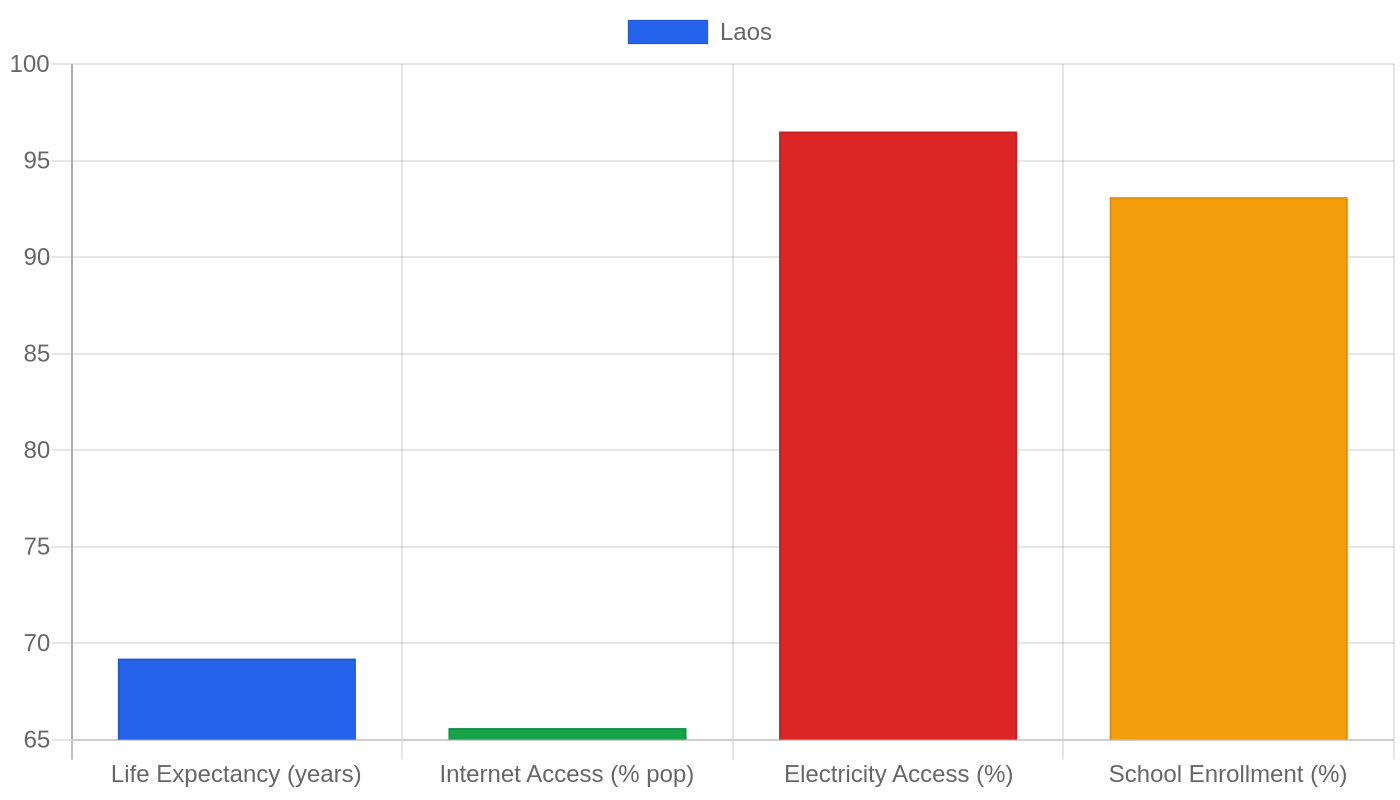
Economic Pulse Net | Sources: World Bank World Development Indicators, Government Sources | 2026
Key Takeaways
* State Dominance: The economy is heavily influenced by state-owned enterprises, particularly in the critical utilities sector, with Lao Holding State Enterprise and Electricite du Laos playing pivotal roles.
Political Rigidity: Classified as an “authoritarian regime” by *The Economist*, Laos maintains a unitary communist structure that prioritizes socialist transition over democratic openness, impacting governance stability.
Service-Led Corporate Landscape: Major domestic players like Boun Oum Airways, Lao Airlines, and Lao Brewery Company dominate consumer services and goods, reflecting a service-oriented corporate hierarchy.
Data Transparency Gaps: Official macroeconomic indicators such as GDP growth, inflation, and unemployment figures are currently unreported by the World Bank, creating a blind spot for international investors.
The Economic Engine: Powering a Hidden Economy
Laos presents a unique economic profile where traditional metrics often fail to capture the full scope of national activity due to significant data gaps. According to the World Bank, key indicators including GDP growth, inflation CPI, and unemployment rates are currently listed as N/A, leaving analysts without precise numerical benchmarks for the country’s health.
However, the industrial backbone is clearly visible through its major corporate entities, which are predominantly concentrated in utilities and consumer services. Nam Theun 2 Power Company stands out as a critical infrastructure player, highlighting the nation’s reliance on hydropower exports and energy production as a primary economic driver.
Alongside this, Lao Holding State Enterprise and Electricite du Laos control vital utility networks, suggesting that the state retains tight control over the most profitable sectors of the economy. While specific GDP per capita PPP figures are unavailable, the presence of established consumer goods manufacturers like the Lao Brewery Company indicates a steady, albeit modest, domestic consumption market.
This structure implies an economy that is less driven by volatile global trade fluctuations and more by internal resource management and state-directed development. The absence of recent World Bank data does not necessarily signal stagnation but rather a lack of transparent reporting mechanisms that complicate external assessment. Ultimately, the economic narrative of Laos is one of controlled resources rather than open-market dynamism, with energy serving as the undisputed kingmaker.
Cost of Living: Navigating Daily Expenses
For residents and expatriates alike, understanding the cost of living in Laos requires looking beyond standard indices, as comprehensive data on daily expenses and housing markets is sparse in current reports. Without specific inflation CPI figures from the World Bank, it is difficult to benchmark price stability against regional peers or track the erosion of purchasing power over time.
Housing costs and rent-versus-buy dynamics remain largely unquantified in available datasets, forcing observers to rely on anecdotal evidence and localized market observations rather than hard statistics. General consumer behavior suggests that while basic necessities may be affordable, imported goods and services associated with the corporate sector—such as those provided by major airlines and utilities—carry a premium.
The dominance of state-run utilities means that electricity and water costs are likely regulated, providing a baseline of stability even if overall inflation trends are unknown. For those navigating the local economy, the lack of transparent cost-of-living indices necessitates careful budgeting and reliance on real-time local feedback rather than aggregate national data.
Consequently, the financial experience in Laos is highly variable, depending heavily on one’s integration into the formal corporate sector versus the informal local market.
Investment & Business Climate: A State-Centric Market
Investing in Laos offers opportunities primarily within sectors where state enterprises have established strong footholds, making partnerships with these entities crucial for market entry. The landscape is defined by major companies such as Lao Airlines, Lao Skyway, and Central Airlines, which control the majority of air transport services, signaling high barriers to entry for foreign competitors in logistics and travel.
In the consumer goods space, the Lao Brewery Company represents a mature market segment, suggesting that established brands with local manufacturing capabilities can thrive despite political constraints. Utilities remain the most strategic sector for investment, given the prominence of Nam Theun 2 Power Company and Electricite du Laos, which handle the bulk of national energy distribution.
The business environment is further shaped by the overarching influence of Lao Holding State Enterprise, which oversees various utility assets and acts as a gatekeeper for large-scale infrastructure projects. Foreign investors must navigate a system where political alignment and regulatory compliance are as important as capital efficiency.
The concentration of top companies in consumer services and utilities indicates that growth opportunities are tied closely to infrastructure development and domestic consumption patterns. Success in this market requires patience and a deep understanding of the state-led economic model, where private enterprise often operates in the shadow of public ownership.
Safety, Politics & Quality of Life: Stability Amidst Control
Quality of life in Laos is deeply intertwined with its political reality, characterized by strict governmental oversight and limited civil liberties. The country operates as a unitary communist state, officially designated as a people’s democratic state, yet it pursues a gradual transition from capitalism to socialism before aiming for communism.
This political framework was starkly illustrated in *The Economist*’s Democracy Index 2016, which classified Laos as an “authoritarian regime,” ranking it lowest among the nine ASEAN nations included in the study. Such a classification underscores the rigid nature of the political landscape, where dissent is minimal and state control over information and movement is pervasive.
Regarding personal safety, crime and safety indices are currently reported as N/A, leaving residents and visitors without standardized metrics to gauge risk levels. However, the authoritarian nature of the regime often correlates with low violent crime rates, though political surveillance and legal restrictions pose different kinds of risks. The combination of political rigidity and unclear safety data creates an environment where stability is maintained through control rather than consensus.
For expatriates and long-term residents, understanding the nuances of this political climate is essential for maintaining a secure and compliant lifestyle.
What’s Happening Now: The Current Political Reality
The most significant current affair in Laos is the continued consolidation of its communist political structure, which defines all other economic and social developments. As a self-designated people’s democratic state, the Lao People’s Democratic Republic (LPDR) is actively engaged in transitioning its mode of production, prioritizing ideological goals alongside economic management.
This political stance directly influences business operations, as seen in the dominance of state-linked entities like Lao Holding State Enterprise and Nam Theun 2 Power Company, which reflect government priorities in energy and infrastructure. The classification of Laos as an authoritarian regime by *The Economist* remains a defining feature of its international standing, affecting diplomatic relations and foreign direct investment flows.
With no new election cycles or major policy shifts reported in the immediate data, the status quo persists: a tightly controlled economy managed by a centralized party apparatus. Companies like Boun Oum Airways and Lao Airlines continue to operate within this constrained framework, adapting to regulations set by a government that values stability over liberalization.
The lack of updated World Bank data suggests that international monitoring of economic reforms has stalled or become less transparent, further isolating the country from global economic discourse. Currently, the narrative is one of endurance and continuity, with the state maintaining firm grip over both political and economic levers.
The Bottom Line
Laos remains a niche destination for investors and researchers who understand the value of operating within state-dominated frameworks. The country offers stability in terms of political continuity but lacks the transparency required for data-driven decision-making, as evidenced by the missing World Bank indicators. Investors should focus on sectors where state enterprises are already entrenched, particularly utilities and consumer services, while remaining cautious of the opaque regulatory environment.
For those willing to navigate the complexities of an authoritarian regime, Laos presents opportunities in infrastructure and energy, but success depends on building strong relationships with local state partners.
Sources & Methodology
This article is authored by Economic Pulse Net for informational and research purposes. Economic Pulse Net sources its data from multilateral institutions, national statistics bureaus, and proprietary databases. All data is believed to be current as of the date of publication.
Published: October 18, 2026 | Category: Research — Laos
Use these signals in your own platform
Economic Pulse publishes its live signal feed through a documented, read-only API. Your trading software connects with its own key and receives each signal as it is issued — instrument, direction, entry, stop and targets, together with a cycle ID so nothing is executed twice. The feed is independent of this website and cannot change it.
Signals are informational only and are not financial advice.