Economic Pulse Net | Sources: World Bank World Development Indicators, Government Sources | 2026
Key Takeaways
– Laos remains one of the world’s last communist states, officially pursuing a transition from capitalism to socialism, yet its economy is increasingly driven by foreign investment, hydropower exports, and tourism.
– The country’s economic engine is its utilities sector, anchored by state-owned giants like Electricite du Laos and Nam Theun 2 Power Company, which sell electricity across Southeast Asia.
– Consumer services and aviation are emerging as growth areas, with multiple domestic airlines and a state-run brewery dominating the formal economy.
– Laos ranks as an “authoritarian regime” in The Economist’s Democracy Index, placing it at the bottom of ASEAN nations in political freedom metrics.
– Despite data gaps in key economic indicators, the country’s corporate landscape reveals a state-centric model where utilities and consumer goods drive formal employment and export revenue.
The Mekong’s Powerhouse — A State-Driven Economy in Transition
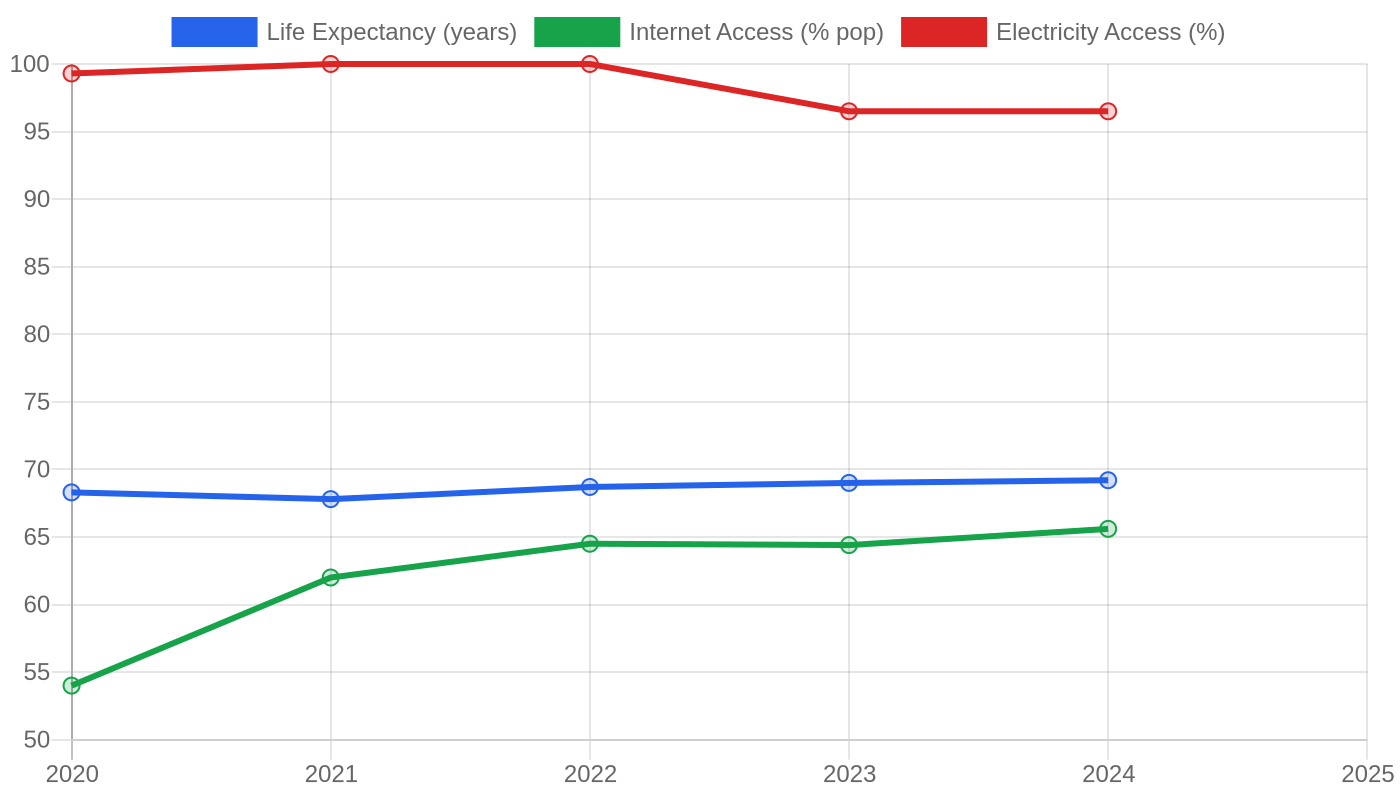
Laos, officially the Lao People’s Democratic Republic, presents a fascinating paradox for economic observers. The World Bank’s latest data shows gaps in headline indicators like GDP growth, inflation, and unemployment, yet the country’s economic structure tells a compelling story through its corporate landscape.
At the heart of this economy sits Electricite du Laos, the state-owned utility that has transformed the country into what analysts call the “battery of Southeast Asia.” Alongside it, Nam Theun 2 Power Company represents one of the region’s most significant hydropower ventures, exporting electricity to neighboring markets and generating crucial foreign exchange revenue.
The utility sector’s dominance is no accident. Laos has leveraged its mountainous terrain and abundant river systems to become a regional energy provider, with hydropower serving as the backbone of its export economy. This strategic positioning has attracted international development financing and created a steady revenue stream that partially insulates the country from global commodity price shocks.
However, the heavy reliance on energy exports also exposes Laos to weather variability and regional demand fluctuations — a vulnerability that becomes more pronounced as climate change alters rainfall patterns across the Mekong basin.
Beyond energy, the consumer goods sector shows surprising vitality. Lao Brewery Company, a joint venture with global brewing interests, has become a household name across Indochina, demonstrating that domestic brands can compete regionally. The aviation sector has similarly expanded, with Boun Oum Airways, Lao Airlines, Lao Central Airlines, and Lao Skyway all operating in a market that would seem too small for four carriers.
This proliferation suggests either robust tourism demand or overcapacity — a question that remains unanswered given the absence of detailed passenger statistics.
The state’s heavy hand in the economy is evident in the presence of Lao Holding State Enterprise alongside the utilities and airlines. This conglomerate structure reflects the communist government’s approach to economic management: maintaining strategic control over key sectors while allowing limited private participation in consumer-facing industries.
The result is an economy that functions differently from market-based neighbors, with state priorities often overriding pure profit considerations in investment decisions.
The Cost of Living — A Tale of Two Economies
For the average Lao citizen, the cost of living remains modest by regional standards, though reliable comparative data is scarce. The formal economy, dominated by state enterprises and their employees, operates within a wage structure set by government policy rather than market forces. This creates a bifurcated reality where state workers enjoy relative stability while those in the informal sector — agriculture, small-scale trade, and construction — face more volatile income streams.
Housing costs in Vientiane, the capital, have risen steadily as foreign investment flows into commercial real estate and expatriate housing. The gap between renting and buying has widened, with land ownership restricted for foreigners and limited to citizens. This constraint has created a rental market that serves both the growing expatriate community and the domestic middle class, though at significantly different price points.
Daily expenses for food and transportation remain low compared to Bangkok or Hanoi, making Laos an affordable destination for regional travelers.
Investment & Business Climate — Where the State Leads, Capital Follows
The investment landscape in Laos is defined by its state-centric model. The top companies list reads like a directory of government-linked enterprises, with utilities and aviation dominating the formal corporate sector. For foreign investors, this means navigating a complex regulatory environment where partnerships with state entities are often the only viable entry strategy.
The hydropower sector has proven most accessible, with international developers partnering with Electricite du Laos on build-operate-transfer projects that provide long-term revenue certainty.
Consumer goods represent a more open but competitive arena. Lao Brewery Company’s success demonstrates that well-managed joint ventures can thrive, though the market’s small size limits scalability. The aviation sector’s multiple carriers suggest either an optimistic bet on tourism growth or a case of political patronage dividing a limited market.
Investors watching Laos should focus on infrastructure projects connected to the regional rail network and energy export corridors, as these align with both government priorities and regional integration trends.
Safety, Politics & Quality of Life — Stability at a Price
The political landscape in Laos is unambiguous. The Economist’s Democracy Index classifies the country as an “authoritarian regime,” ranking it lowest among the nine ASEAN nations included in the 2016 study. This classification reflects the Lao People’s Revolutionary Party’s monopoly on power and the absence of meaningful political opposition.
For residents, this translates into a stable but constrained public sphere, where political expression is limited and civil society operates under tight government oversight.
Crime and safety indices are not available for Laos, but the country’s reputation among travelers suggests relatively low levels of petty crime compared to regional peers. The security situation is generally stable, with the government maintaining strong internal control. Quality of life metrics are mixed: while economic growth has reduced poverty over the past two decades, income inequality and rural-urban divides remain significant challenges.
The trade-off for residents is clear — political stability and safety in exchange for limited political freedoms and restricted civic participation.
What’s Happening Now — The Landlocked Nation Looks Outward
Laos is currently navigating a delicate balancing act between its communist governance structure and the practical demands of economic development. The country’s participation in regional infrastructure projects signals a pragmatic approach to integration with market-based neighbors, even as political rhetoric maintains ideological purity. The energy sector continues to dominate headlines, with ongoing hydropower projects expanding export capacity and attracting international financing.
The aviation industry’s expansion suggests confidence in tourism growth, though the market’s ability to sustain four carriers remains questionable. Consumer goods companies are modernizing operations to meet rising domestic expectations and regional competition. Meanwhile, the government faces the perennial challenge of managing foreign debt, particularly from infrastructure projects, while maintaining the social stability that has characterized Lao society.
The most significant development is Laos’s growing integration into regional supply chains, particularly through energy exports and transportation links. This economic opening, however careful and controlled, represents a pragmatic acknowledgment that the country’s future prosperity depends on engagement with its dynamic neighbors. The tension between ideological purity and economic pragmatism will define Laos’s trajectory in the coming years.
The Bottom Line
Laos is a country to watch for investors interested in Southeast Asia’s energy and infrastructure sectors, where state partnerships offer stable returns despite political constraints. The country’s hydropower exports and strategic location along regional trade corridors provide economic fundamentals that transcend its political system. For those willing to navigate the complexities of a communist state with capitalist ambitions, Laos offers opportunities that more open markets cannot match.
The coming years will reveal whether this quiet nation can maintain its stability while embracing the economic integration it needs to thrive.
Sources & Methodology
This article is authored by Economic Pulse Net for informational and research purposes. Economic Pulse Net sources its data from multilateral institutions, national statistics bureaus, and proprietary databases. All data is believed to be current as of the date of publication.
Published: August 21, 2026 | Category: Research — Laos
Use these signals in your own platform
Economic Pulse publishes its live signal feed through a documented, read-only API. Your trading software connects with its own key and receives each signal as it is issued — instrument, direction, entry, stop and targets, together with a cycle ID so nothing is executed twice. The feed is independent of this website and cannot change it.
Signals are informational only and are not financial advice.