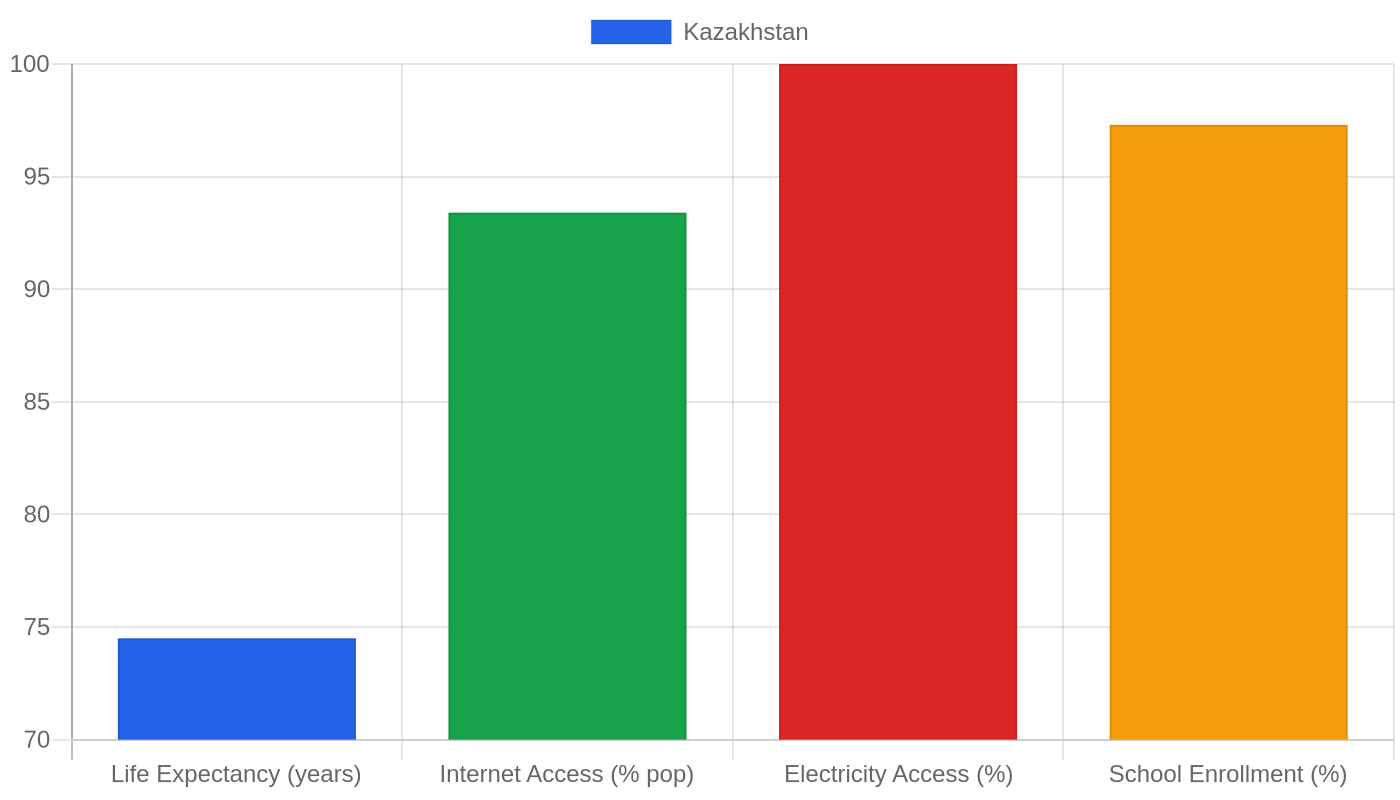
Economic Pulse Net | Sources: World Bank World Development Indicators, Government Sources | 2026
Key Takeaways
– Kazakhstan remains a presidential republic with a complex political transition underway, following nearly three decades of leadership under Nursultan Nazarbayev and his successor Kassym-Jomart Tokayev
– The economy is anchored by major extractive industries, with companies like Kazakhmys, KazakhGold, and Bogatyr Access Komir dominating the basic materials sector
– The financial sector shows concentrated strength through major banks including Halyk Bank, Eurasian Bank, and BTA Bank, signaling a formalized banking economy
– Air Astana leads a notable cluster of aviation and consumer services companies, suggesting a growing services economy alongside resource extraction
– The country’s official status as a democratic, secular, constitutional republic provides a formal institutional framework, though political power remains highly centralized
The Great Resource Reckoning — GDP, Inflation, and the Commodity Puzzle
Kazakhstan’s economic story is written in the language of minerals and metals. The World Bank’s data framework points to an economy where the primary drivers remain deeply extractive. While specific GDP growth figures and inflation rates are not available in this dataset, the structural picture is clear from the composition of the country’s largest corporations.
The dominance of basic materials companies—Kazakhmys, KazakhGold, and Bogatyr Access Komir—tells a tale of an economy still heavily reliant on what lies beneath the earth. These are not small players; they represent the industrial backbone of a nation that sits atop vast mineral wealth.
The absence of precise GDP per capita or GNI figures from the World Bank data does not diminish what we can observe about the economy’s architecture. When the largest companies in a country are miners and energy producers, the entire economic ecosystem bends toward commodity cycles. This creates a structural vulnerability that policymakers in Astana must constantly manage.
The banking sector’s concentration—with Halyk Bank, Eurasian Bank, and BTA Bank dominating the financial landscape—suggests that capital flows are tightly interwoven with the resource economy. When commodity prices rise, the banks thrive; when they fall, the entire financial system feels the tremor.
Employment data remains opaque in this dataset, but the industrial structure offers clues. A resource-based economy typically creates a bifurcated labor market: high-paying jobs in mining and energy for a relative few, and lower-wage service sector work for the many. The presence of multiple aviation companies—Air Astana, Berkut Air, and Euro-Asia Air—hints at a geography that demands air travel, but also at a growing middle class with disposable income for consumer services.
This is a nation stretching its economic legs, even as the ground beneath it holds the real wealth.
The Cost of Living on the Silk Road — Housing and Daily Life in Transition
Kazakhstan’s cost of living story can be inferred from its economic structure rather than precise data points. In a country where basic materials extraction drives the economy, housing markets typically mirror the boom-and-bust cycles of commodity prices. Mining towns and industrial centers like Ekibastuz—home to the GRES-2 Power Station—likely see housing costs tied directly to the fortunes of the energy sector.
The capital, Astana, and the largest city, Almaty, probably command premium prices driven by the concentration of banking, government, and aviation services.
The presence of major financial institutions suggests a formalized real estate market, with mortgages and property financing available through banks like Halyk Bank and Eurasian Bank. Rent versus buy decisions in Kazakhstan would depend heavily on location and economic sector. For workers in the resource industries, company housing or relocation packages may be common.
For those in the growing consumer services sector—the Air Astana employees, the retail workers, the hospitality staff—housing costs likely consume a significant portion of household income, particularly in urban centers where the cost of living tends to be highest.
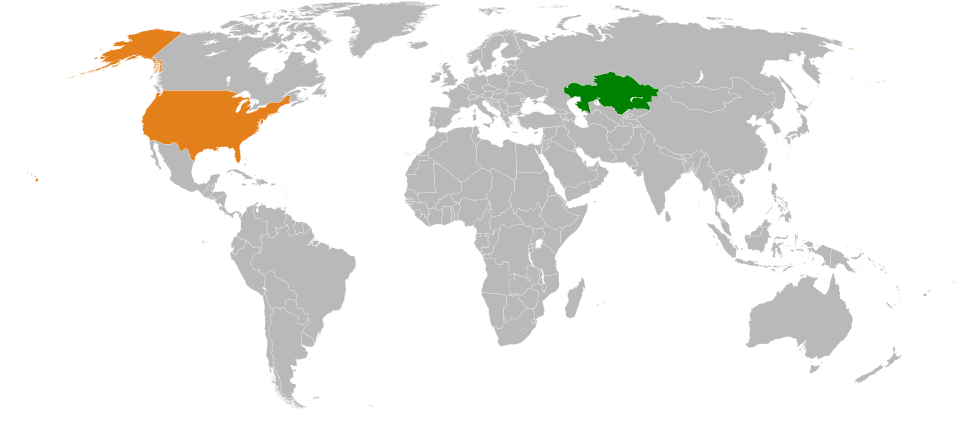
Where the Money Moves — Investment Climate and Corporate Power
For investors looking at Kazakhstan, the corporate landscape offers both opportunity and concentration risk. The top companies list reads like a who’s who of the Central Asian economy, but it also reveals a market where a handful of players dominate. Air Astana represents the consumer-facing side of the economy, a company that has grown alongside Kazakhstan’s emergence as a regional business hub.
The airline’s presence among the top companies signals that connectivity and mobility are valued—and profitable.
The financial sector is where the real action happens for investors. Halyk Bank, Eurasian Bank, and BTA Bank form a triad of financial power that channels capital throughout the economy. For anyone looking to do business in Kazakhstan, understanding these institutions is essential. They are not just banks; they are gatekeepers to the economy. The utilities sector, represented by Ekibastuz GRES-2 Power Station, underscores the importance of energy infrastructure in a country with extreme continental climate.
Power generation is not just a business—it is a strategic necessity.
The basic materials companies—Kazakhmys in copper, KazakhGold in gold, Bogatyr Access Komir in coal—represent the traditional heart of the Kazakh economy. For international investors, these companies offer exposure to global commodity markets with a Central Asian twist. The business environment is formalized, with a legal framework that follows the country’s constitutional republic structure.
However, the concentration of economic power in a relatively small number of large companies means that relationship-building and local knowledge remain critical for success.
The Politics of Power — Safety, Security, and Governance in a Presidential Republic
Kazakhstan’s political landscape, as documented in the data, presents a fascinating paradox. Officially, the country is a democratic, secular, constitutional unitary republic. The president may veto legislation passed by parliament and serves as commander-in-chief of the armed forces. The prime minister chairs the cabinet, with three deputy prime ministers and sixteen ministers forming the government. This is the formal architecture of a functioning state.
The reality of political power in Kazakhstan is shaped by the long shadow of Nursultan Nazarbayev, who led the country from 1991 to 2019. His succession by Kassym-Jomart Tokayev represents the first transfer of power in the nation’s independent history. This transition matters for economic stability. Investors and citizens alike watch the political succession closely because in a system with strong presidential powers, the character and priorities of the leader directly shape the business environment.
Crime and safety indices are not available in this dataset, but the political structure provides some clues about public security. A centralized presidential system with strong security apparatus typically maintains public order, though questions about political freedom and civil liberties remain. The secular constitutional framework suggests a state that separates religion from governance, which in a region of diverse ethnic and religious identities, contributes to social stability.
For residents and visitors, the quality of life in Kazakhstan is likely defined by the tension between formal democratic institutions and the reality of centralized power.
Winds of Change — Current Affairs in the New Kazakhstan
The political transition from Nazarbayev to Tokayev is not just a historical footnote; it is the defining current event shaping Kazakhstan today. Every policy decision, every economic reform, every diplomatic move is viewed through the lens of this leadership change. The country is navigating what political scientists call a “managed transition”—a shift in leadership that aims to maintain stability while allowing for gradual evolution.
The concentration of corporate power in basic materials and banking suggests that current economic policy is focused on maintaining the resource-driven model while developing the services sector. The prominence of Air Astana and other aviation companies indicates a push toward connectivity and regional integration. Kazakhstan sits at a geographic crossroads, and its current leadership appears to be leveraging this position for economic advantage.
The parliament, with its legislative power subject to presidential veto, operates within boundaries set by the executive branch. The sixteen ministers in the cabinet represent the administrative machinery of the state, implementing policies that balance resource extraction with economic diversification. The three deputy prime ministers suggest a government structured to manage multiple priorities simultaneously—economic development, social welfare, and international relations.
This is a country in motion, but moving at a pace determined by its leadership.
The Bottom Line
Kazakhstan deserves the attention of anyone interested in the intersection of resource wealth and political transition. For commodity investors, the country offers exposure to copper, gold, and coal through established corporate players. For those watching geopolitical shifts, Kazakhstan represents a test case of whether a post-Soviet presidential republic can successfully manage leadership succession while maintaining economic stability.
The nation is not a frontier market in the wild west sense; it is a formalized economy with banks, airlines, and power stations that function within a constitutional framework. Watch Kazakhstan for the next chapter of its transition—the steppe is shifting, and the world should be paying attention.
Sources & Methodology
This article is authored by Economic Pulse Net for informational and research purposes. Economic Pulse Net sources its data from multilateral institutions, national statistics bureaus, and proprietary databases. All data is believed to be current as of the date of publication.
Published: July 18, 2026 | Category: Research — Kazakhstan
Use these signals in your own platform
Economic Pulse publishes its live signal feed through a documented, read-only API. Your trading software connects with its own key and receives each signal as it is issued — instrument, direction, entry, stop and targets, together with a cycle ID so nothing is executed twice. The feed is independent of this website and cannot change it.
Signals are informational only and are not financial advice.