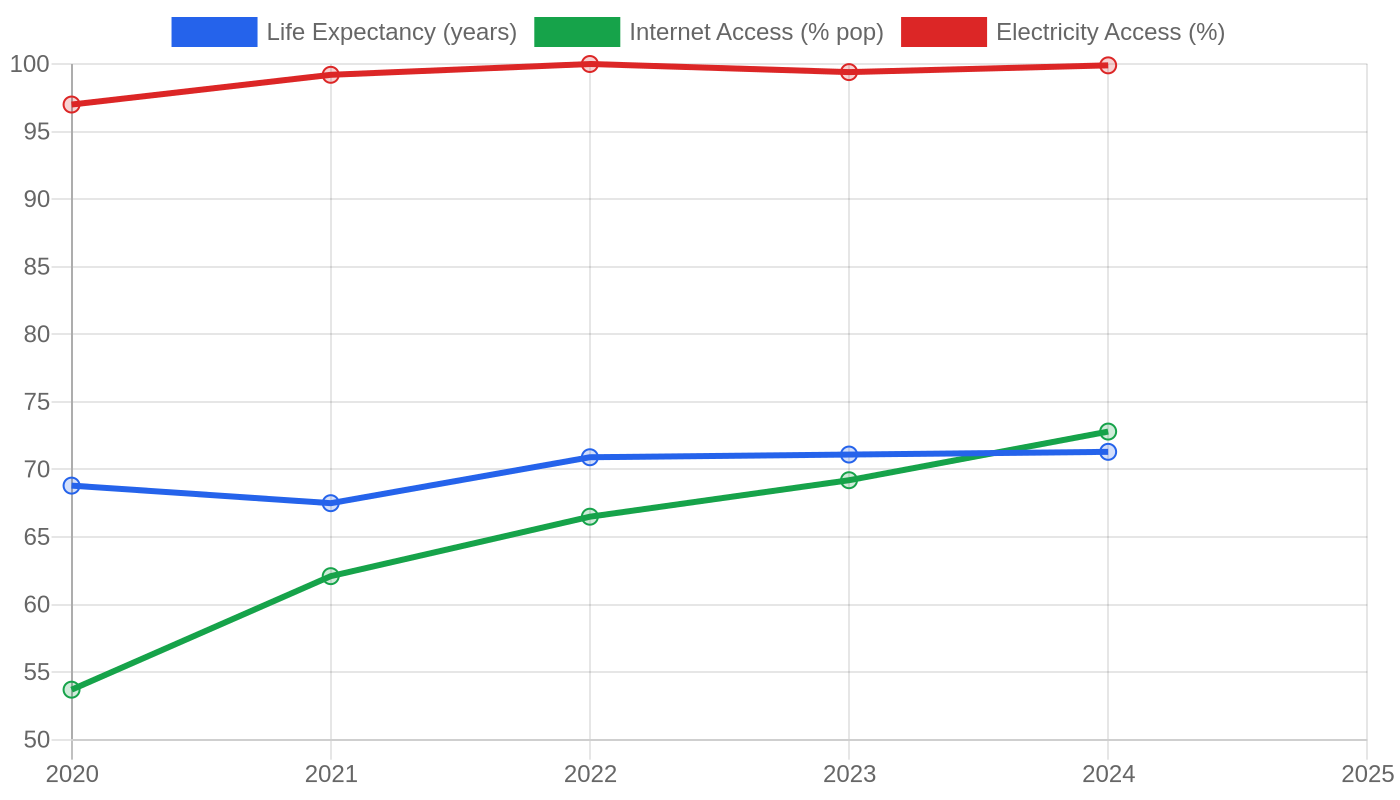
Economic Pulse Net | Sources: World Bank World Development Indicators, Government Sources | 2026
Key Takeaways
– Indonesia’s inflation rate stands at a remarkably low 1.91%, providing the central bank with rare policy flexibility in a region often plagued by price volatility.
– Unemployment sits at just 3.24%, signaling a labor market that is absorbing workers despite global headwinds.
– The financial sector dominates Indonesia’s corporate landscape, with five of the top ten companies being banks, underscoring the deepening of the country’s financial infrastructure.
– GNI per capita has reached $5,120, placing Indonesia firmly in the lower-middle-income bracket and on the cusp of a potential upgrade to upper-middle-income status.
– The political system, reformed after the fall of the New Order in 1998, now features direct presidential elections and expanded regional autonomy, creating a more complex but more democratic business environment.
The Numbers That Define a Nation
The World Bank’s latest data paints a picture of an economy in a delicate but promising equilibrium. With inflation at 1.91%, Indonesia has achieved something many emerging markets only dream of: price stability without the kind of brutal austerity that usually accompanies it. This is not a fluke of global commodity prices or a temporary dip—it is the result of years of monetary discipline and the country’s evolution into a more sophisticated, diversified economy.
The unemployment rate of 3.24% is arguably the most striking figure in the dataset. For a nation of Indonesia’s geographic and demographic complexity—an archipelago of thousands of islands with vastly different economic realities—this level of labor absorption suggests that growth, wherever it is occurring, is reaching workers. It also reflects the informal sector’s resilience, a double-edged sword that masks underemployment even as it prevents outright joblessness.
The corporate landscape tells the story of Indonesia’s economic DNA. Five of the top ten companies are banks—Bank Central Asia, Bank Mandiri, Bank Rakyat Indonesia, Bank Negara Indonesia, and Bank Tabungan Negara. This concentration is not a weakness; it is a signal. A country’s banking sector only becomes this dominant when the population is increasingly banking, borrowing, and investing.
The presence of Astra International, the conglomerate that touches everything from autos to heavy equipment, and Angkasa Pura, the airport operator, reveals an economy that is building infrastructure and moving people and goods. Asuransi Jasindo indicates a growing insurance penetration, while Badak LNG and Alumindo show that Indonesia remains a critical player in energy and industrial materials.
The Cost of Living Puzzle: GNI and the Everyday Reality
With a GNI per capita of $5,120, according to World Bank figures, Indonesia sits in a peculiar middle zone. This is not a poor country by regional standards, but it is not yet a rich one either. What this number means on the ground is a nation where a growing middle class in Jakarta, Surabaya, and Bandung enjoys access to modern shopping malls, ride-hailing apps, and international cuisine, while rural communities in eastern Indonesia still grapple with basic infrastructure challenges.
The housing market reflects this divide. In major urban centers, the cost of apartments has risen steadily as the professional class expands, making homeownership a multi-generational financial commitment for many families. Renting has become an increasingly attractive option for young professionals who prioritize flexibility over the traditional Indonesian emphasis on property ownership.
Outside the major cities, housing remains relatively affordable, but the gap between urban and rural living costs continues to widen. For the average Indonesian household, food and transportation consume a significant portion of income, though the low inflation rate means that purchasing power is not being eroded as quickly as in neighboring economies.
Business and Investment: A Banking-Led Boom
For investors, Indonesia offers a compelling proposition: a stable political system, a young population, and a financial sector that is mature enough to facilitate capital flows but still has room to grow. The dominance of banks among the top companies is a positive signal for anyone looking to enter the market—it means there is a functioning credit system that can support new ventures.
The industrial players in the top ten—Badak LNG in energy and Alumindo in materials—highlight the sectors that will drive Indonesia’s next phase of development. The country is not just a consumer market; it is a producer of critical resources and manufactured goods. Angkasa Pura’s presence in the top companies list is particularly noteworthy, as it points to the expanding aviation sector and the government’s commitment to connecting the archipelago’s many islands.
The political reforms that followed the fall of the New Order in 1998 have created a more predictable business environment. Direct presidential elections mean that policy direction is now determined by popular mandate rather than elite consensus, which brings both opportunities and risks for investors. Regional autonomy, enshrined in the constitutional amendments, has shifted some decision-making power away from Jakarta, creating a more complex but ultimately more democratic business landscape.
Security, Stability, and the New Political Order
Indonesia’s political system, as described in the country’s constitutional framework, is a unitary republic built on the five principles of Pancasila. These principles—belief in one God, just and civilized humanity, the unity of Indonesia, democracy through deliberation, and social justice—are not just rhetorical flourishes; they are taught in civic education and form the basis of citizenship values.
The post-1998 reforms have fundamentally reshaped the country’s governance. The four constitutional amendments that followed the fall of the New Order introduced direct presidential elections, created new state institutions, and reduced the role of the People’s Consultative Assembly. These changes have made the system more responsive to voters but also more contentious, as political parties compete for influence in a more open arena.
For the average Indonesian, this has meant a more vibrant public sphere and greater accountability from leaders. The safety landscape is complex—while the country has faced challenges related to religious extremism in the past, the overall trend has been toward greater stability and moderation. The government’s commitment to Pancasila as a unifying ideology has helped maintain social cohesion across the country’s diverse ethnic and religious communities.
What’s Happening Now: The Jakarta Post’s View of the Present Moment
The Jakarta Post, one of Indonesia’s leading English-language newspapers, has been tracking the economic pulse closely. A recent headline about US economic growth and its impact on Indonesia highlights the country’s ongoing integration into the global economy, though the focus remains on domestic resilience. The Indonesian economy is increasingly driven by internal demand rather than export dependence, which has insulated it from some of the volatility affecting other emerging markets.
The low inflation rate of 1.91% is not just a statistic—it is a political achievement that gives the government room to maneuver. With prices stable, policymakers can focus on long-term structural reforms rather than crisis management. The unemployment figure of 3.24% suggests that the labor market is absorbing new entrants, though questions about the quality of jobs and wage growth remain central to public discourse.
Indonesia’s position in 2026 is one of cautious optimism. The country has weathered global economic storms better than many of its peers, and its political system, while still evolving, has proven resilient. The Jakarta Post’s coverage reflects a nation that is engaged with the world but increasingly confident in its own path.
The Bottom Line
Indonesia is not a country for investors or observers seeking dramatic headlines—it is a country for those who understand the power of steady, compounding progress. With inflation under control, unemployment low, and a financial sector that is both deep and growing, the fundamentals are solid. The political reforms of the past quarter-century have created a more stable and democratic foundation.
Anyone with an interest in Southeast Asia’s economic future—whether as an investor, a business partner, or a student of development—should be watching Indonesia closely. The archipelago has learned the lessons of its turbulent past and is now writing a more measured, more prosperous chapter.
Sources & Methodology
This article is authored by Economic Pulse Net for informational and research purposes. Economic Pulse Net sources its data from multilateral institutions, national statistics bureaus, and proprietary databases. All data is believed to be current as of the date of publication.
Published: July 31, 2026 | Category: Research — Indonesia
Use these signals in your own platform
Economic Pulse publishes its live signal feed through a documented, read-only API. Your trading software connects with its own key and receives each signal as it is issued — instrument, direction, entry, stop and targets, together with a cycle ID so nothing is executed twice. The feed is independent of this website and cannot change it.
Signals are informational only and are not financial advice.