Economic Pulse Net | Sources: World Bank World Development Indicators, Government Sources | 2026
Key Takeaways
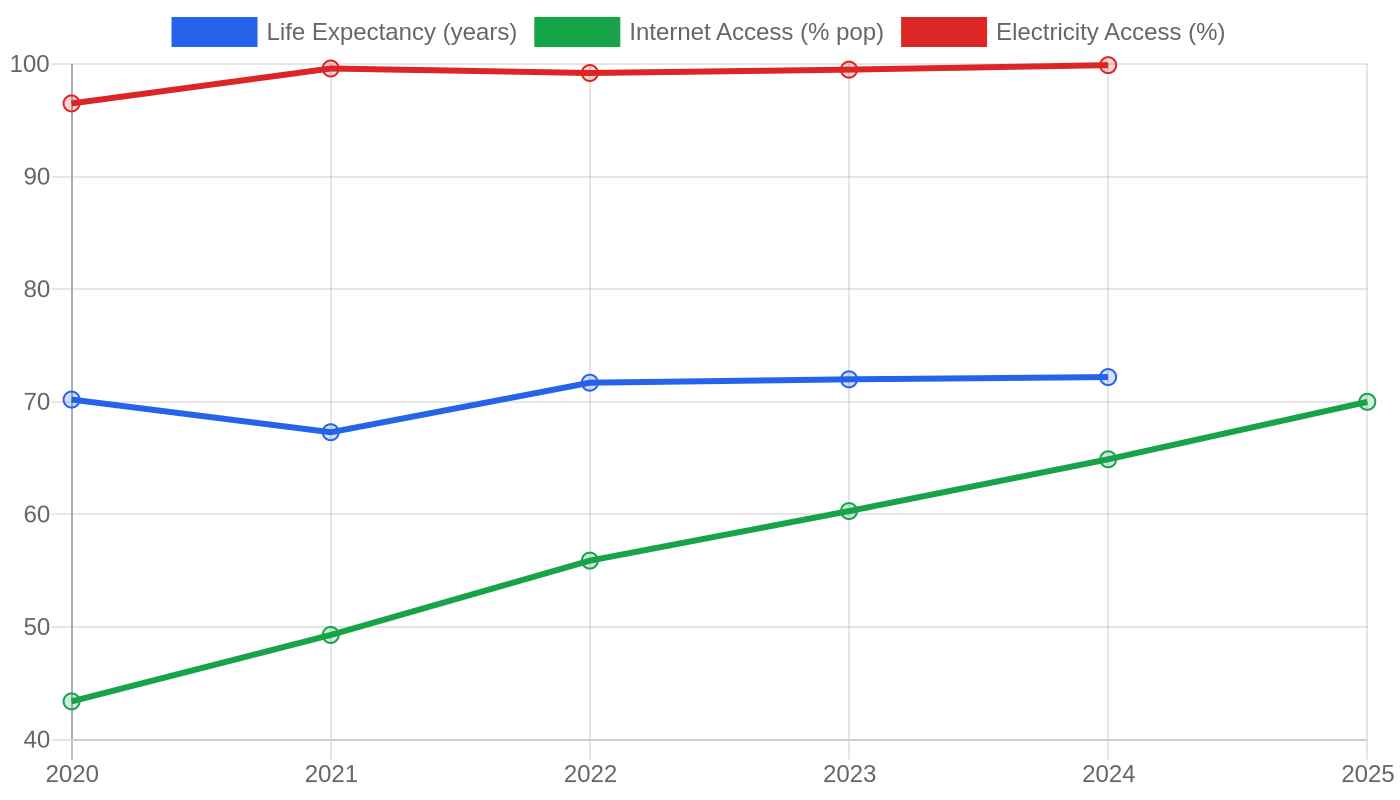
– India’s GDP surged 7.57% in 2025, according to the World Bank, making it one of the fastest-growing major economies globally — a remarkable achievement amid global uncertainty.
– Inflation has been tamed to just 2.4% (CPI), a stunning feat for an economy historically plagued by price volatility, giving the central bank rare room to maneuver.
– Unemployment stands at a low 4.2%, signaling a labor market that is absorbing workers even as the economy undergoes rapid structural transformation.
– The political landscape remains dominated by the BJP’s right-wing agenda, but with over 50 regional parties in play, policy stability is never guaranteed.
– Top conglomerates like Adani Group and 63 Moons Technologies are driving innovation across industrials, energy, and technology, signaling where the next wave of growth will come from.
The Growth Paradox — Why 7.6% Is More Than a Number
The World Bank’s latest data places India’s GDP growth at 7.57% for 2025 — a figure that would be headline news in any era, but is especially striking given the global context. While many economies are wrestling with stagnation, India is expanding at a pace that few can match. To put this in perspective: a 7.6% growth rate means the economy is doubling in size roughly every decade. For a nation already producing nearly $4 trillion in GDP (World Bank: $3.956 trillion), that is no small feat.
What makes this number particularly noteworthy is what accompanies it. Inflation, measured by the Consumer Price Index, has collapsed to just 2.4%. This is a dramatic shift from the double-digit inflation scares that have historically haunted Indian policymakers. The World Bank data suggests that the Reserve Bank of India has managed to thread the needle — cooling prices without crushing growth.
For the average Indian household, this means that the purchasing power of the rupee is holding steady even as wages rise in a tight labor market.
Speaking of which: unemployment at 4.2% is effectively full employment by international standards. The World Bank figure indicates that the jobs market is absorbing new entrants, though economists would caution that underemployment — people working below their skill level — remains a structural challenge. Still, the headline number tells a story of an economy that is firing on most cylinders.
The main industries driving this expansion deserve attention. India’s industrial base, represented by companies like ACC and Action Construction Equipment, is modernizing rapidly. The energy sector, anchored by Adani Group and Aban Offshore, is undergoing a dual transition — expanding traditional capacity while pivoting toward renewables. And in technology, 63 Moons Technologies exemplifies the kind of high-value innovation that is reshaping India’s export profile beyond IT services.
The Cost of Living Tightrope — Prosperity Meets Pressure
With inflation at 2.4%, the cost of living in India is relatively stable compared to recent history. The World Bank’s CPI data suggests that basic necessities — food, fuel, housing — are not experiencing the runaway price spikes seen in other emerging markets. However, stability is not the same as affordability.
India’s urban centers, particularly Mumbai, Delhi, and Bengaluru, have seen property prices climb steadily as the economy expands. The top companies listed in the data — from ABG Shipyard to Acko General Insurance — are concentrated in these cities, driving demand for housing among a growing professional class. For a middle-class family in Mumbai, buying a home can require a mortgage of 15 to 20 times annual household income.
Renting, meanwhile, has become the default for millions of young professionals migrating to cities for jobs in the technology and services sectors.
Daily expenses tell a more nuanced story. While inflation is low, the base effect matters: many essentials remain expensive relative to incomes in rural areas. The gap between urban prosperity and rural reality is one of India’s persistent economic fault lines. Yet the low unemployment figure suggests that more households are earning than at any point in recent memory, which softens the blow of high housing costs.
The Corporate Engine — Conglomerates, InsureTech, and the Next Wave
India’s corporate landscape is dominated by a handful of massive conglomerates, and the data provided by the World Bank’s company list reveals a fascinating concentration of power. The Adani Group — a conglomerate spanning ports, energy, and infrastructure — is perhaps the most visible symbol of India’s ambition. Alongside it, Action Group and ABP Group represent the diversity of Indian capitalism, from industrials to consumer services.
But the most interesting story may be in the technology and insurance sectors. 63 Moons Technologies, despite its whimsical name, is a serious player in financial technology and blockchain. Acko General Insurance represents the new wave of digital-first insurers that are penetrating a market where insurance penetration has historically been low. These companies are not just serving India — they are building platforms that could scale globally.
For investors, the message from the World Bank data is clear: India’s corporate sector is deep, diversified, and increasingly sophisticated. The presence of companies like ABG Shipyard (industrials) and ACC (construction materials) alongside tech and insurance firms suggests an economy that is building its future on multiple foundations. The business environment, while still bureaucratic, has improved significantly with digitalization of tax systems and regulatory filings.
Politics and Stability — The BJP’s Grip and the Regional Reality
India is a parliamentary republic with a multi-party system, according to the data, and the political landscape is defined by the dominance of the Bharatiya Janata Party (BJP), described as right-wing to far-right in ideological orientation. The Indian National Congress, positioned as the ideological center, remains the primary opposition, but has struggled to regain the national appeal it once commanded.
The implications for economic policy are significant. The BJP’s business-friendly orientation has attracted both domestic and foreign investment, particularly in infrastructure and manufacturing. However, with over 50 regional parties holding influence, national policy often requires coalition-building and compromise. This creates a political environment where major reforms can be slow, but also where extreme policy swings are rare.
For the average citizen, the quality of life is shaped by this political stability. Crime and safety indices were not provided in the data, but India’s large cities generally have moderate crime rates compared to global peers, with property crime more common than violent crime. The political system, while noisy and contentious, has proven resilient over seven decades of democracy — a fact that underpins investor confidence.
What’s Happening Now — Bitcoin, Harvard, and the Pulse of Markets
The most recent data from India’s financial press — including The Economic Times and Livemint — reveals a market that is anything but sleepy. Bitcoin trading near $65,000, as reported by The Economic Times, is capturing headlines, reflecting India’s growing engagement with cryptocurrency despite regulatory uncertainty. The same source reports Harvard Business Review exclusives and “Alpha Trades” content, suggesting that Indian business readers are hungry for sophisticated analysis.
The “Market Snapshot” from Livemint and “Trending in Markets” coverage indicate that Indian equities are responding to both domestic fundamentals and global capital flows. With inflation low and growth high, Indian assets are attracting attention from international funds seeking yield in a low-growth world.
The geopolitical concerns mentioned in the Bitcoin story — likely related to tensions in the Middle East or Eastern Europe — are being watched closely by Indian traders, but so far have not derailed the domestic bull case.
What makes this moment distinctive is the convergence of factors: strong GDP growth, low inflation, full employment, and a political system that, while contentious, is stable. The data from the World Bank and the tone of the recent news suggest that India is not just growing — it is maturing as an economy.
The Bottom Line
India in 2025 is an economy that has earned its optimism. With 7.6% GDP growth, 2.4% inflation, and 4.2% unemployment, the World Bank data paints a picture of an economy firing on all cylinders. Investors should watch India for its structural growth story — a young population, a diversifying industrial base, and a political system that, while messy, delivers stability. Policymakers in other emerging markets should study how India tamed inflation without killing growth.
For the rest of us, India is the rare bright spot in a world that needs more of them.
Sources & Methodology
This article is authored by Economic Pulse Net for informational and research purposes. Economic Pulse Net sources its data from multilateral institutions, national statistics bureaus, and proprietary databases. All data is believed to be current as of the date of publication.
Published: July 28, 2026 | Category: Research — India
Use these signals in your own platform
Economic Pulse publishes its live signal feed through a documented, read-only API. Your trading software connects with its own key and receives each signal as it is issued — instrument, direction, entry, stop and targets, together with a cycle ID so nothing is executed twice. The feed is independent of this website and cannot change it.
Signals are informational only and are not financial advice.