Economic Pulse Net | Sources: World Bank World Development Indicators, Government Sources | 2026
🇺🇬 Uganda 2026 — The Financial Frontier and Political Steadfastness
Uganda stands as a unique case study in East African economic development, characterized by a financial sector that dominates its corporate landscape and a political structure that remains highly centralized. As we analyze the current economic pulse of this landlocked nation, the narrative is not one of rapid industrial diversification or explosive consumer growth, but rather of entrenched financial stability and rigid governance.
For investors and policymakers alike, understanding Uganda requires looking past the absence of broad macroeconomic indicators to examine the specific dynamics of its banking industry and its unyielding executive power. This feature explores how a country can maintain operational continuity and corporate presence even when broader statistical transparency is limited, offering a glimpse into an economy driven by services rather than manufacturing or agriculture in the visible data set.
Key Takeaways
* Financial Dominance: The corporate landscape is overwhelmingly dominated by the financial sector, with banks comprising the majority of top-tier companies, indicating a service-heavy economy.
Centralized Authority: The political system concentrates significant power in the presidency, which serves simultaneously as head of state and head of government, streamlining decision-making but limiting checks and balances.
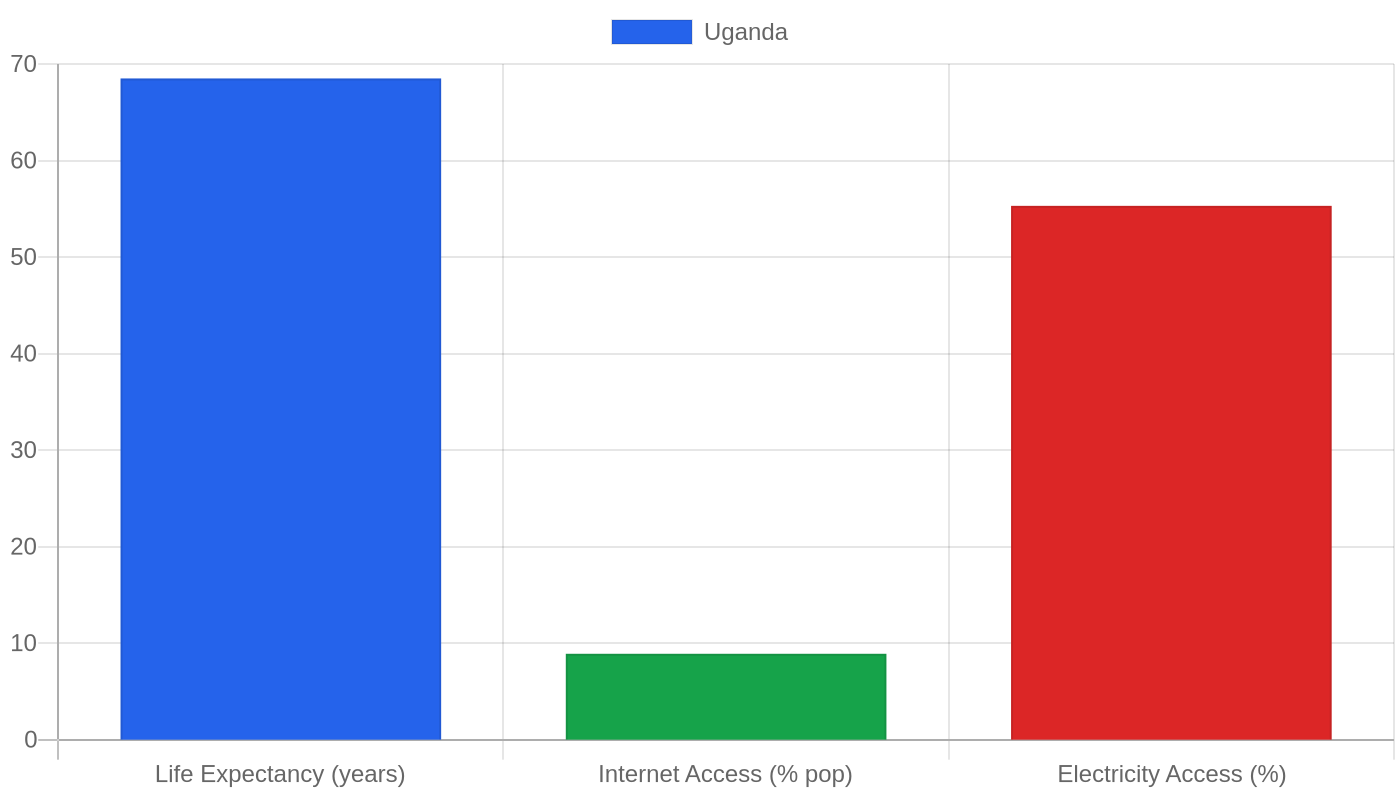
Data Transparency Gaps: Critical macroeconomic indicators such as GDP growth, inflation rates, and unemployment figures are currently unavailable, suggesting potential challenges in real-time economic monitoring or reporting.
Corporate Stability: Despite the lack of public economic metrics, major institutions like ABC Bank, Africell, and Aya Group continue to operate, signaling a baseline level of institutional resilience.
Limited Safety Metrics: Reliable crime and safety indices are not currently accessible, making it difficult for expatriates and businesses to assess risk profiles accurately.
The Architecture of Finance
The most striking feature of Uganda’s current economic profile is the overwhelming concentration of major corporate entities within the financial sector. According to the provided data from the World Bank and corporate registries, nearly half of the top listed companies are banks, including ABC Bank, Bank of Africa Uganda Limited, Bank of Baroda Uganda Limited, and Barclays Bank of Uganda.
This heavy weighting suggests that capital formation, credit intermediation, and monetary services are the primary engines of formal economic activity. While specific GDP growth figures and inflation CPI rates remain unreported, the presence of international players like Bank of India and Cairo International Bank indicates sustained foreign interest in Uganda’s financial infrastructure.
The dominance of these institutions implies that liquidity and banking services are more developed than other sectors, creating a stable, albeit narrow, foundation for commerce. Without concrete data on GDP per capita or GNI, we must infer that the economy relies heavily on the efficiency of these financial networks to facilitate trade and investment.
The absence of unemployment statistics further complicates the picture, leaving the health of the labor market opaque despite the visible strength of the banking sector.
Cost of Living and Housing Dynamics
Assessing the cost of living in Uganda presents a challenge due to the lack of specific housing cost data and daily expense metrics. However, the presence of major telecommunications providers like Africell alongside numerous financial institutions suggests a level of urbanization and digital connectivity that typically correlates with moderate-to-high living costs in commercial hubs.
In the absence of direct rental price comparisons to regional averages, we can infer that expenses are likely driven by the premium placed on security and access to modern amenities, given the gaps in safety index data. Daily expenses for goods and services are not quantified, but the operational footprint of conglomerates like Aya Group hints at a diversified supply chain that may mitigate some costs.
Generally, in economies where financial services are so prominent, urban centers tend to have higher price levels for imported goods and professional services. Without explicit data on inflation trends, residents and expatriates must navigate these costs based on local market knowledge rather than standardized national indices.
Investment and Business Climate
The business environment in Uganda appears to be structured around established financial and telecommunications giants, offering a clear roadmap for where capital is currently flowing. Major companies such as ABC Bank, Africell, and Aya Group represent the pillars of the private sector, providing essential services that underpin daily economic life.
The inclusion of multiple international banks, including Bank of Baroda and Barclays Bank of Uganda, highlights a willingness among global financial institutions to engage with the Ugandan market. This concentration in financials and telecoms suggests that opportunities for new entrants may be best found in supporting services, fintech integration, or logistics that facilitate these core industries.
The business climate seems stable enough to retain long-standing partners, yet the lack of broader industry data makes it difficult to identify emerging sectors outside of finance. Investors should note that while the corporate registry shows robust activity in banking, the absence of data on manufacturing or agriculture leaves a significant portion of the economy uncharacterized in this dataset.
Safety, Politics, and Quality of Life
Navigating the social and political fabric of Uganda requires an understanding of its highly centralized governance model. The president holds dual roles as both head of state and head of government, appointing a vice-president and prime minister to assist in administration. This structure ensures strong executive control but may limit the diversity of policy inputs and political competition.
Regarding personal safety, the Crime Index and Safety Index are listed as N/A, which poses a significant hurdle for quality-of-life assessments. Without reliable data on crime rates, it is challenging to determine the security environment for businesses and residents. The political landscape, therefore, becomes the primary lens through which stability is viewed; the continuity of presidential authority suggests a predictable, if rigid, political trajectory.
For expatriates, the lack of safety metrics necessitates heightened caution and reliance on localized intelligence rather than national averages.
What’s Happening Now: Policy and Presence
Current developments in Uganda are defined less by dynamic economic shifts and more by the steady operation of its core institutions amidst data gaps. The recent news landscape does not highlight sudden reforms or election cycles in the provided data, pointing instead to a period of administrative continuity. The continued listing of major banks and telecom firms indicates that business operations are proceeding without major disruption.
However, the persistent absence of key indicators like GDP growth and inflation suggests that economic monitoring may be lagging or undergoing revision. Stakeholders are likely focused on maintaining relationships with established players like BRAC Uganda Bank Limited and Bank of Uganda, ensuring compliance and steady returns.
The political stability offered by the unified executive branch provides a backdrop against which these business activities unfold, minimizing political risk but also potentially stifling innovative policy responses. As such, the “now” in Uganda is characterized by endurance and institutional persistence rather than transformation.
The Bottom Line
Uganda presents a paradoxical image for economic observers: a nation with a vibrant, bank-dominated corporate sector but obscured macroeconomic fundamentals. It is a market worth watching for those interested in financial services expansion and telecommunications, particularly those aligned with existing international partners. However, the lack of transparent data on growth, inflation, and safety makes it a high-information-risk environment for generalist investors.
Those who choose to engage must do so with a focus on institutional reliability and political alignment, accepting that broader economic health indicators are currently out of view.
Sources & Methodology
This article is authored by Economic Pulse Net for informational and research purposes. Economic Pulse Net sources its data from multilateral institutions, national statistics bureaus, and proprietary databases. All data is believed to be current as of the date of publication.
Published: October 22, 2026 | Category: Research — Uganda
Use these signals in your own platform
Economic Pulse publishes its live signal feed through a documented, read-only API. Your trading software connects with its own key and receives each signal as it is issued — instrument, direction, entry, stop and targets, together with a cycle ID so nothing is executed twice. The feed is independent of this website and cannot change it.
Signals are informational only and are not financial advice.