Economic Pulse Net | Sources: World Bank World Development Indicators, Government Sources | 2026
Key Takeaways
* Robust Expansion: China’s economy is projected to grow by nearly 5% in 2025, driven by significant policy support that buoyed the full-year outlook.
Price Stability: Inflation remains exceptionally low at roughly 0.06%, indicating a stable but potentially sluggish consumer price environment.
Labor Market Resilience: With an unemployment rate of 4.615%, the labor market shows surprising stability despite global headwinds.
State-Led Model: The economic framework operates under “socialism with Chinese characteristics,” blending Marxist-Leninist ideology with a primary-stage market economy.
Corporate Powerhouse: Dominated by giants like Alibaba and Anta Sports, the business landscape reflects a mix of technology dominance and traditional industrial strength.
Economic Dynamics: Growth Amidst Low Inflation
China’s macroeconomic profile presents a fascinating study in controlled expansion. According to World Bank data, the nation’s GDP growth is projected at 4.95994886240992% for 2025, a figure that underscores resilience in the world’s second-largest economy. This growth is supported by a massive total GDP of approximately $19.5 trillion USD, reflecting the sheer scale of its output.
However, this expansion occurs against a backdrop of remarkably low inflation, with the Consumer Price Index (CPI) sitting at a mere 0.0595646916565403%. Such low inflation suggests that while demand exists, it is not outpacing supply aggressively, which can be both a sign of stability and a cautionary signal regarding consumer spending power.
The workforce remains largely employed, with the unemployment rate holding steady at 4.615%, indicating that job creation mechanisms are functioning effectively enough to absorb labor force participation. Furthermore, the average citizen contributes significantly to the national wealth, with a GDP per capita (PPP) of $29,333.33, suggesting a rising middle class capable of sustaining domestic consumption.
This economic structure is unique because it does not rely on Western-style liberal democracy; instead, it functions as a unitary state under the absolute leadership of the Chinese Communist Party (CCP). Since the 1980s, the CCP has guided the nation through “socialism with Chinese characteristics,” an adapted form of Marxism–Leninism that treats the current market economy as the necessary primary stage of socialism.
Many academic sources describe this system as authoritarian, yet it has delivered consistent macroeconomic metrics that prioritize state stability and long-term planning over short-term political cycles.
Cost of Living: Affordability and Daily Expenses
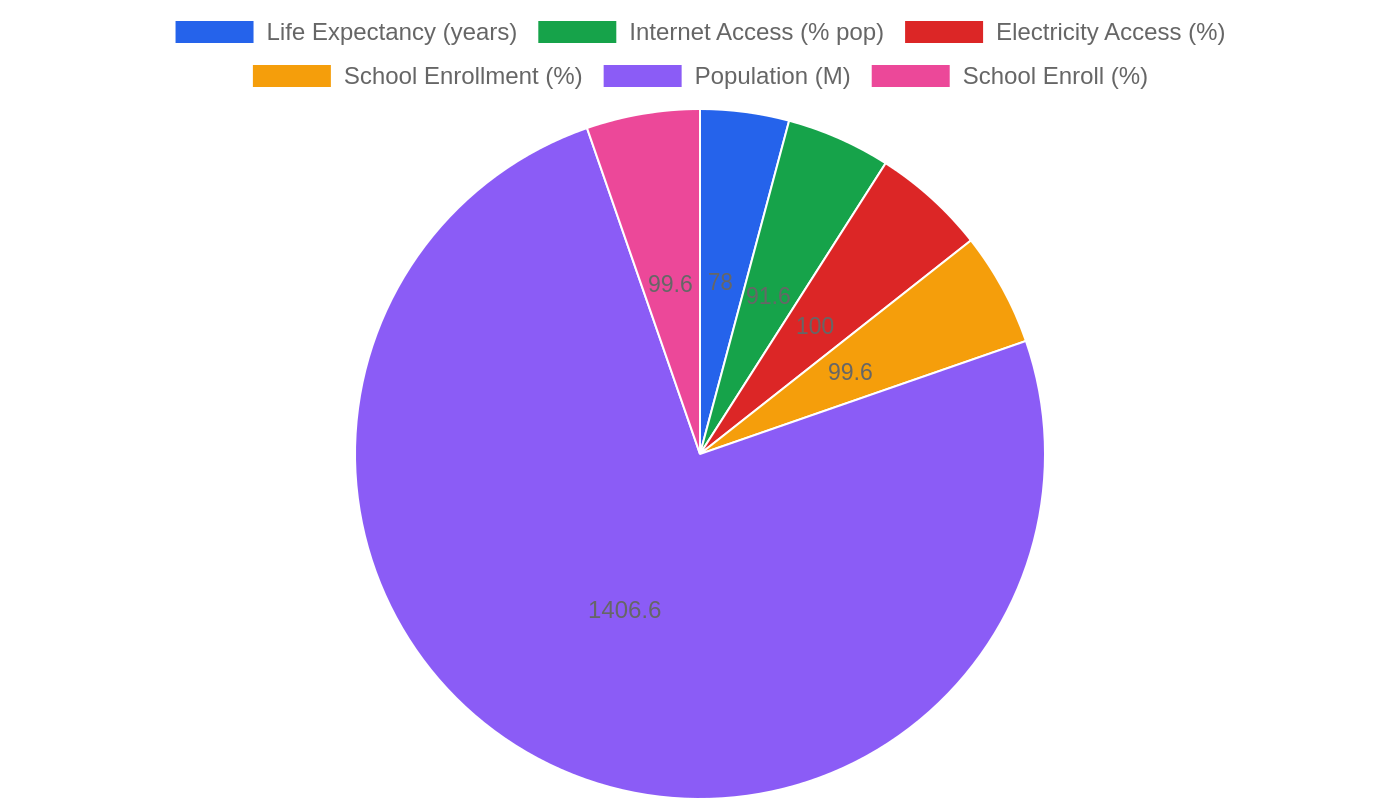
While specific housing rent indices or detailed cost-of-living baskets are not provided in the current dataset, the broader economic indicators offer clues about daily financial realities. With a GNI per capita of $14,230.00, the average income level suggests a moderate standard of living that is accessible for a significant portion of the 1.4 billion population.
For expatriates or investors, the low inflation rate of 0.06% implies that daily expenses—such as food, utilities, and services—are likely stable and predictable, lacking the volatility seen in many emerging markets. This price stability can make budgeting easier for residents, although it may also reflect weaker purchasing power if wages have not kept pace with historical trends.
The sheer size of the population, totaling 1,406,585,000 people, creates intense competition for resources and space, which typically drives up urban housing costs even if general goods remain cheap. Consequently, while the national average income appears healthy, regional disparities within such a vast country mean that the cost of living in tier-one cities like Shanghai or Beijing would likely exceed these national averages significantly.
Without specific rental yield data, one must infer that the affordability of basic necessities is high, but premium real estate and luxury goods remain exclusive to higher-income brackets.
Investment & Business Climate: Giants and Industries
The investment landscape in China is defined by the presence of colossal enterprises that dominate their respective sectors. Major players include Alibaba Group in technology, which serves as a cornerstone of the digital economy, and Agricultural Bank of China, representing the deep integration of finance into the state apparatus. In the consumer goods sector, brands like Anker, Anta Sports, and 361 Degrees showcase China’s ability to produce globally competitive products that appeal to international markets.
Industrial strength is equally prominent, with Aluminum Corporation of China Limited leading in basic materials and AVIC driving advancements in aerospace and defense industries. These companies operate within a business environment that is heavily influenced by government policy rather than pure free-market forces. For foreign investors, this means navigating a complex regulatory framework where alignment with national strategic goals is often as important as profitability.
The presence of diverse entities ranging from Air China in consumer services to Amoi in industrials highlights a diversified economy that is less reliant on any single export commodity. However, the lack of detailed industry breakdowns in the provided data suggests that opportunities may be concentrated in technology and manufacturing, sectors where China has historically invested heavily in infrastructure and innovation.
Investors must therefore view these companies not just as commercial entities, but as instruments of national economic policy.
Safety, Politics & Quality of Life: A Controlled Environment
Navigating life in China requires an understanding of its distinct political and social fabric. The country is described by many academic sources as an authoritarian state, operating under a people’s democratic dictatorship that prioritizes collective stability over individual political freedoms. This political reality directly impacts quality of life, as social order is maintained through strict governance structures.
While specific crime and safety indices are listed as N/A in the provided data, the emphasis on social control and the CCP’s absolute leadership suggests that public safety is generally high due to rigorous law enforcement and surveillance measures. For residents and visitors alike, the absence of violent crime is often offset by the need to adhere to strict regulations regarding speech, assembly, and digital behavior.
The happiness index or subjective well-being data is not explicitly quantified here, but the focus on economic growth and poverty alleviation indicates that material improvements are the primary metric of success for the government. Living in such a system means enjoying the benefits of rapid infrastructure development and low inflation, while accepting limitations on personal liberties.
The political landscape is not static; it evolves through internal party dynamics and policy shifts that can suddenly alter the rules for businesses and citizens alike. Therefore, understanding the political context is not just academic—it is a practical necessity for anyone seeking to live or work in the country.
What’s Happening Now: Policy Shifts and Regional Adaptations
The current economic narrative in China is being shaped by active policy interventions and regional adjustments. Recent reports indicate that policy support is currently buoying the full-year growth outlook, suggesting that the government is actively injecting measures to sustain momentum. In Hong Kong, a special administrative region, there are moves to relax advertising rules for broadcasters, a strategic decision aimed at boosting business edges and revitalizing the media sector.
This move reflects a broader trend of using regulatory flexibility to stimulate commerce in key economic hubs. Meanwhile, coverage from major outlets like SCMP and China Daily highlights ongoing debates and developments in the global economy, positioning China as a central player in international trade discussions. The business sector is adapting to these changes, with companies likely recalibrating strategies to align with new broadcasting regulations and broader economic policies.
These developments underscore a dynamic environment where local innovations, such as Hong Kong’s media reforms, can have national implications. The focus on “policy support” signals that the state remains the primary driver of economic direction, ready to intervene when growth targets are at risk. For observers, this means that headlines about regulatory tweaks should be read as signs of deeper structural adjustments rather than isolated incidents.
The Bottom Line
China remains a critical destination for investors and analysts seeking exposure to large-scale economic stability and state-guided growth. The combination of near-5% GDP growth, ultra-low inflation, and strong corporate champions like Alibaba and AVIC offers a compelling, albeit complex, investment case. However, success in this market requires more than capital; it demands a nuanced understanding of the political landscape and the CCP’s overarching influence.
Those who can navigate the authoritarian framework and align with national policy goals will find significant opportunities in this vast and resilient economy.
Sources & Methodology
This article is authored by Economic Pulse Net for informational and research purposes. Economic Pulse Net sources its data from multilateral institutions, national statistics bureaus, and proprietary databases. All data is believed to be current as of the date of publication.
Published: October 03, 2026 | Category: Research — China
Use these signals in your own platform
Economic Pulse publishes its live signal feed through a documented, read-only API. Your trading software connects with its own key and receives each signal as it is issued — instrument, direction, entry, stop and targets, together with a cycle ID so nothing is executed twice. The feed is independent of this website and cannot change it.
Signals are informational only and are not financial advice.