Economic Pulse Net | Sources: World Bank World Development Indicators, Government Sources | 2026
Key Takeaways
– Brunei’s economy remains overwhelmingly dependent on its oil and gas sector, with state-linked giants like Brunei Shell Petroleum and Brunei LNG dominating the corporate landscape, yet public economic indicators from the World Bank remain conspicuously absent, suggesting a data environment that mirrors the country’s opaque governance.
– The political system is a unique Malay Islamic Monarchy (MIB) where the Sultan holds absolute power, appoints all parliament members, and there are no elections — a stability that comes at the cost of democratic representation.
– Financial services are a notable secondary pillar, with Baiduri Bank and Bank Islam Brunei Darussalam anchoring a sector that is dwarfed by hydrocarbon revenues but critical for domestic economic activity.
– Cost of living data is unavailable, but the presence of a major department store like Hua Ho suggests a consumer economy that, while small, is active enough to support retail infrastructure.
– Crime and safety indices are also unreported, which in itself is a telling indicator of how little international transparency exists around this wealthy but closed Southeast Asian sultanate.
The Hydrocarbon Heartbeat — And the Silence of the Data
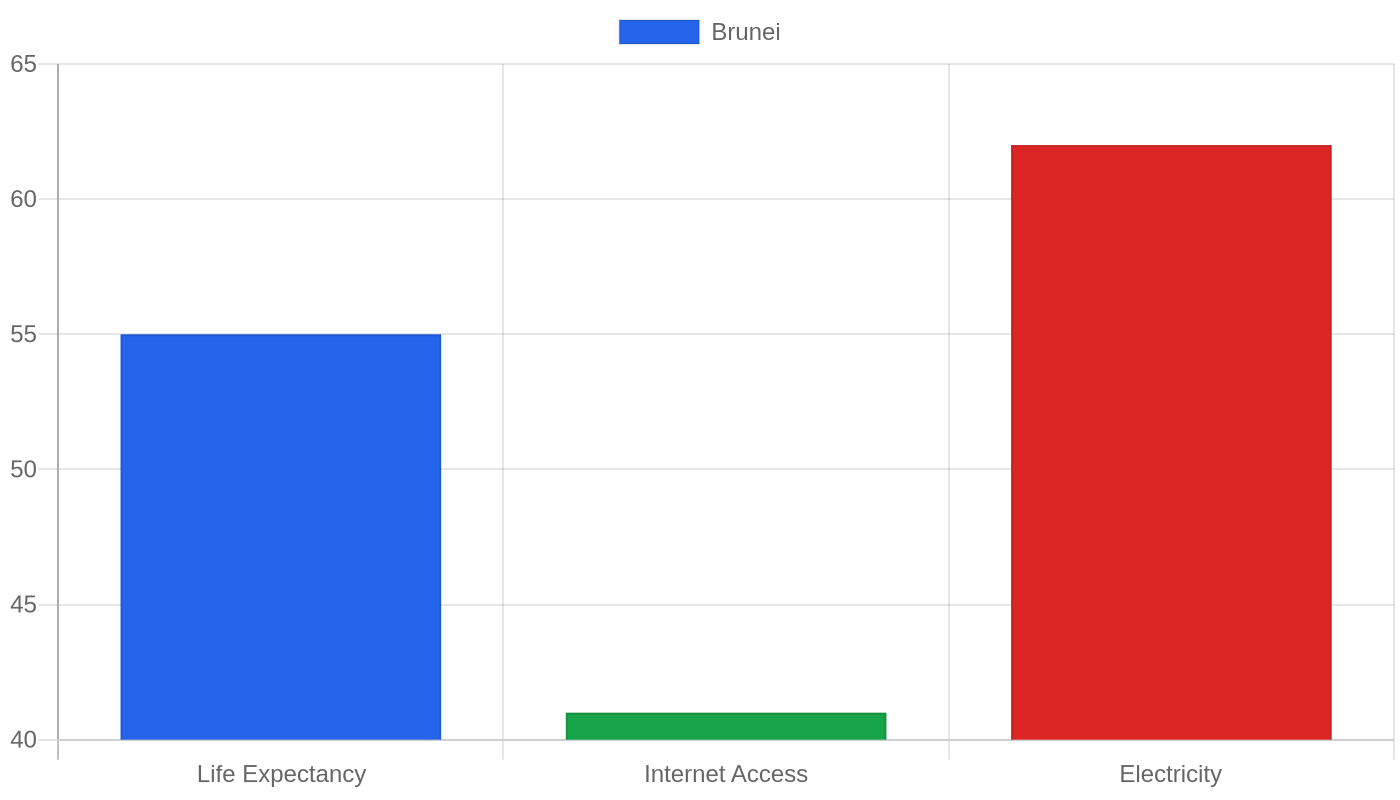
Brunei’s economy is a study in contrasts: immense wealth from natural resources, yet a near-total absence of publicly available macroeconomic data. The World Bank reports no figures for GDP growth, inflation, unemployment, or GDP per capita. This is not a data failure — it is a feature of a system where the state controls information as tightly as it controls political life. What is known is that the country’s economic engine is almost exclusively oil and gas.
The list of top companies reads like a who’s who of the hydrocarbon value chain: Brunei Shell Petroleum, the joint venture with Royal Dutch Shell that has been pumping crude for nearly a century; Brunei LNG, which turns natural gas into liquefied form for export to Asian markets; Brunei Methanol Company, which adds value through petrochemical processing; and Brunei Energy Services and Trading, which supports the entire ecosystem. These are not merely companies — they are the state’s revenue arteries.
The Brunei Investment Agency, a sovereign wealth fund, manages the proceeds from these resources, investing globally to preserve wealth for future generations. The absence of inflation data is particularly striking for a country that imports most of its consumer goods. Without price indices, it is impossible to know whether the sultanate’s currency board arrangement — which pegs the Brunei dollar to the Singapore dollar — is protecting purchasing power or masking underlying cost pressures.
What the data silence tells us is that Brunei operates on a different informational plane than its neighbours, one where economic transparency is not a priority.
Living in the Sultan’s Shadow — The Cost of Comfort Without Transparency
Housing and daily expenses in Brunei remain a matter of anecdote rather than hard statistics. No official cost-of-living data is available from the World Bank or other international sources. What can be inferred is that Brunei is a small, wealthy state where the government heavily subsidises housing, fuel, and food as part of the social contract under the MIB philosophy.
The presence of Hua Ho Department Store — a local retail institution — suggests a consumer market that caters to both locals and the expatriate workforce that supports the oil and gas industry. Rentals in the capital, Bandar Seri Begawan, are generally considered affordable compared to neighbouring Singapore or Kuala Lumpur, largely because land is abundant and the population is small. The government provides housing loans and land grants to citizens, which suppresses the private rental market.
However, without data, it is impossible to quantify these dynamics. What is clear is that the cost of living is likely manageable for Bruneians who benefit from state subsidies, but less so for the foreign workers who make up a significant portion of the workforce and do not have access to the same support systems. The absence of data on this front is itself a political statement — in a country where the Sultan controls the narrative, economic comfort is assumed rather than measured.
Banking on Stability — Investment Climate in a One-Company Town
For investors, Brunei presents a paradox. The top companies list reveals a financial sector that punches above its weight: Baiduri Bank, Bank Islam Brunei Darussalam, and the Brunei Darussalam Central Bank all feature prominently. This is not a sign of a diversified economy but rather of a state that needs sophisticated financial infrastructure to manage its hydrocarbon wealth.
The Brunei Investment Agency is the silent giant, managing the country’s overseas assets and ensuring that oil revenues today translate into financial security tomorrow. For foreign investors, the opportunities are narrow but potentially lucrative. The oil and gas sector is dominated by Brunei Shell Petroleum, a joint venture that leaves little room for newcomers.
However, downstream industries — like Brunei Fertilizer Industries and Brunei Methanol Company — suggest that the government is trying to capture more value from its natural resources before export. The business environment is stable but restrictive. The legal system is based on English common law, which provides some comfort for international firms, but Islamic sharia law supersedes in certain areas, creating uncertainty for sectors like finance and insurance.
There are no elections, no independent judiciary in the Western sense, and no free press. For a risk-averse investor seeking long-term stability in a politically predictable environment, Brunei offers safety. For those seeking transparency, rule of law, or democratic governance, it is a non-starter.
The MIB Framework — Safety Through Control
Brunei’s political landscape is defined by the Malay Islamic Monarchy — known locally as Melayu Islam Beraja, or MIB. This is not merely a political system but a comprehensive national ideology that fuses Malay cultural identity, Islamic religious practice, and absolute monarchical rule. The constitution enshrines this trinity, and the Sultan is both head of state and head of religion. There is a parliament, but it is entirely appointed by the Sultan.
The last election was held at some point in the past — the data provided cuts off mid-sentence, which is fitting for a country where electoral history is more footnote than feature. Crime and safety indices are unreported, which in Brunei’s case may actually be a positive signal: the country is widely considered one of the safest in Southeast Asia, with low rates of violent crime and strict penalties that deter offenders. However, this safety comes at a cost.
The same legal system that keeps streets safe also enforces sharia law provisions that criminalise homosexuality, impose harsh penalties for blasphemy, and restrict freedom of expression. The quality of life for those who conform to MIB norms is high — subsidised housing, free healthcare, no income tax. For those who do not, life can be restrictive. The absence of data on happiness or well-being is notable, but in a country where the state defines what happiness should look like, perhaps that is the point.
The Data Void and the Diversification Dilemma
Right now, Brunei is at a quiet crossroads. The World Bank data is a blank slate — no GDP growth, no inflation, no unemployment figures. This is not because the numbers do not exist, but because they are not being shared. In an era of increasing economic transparency across Southeast Asia, Brunei’s data silence is a political choice.
The government has long talked about diversifying away from oil and gas, but the corporate landscape tells a different story: eight of the ten largest companies are either directly in hydrocarbons or in financial services that manage hydrocarbon wealth. The two exceptions — Baiduri Bank and Hua Ho Department Store — are not exactly engines of industrial transformation. The recent news landscape is similarly quiet. There are no major reforms, no election cycles, no policy shifts to report.
This stability is the brand. But it is also the risk. As the global energy transition accelerates and demand for fossil fuels faces long-term structural decline, Brunei’s lack of economic diversification becomes more precarious with each passing year. The country has built a welfare state on oil revenues, but that model is not sustainable indefinitely.
The absence of current news on diversification efforts, new industries, or economic reforms suggests either that the government is moving slowly — or that it is not moving at all. For now, the sultanate remains a wealthy outlier, comfortable in its data vacuum, but the clock is ticking on the hydrocarbon era that built it.
The Bottom Line
Brunei is a country for investors and observers who value stability above all else — and who are comfortable with opacity. Its hydrocarbon wealth ensures a high standard of living for citizens and a predictable business environment for state-linked partners. But the lack of economic data, political representation, and diversification means this is a nation living on borrowed geological time.
Watch Brunei for its sovereign wealth fund strategy and its quiet attempts to build a post-oil future, but do not expect transparency or transformation anytime soon.
Sources & Methodology
This article is authored by Economic Pulse Net for informational and research purposes. Economic Pulse Net sources its data from multilateral institutions, national statistics bureaus, and proprietary databases. All data is believed to be current as of the date of publication.
Published: July 18, 2026 | Category: Research — Brunei
Use these signals in your own platform
Economic Pulse publishes its live signal feed through a documented, read-only API. Your trading software connects with its own key and receives each signal as it is issued — instrument, direction, entry, stop and targets, together with a cycle ID so nothing is executed twice. The feed is independent of this website and cannot change it.
Signals are informational only and are not financial advice.