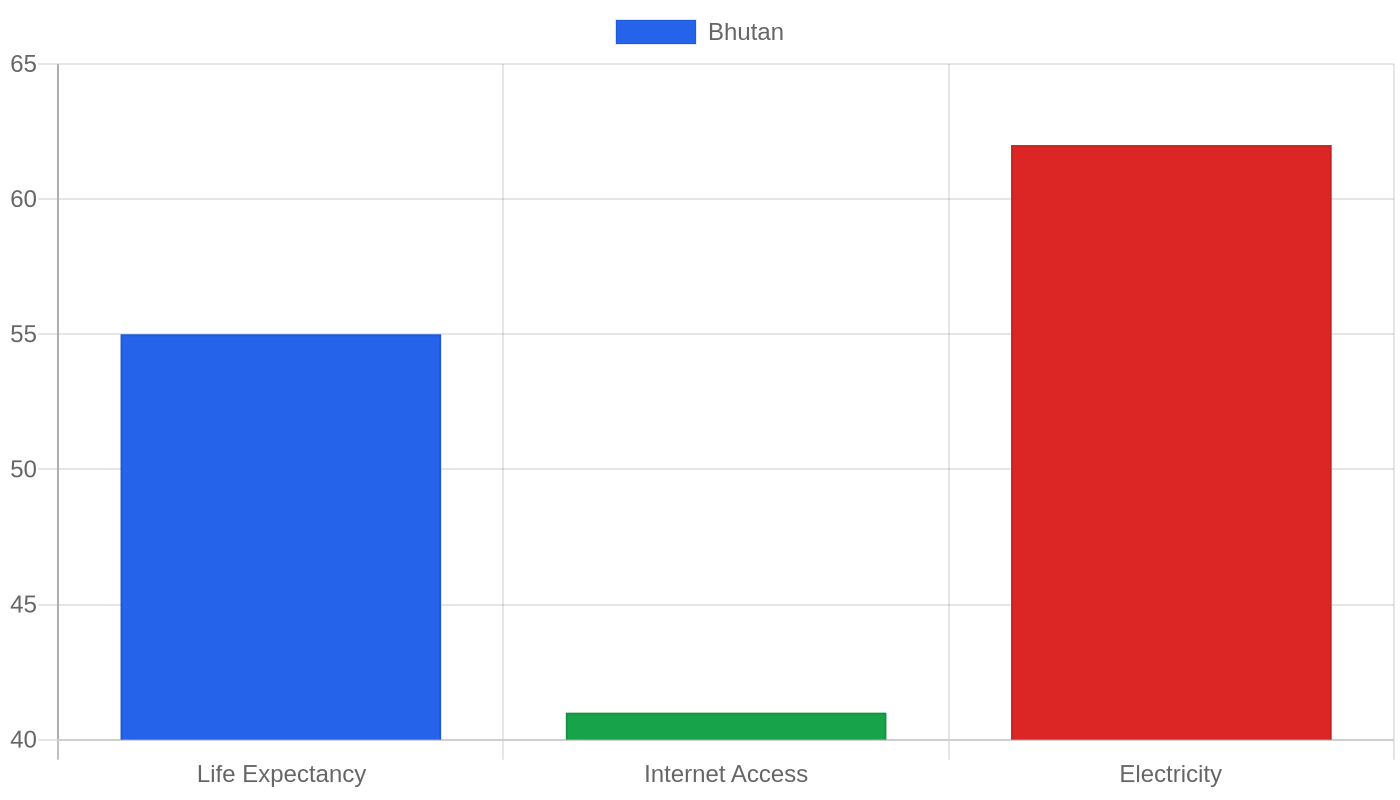
Economic Pulse Net | Sources: World Bank World Development Indicators, Government Sources | 2026
Key Takeaways
– Bhutan operates under a unique constitutional monarchy with a parliamentary democracy, transitioning from absolute monarchy in 2008—a peaceful evolution that the V-Dem Democracy Indices classified as an electoral democracy for 2024.
– The economy remains dominated by consumer services and state-linked enterprises, with aviation, broadcasting, and postal services forming the backbone of formal sector activity.
– While Bhutan famously prioritizes Gross National Happiness over GDP, the absence of recent World Bank data on growth, inflation, and employment suggests significant gaps in economic transparency that investors should note.
– The country’s political landscape is stable under Prime Minister Tshering Tobgay of the People’s Democratic Party, with King Jigme Khesar Namgyel Wangchuck serving as constitutional monarch.
– Bhutan’s small, landlocked economy faces structural challenges common to Himalayan nations—limited industrial diversification, reliance on hydropower exports, and a service sector that punches above its weight in employment.
The Happiness Paradox — Bhutan’s Economic Identity in Numbers
The World Bank’s latest data on Bhutan presents an intriguing puzzle for economic analysts. Key indicators—GDP growth, inflation, unemployment, and even GDP per capita—are listed as unavailable, a situation that speaks volumes about the challenges of tracking economic performance in a nation that deliberately measures progress differently. Bhutan’s famous commitment to Gross National Happiness, a philosophy enshrined since the 1970s, means that conventional metrics tell only part of the story.
Yet the absence of basic data from the World Bank also raises legitimate questions about statistical infrastructure and economic governance in this Himalayan kingdom.
What we do know from the available data is that Bhutan’s economy is structured around consumer services. The top companies listed—Bhutan Airlines, Druk Air, Bhutan Broadcasting Service, Kuensel, and Bhutan Times—reveal a service-oriented economy where aviation and media dominate the formal corporate landscape. This is consistent with a nation that has positioned itself as a high-value tourism destination and a media hub for the region.
The presence of Bhutan Postal Corporation in the industrials category suggests that logistics and communication infrastructure remain state-led priorities. Without hard numbers on GDP composition or sectoral growth rates, analysts must infer that Bhutan’s economy is small, service-heavy, and heavily influenced by government policy and state-owned enterprises.
The inflation picture is similarly opaque. Without CPI data from the World Bank, it is impossible to assess whether Bhutan is experiencing the same price pressures affecting other South Asian economies. However, given the country’s reliance on imports for manufactured goods and its limited industrial base, it is reasonable to assume that global commodity price fluctuations have meaningful domestic effects.
The unemployment data gap is perhaps most concerning, as it obscures one of the most critical social indicators for any government, particularly one that prides itself on citizen wellbeing.
The Cost of Happiness — Living in the Land of the Thunder Dragon
Housing and living costs in Bhutan remain difficult to quantify without official statistics, but the country’s economic structure offers some clues. As a predominantly mountainous nation with limited arable land and a concentrated urban population in Thimphu and Paro, housing supply constraints are likely significant.
The dominance of consumer services in the corporate landscape suggests that urban employment is centered on tourism, media, and government services—sectors that typically concentrate in capital cities and drive up local real estate costs.
Rental markets in Thimphu, by most anecdotal accounts, command a premium relative to regional peers, particularly for modern housing that meets expatriate and diplomatic standards. The cost of imported construction materials, combined with Bhutan’s strict building codes that mandate traditional architectural styles, likely pushes new housing supply costs above regional averages.
For Bhutanese citizens, the government’s commitment to free education and healthcare partially offsets living costs, but the absence of reliable data means that household budget allocation—how much goes to housing versus food versus transportation—remains a matter of inference rather than analysis.
Investing in Happiness — Bhutan’s Corporate and Business Landscape
The list of top companies in Bhutan reads like a who’s who of state-linked services and media. Bhutan Airlines and Druk Air dominate the aviation sector, essential for a landlocked country where air travel is the primary international gateway. The presence of five media companies—Bhutan Broadcasting Service, Bhutan Observer, Bhutan Times, Bhutan Today, and Kuensel—along with Business Bhutan and Druk Yoedzer, suggests a surprisingly vibrant press sector for a small nation.
This media density likely reflects Bhutan’s democratic transition and the demand for diverse news sources in a newly pluralistic political environment.
For potential investors, Bhutan’s business climate presents a mixed picture. The dominance of state-owned or state-linked enterprises in aviation and broadcasting indicates that the government maintains significant control over strategic sectors. However, the existence of multiple private media outlets suggests that the regulatory environment permits competition in certain industries.
The absence of data on foreign direct investment, ease of doing business rankings, or corporate tax rates from the provided information means that investors must rely on qualitative assessments. Bhutan’s deliberate economic philosophy—prioritizing happiness over growth—may appeal to impact investors but could frustrate those seeking rapid returns or scalable opportunities.
Stability in the Shadow of the Himalayas — Safety, Politics, and Quality of Life
Bhutan’s political landscape is a study in managed transition. The country is a constitutional monarchy with a parliamentary form of government, where King Jigme Khesar Namgyel Wangchuck reigns as head of state while Prime Minister Tshering Tobgay, leader of the People’s Democratic Party, leads the government. The V-Dem Democracy Indices classified Bhutan as an electoral democracy for 2024, placing it among the world’s functioning democratic systems.
This classification is notable for a nation that only transitioned from absolute monarchy in 2008, a relatively recent democratic experiment that has so far proven stable.
The crime and safety indices are listed as unavailable, which in itself is a data point. For a country that markets itself as a peaceful Buddhist kingdom, the absence of crime statistics could indicate either low crime rates that require less systematic tracking, or gaps in law enforcement data collection. Bhutan’s reputation among travelers and diplomats has historically been one of safety and social cohesion, with low rates of violent crime compared to regional neighbors.
The quality of life narrative is dominated by Gross National Happiness, a holistic development philosophy that measures progress through nine domains including psychological wellbeing, health, education, and community vitality. This approach, while difficult to quantify in traditional economic terms, has given Bhutan a distinct identity in global development discussions.
The Democratic Decade — Bhutan’s Current Political and Economic Moment
Bhutan in 2026 finds itself navigating the complexities of democratic maturity. The 2008 transition from absolute monarchy to constitutional democracy, described by analysts as “an evolution of its social contract with the monarchy since 1907,” has now passed the fifteen-year mark.
Prime Minister Tshering Tobgay’s People’s Democratic Party represents the continuation of this democratic experiment, governing in a system where the monarchy retains significant moral authority but limited political power. The V-Dem Democracy Indices classification as an electoral democracy for 2024 provides external validation that Bhutan’s institutions are functioning, but the real test lies in economic performance and public service delivery.
The current moment is defined by the tension between Bhutan’s philosophical commitments and practical economic realities. While the government maintains its focus on Gross National Happiness, the absence of basic economic data from the World Bank suggests that statistical capacity building remains an unfinished agenda.
For a country that depends on tourism, hydropower exports, and international development assistance, transparent economic data is essential for attracting investment and managing public expectations. The media landscape—with companies like Kuensel, Bhutan Times, and Bhutan Broadcasting Service—suggests an active public sphere where economic debates can play out, but the quality of those debates depends on access to reliable information.
The Bottom Line
Bhutan remains one of the world’s most intriguing economic experiments—a nation that deliberately chose happiness over growth and is now navigating the practical challenges of that choice in a globalized world. For development economists, political scientists, and impact investors, Bhutan offers a case study in alternative development models, democratic transition in a traditional society, and the limits of data-driven analysis when a country rejects conventional metrics.
For mainstream investors and businesses, Bhutan’s small market size, data gaps, and state-dominated economy present significant risks that outweigh potential rewards. Watch Bhutan if you are interested in how nations can define progress on their own terms—but do not expect conventional economic returns.
Sources & Methodology
This article is authored by Economic Pulse Net for informational and research purposes. Economic Pulse Net sources its data from multilateral institutions, national statistics bureaus, and proprietary databases. All data is believed to be current as of the date of publication.
Published: July 26, 2026 | Category: Research — Bhutan
Use these signals in your own platform
Economic Pulse publishes its live signal feed through a documented, read-only API. Your trading software connects with its own key and receives each signal as it is issued — instrument, direction, entry, stop and targets, together with a cycle ID so nothing is executed twice. The feed is independent of this website and cannot change it.
Signals are informational only and are not financial advice.